Thrifted yarn: (in which I contemplate unraveling, knitting, and redemption)

It’s been a long winter. A desperately long winter. A maddeningly long winter. A (re)learn-how-to-knit winter, because when it’s dark and dreary and snowy for days and weeks on end, there are only so many ways to keep from tumbling over the edge of rational existence.

Knitting helps.
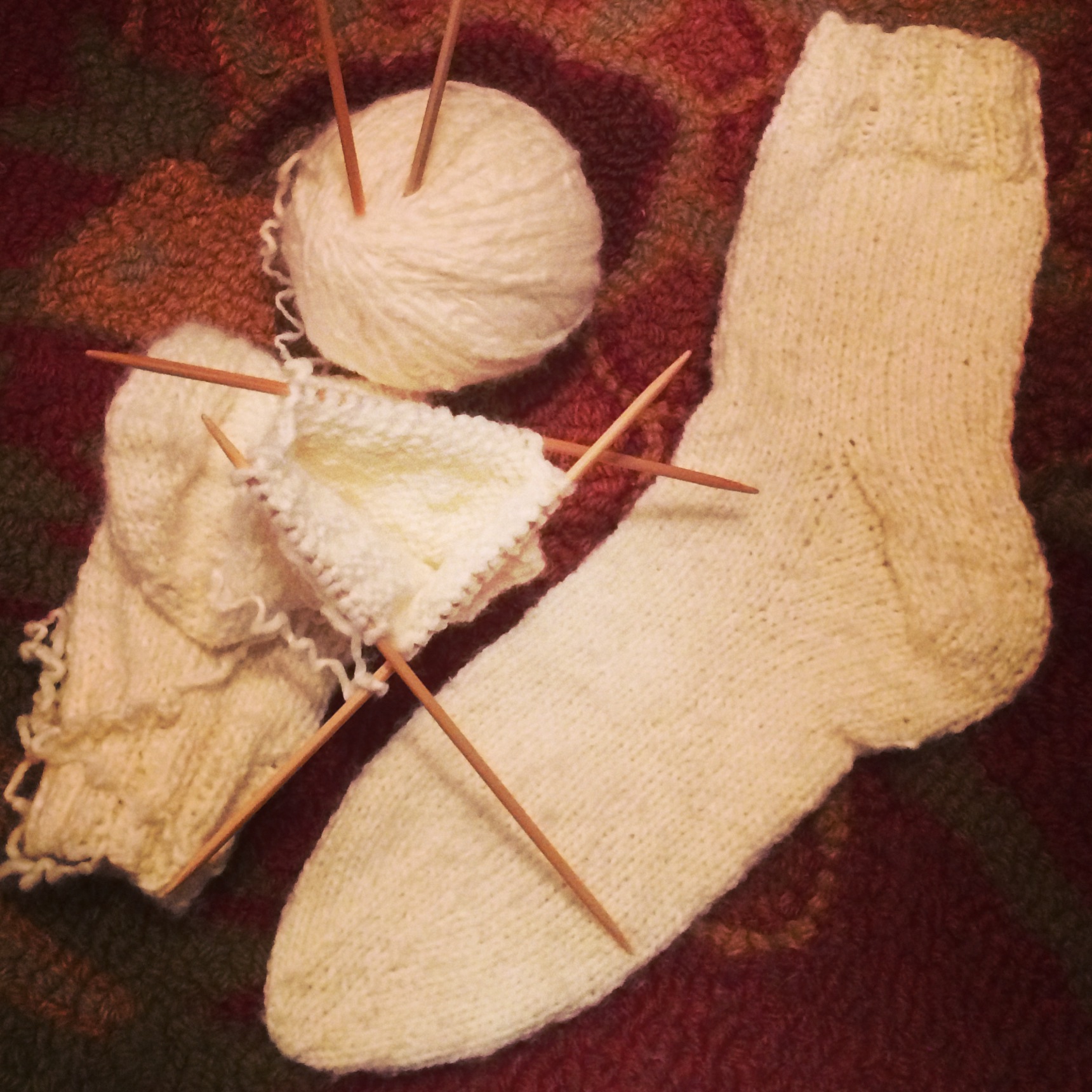
Socks from thrifted sweater yarn (Photo: CKirgiss)

But knitting – unlike me – is not cheap. So I am forced to thrift my yarn, which is to say that I rescue knitted things from the thrift store and then dismantle them into reknittable balls of lovely yarn.
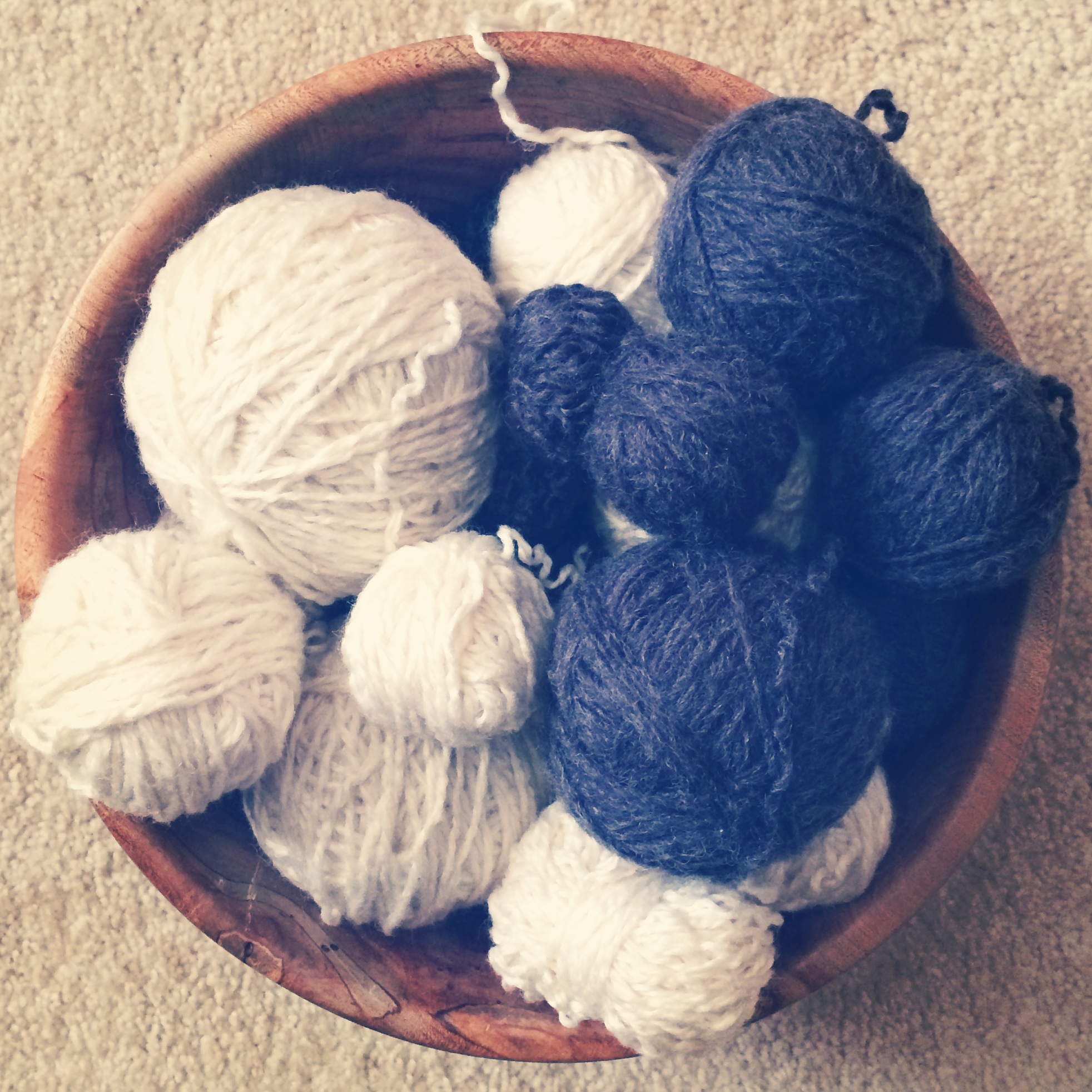
Thrifted yarn (Photo: CKirgiss)

The dismantling is neither fast nor easy.

These are the rules:

1. The knitted things must be worthy of dismantling. That is, they must be so out of style that they have no chance of being bought and worn. Or they must have a noticeable flaw – a big hole, a tragic snag, an irreparable run. Or they must be obviously unusable – a sweater shrunk to smithereens, a pair of socks stretched too large for Bigfoot, a winter scarf worn down to the weight of dragonfly wings – in other words broken, damaged, discarded. Knitted things in perfect condition are best left alone. They don’t want rescuing.

2. The knitted things must be the best of knitted things – “best” referring to how they are formed and made, not to their perceived social value – because only the best of knitted things can be dismantled, unravelled, and unmade with any success, for only the best of knitted things are formed with carefully shaped individual pieces held together with elegantly envisioned and precisely placed sinews.  Knitted things made from violently serged pieces that were cut from larger shapeless swaths are best left alone. They don’t want dismantling.

3. The knitted things must have redeeming qualities (in addition to redeemable faults: see #1). A beautiful color. A pleasing texture. A warm weight. A light caress. A workable thickness. Look beyond the ugly sweater, beyond the misshaped scarf, beyond the worn cap, beyond the tired skirt to see the underlying grace and inherent value. But beware: the most exclusive and haute couture knitted things, if made from stiff, stubborn, and abrasive threads, are best left alone. They don’t want disrupting.

Thrifted yarn (Photo: CKirgiss)

I’ve become an expert unraveller of sorts, which is to say I’ve done a fair bit of unravelling this winter. All of that unravelling has set me to thinking.

These are the thoughts:

1. Unravelling hurts. If my rescued knits had feelings, there’d likely be a whole lot of crying, complaining, weeping, and whining going on. A whole lot. Because being unmade is neither easy nor natural nor fun. Being unmade is neither glamorous nor enchanting nor sexy. Being unmade is not something after which the masses clamor. Rather, being unmade is uncomfortable. Bothersome. Tedious. Humbling. Emptying. This being entirely unmade, piece by piece, row by row, stitch by stitch, thread by thread – entirely, thoroughly, completely unmade – is not the stuff of fairy tales.

2. Some things cannot be salvaged. The process of unmaking reveals things beyond repair. Things that must be cast aside. Things that must be left behind. Things that must be discarded.  Every now and then, the process of unmaking does more than simply reveal things beyond repair. Sometimes the process of unmaking leads to new unsalvageables. Sometimes a thread must be cut – completely severed – in order to unravel and salvage many other threads. Sometimes a whole section must be sacrificed – completely given up – in order for another section to be saved. If the standard unravelling causes discomfort, I suspect the necessary severing and the intentional sacrificing causes pain – deep, biting, shattering pain – that seems beyond surviving.

3. Glory! The uncomfortable, bothersome, tedious unravelling and the deep, biting, shattering pain are not lasting things. Rather, they are the early stages of transformation. The beginning of the new. The start of the grace. Going from broken, damaged, and discarded to beautifully remade requires more than simple rearranging and resorting. It requires restoration. Going from unmade to made new requires more than simple patching and repairing. It requires transformation, re-creation. From the bottom up. From the inside out.

And that is my life. My wholly broken life. My totally unravelled and thoroughly tangled life. My undeservedly, gently, lovingly recreated life.

I am broken, then rescued. Discarded, then chosen. Dismantled, then transformed. Unmade, then remade. Pruned, then sanctified. Dead, then alive.

I am created anew.

(Knitting is indeed a finely spun truth.)
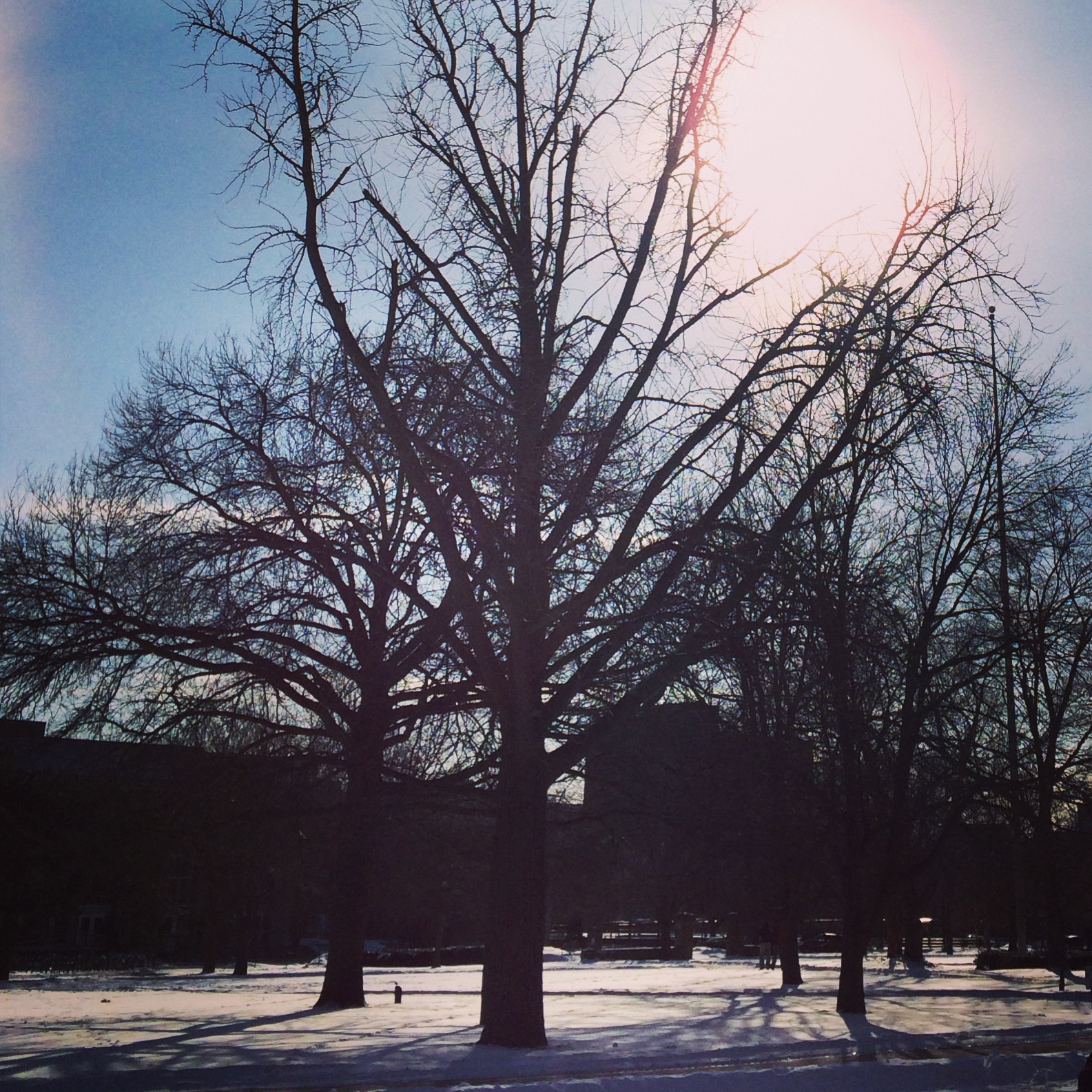
 

Purdue, Day Three: the hard realities of death and life

Purdue Memorial Mall, Day Three (Photo: CKirgiss)
Purdue Memorial Mall, Day Three 1-23-2014 (Photo: CKirgiss)

It was sunny today at Purdue. Sunny and snowy. Sunny and snowy and freezing. Sunny and snowy and freezing and beautiful. Which is to say, it was a day pretty much like every other wintry day on campus the past two weeks.

Except that it wasn’t,

because two days ago, Tuesday, January 21, 2014, someone was killed here. Most people know this already. The world is like that these days – something happens one minute and the world knows the next. And the world graciously and kindly and sincerely mourns and aches and supports from both near and far, until another tragedy strikes, which it will, because that is the kind of world we live in.

Things are quite back to normal here today for many people. On the surface, at least. It’s not always easy to know what’s going on underneath the surface, in the private corners of peoples’ minds, in the silent spaces of peoples’ souls. Sometimes we are not aware of those things even in our own selves because those private corners and silent spaces can be daunting, overwhelming, and (we might think) better left alone. Who has time to ask those questions? To face those fears? To navigate those emotions? Worse yet, what if there are no questions to ask, no fears to face, and no emotions to navigate?

I fear that on this Day Three of what has been called The Purdue University Shooting Tragedy – because we must have a way to refer to it – too many private corners of peoples’ minds and silent spaces of peoples’ souls will be left undisturbed, pushed aside because of busyness, or fear, or nonchalance, or something else entirely.

And that would make what happened just two short days ago doubly tragic.

It would surely be a mistake to contrive meaningless questions, conjure false fears, and navigate non-existent emotions just for the sake of being able to discuss one’s “personal grief process” or one’s “difficult emotional journey.” After all, not everyone has questions or fears or tangled emotions surrounding what happened here two days ago.

And that is absolutely fine. It really is. It is not a direct measure of one’s compassion or empathy or humanity.

But everyone, absolutely everyone, should know without a shadow of a doubt that what happened here on Tuesday was indeed a tragedy. Not because it happened at Purdue. Not because some of us were in the vicinity. Not because some of us were directly affected. Not even because some of us knew the people involved.

What happened here on Tuesday was a tragedy simply because it happened at all. Every single time a life is taken, regardless or where or when or why, it is a tragedy of unspeakable magnitude.

Every single time –

because life is inherently miraculous. Mysterious. Amazing. Wondrous. Breathtaking. Sacred.

If it were not, there would be no reason to mourn what happened here just two days ago.

If life matters, then certainly we must mourn its loss. (And oh my gracious, I cannot begin to imagine what that mourning and loss looks like for families, those who love longest and deepest.)

But more importantly:

If life matters, we must live out that reality each and every moment of each and every day with each and every person. Period.

If we do not, then how dare we presume to mourn a lost life? How dare we presume to struggle with death’s sorrow? How dare we band together in a show of support and solidarity for a life cut short?

Someone I greatly admire said today, through heartbreakingly wrenching tears, “I feel as though I have lost a child.” We should all feel that way — not because this is about us or how we feel, not because our sadness is what really matters, and certainly not because we are in a position to understand the pain of those who in reality did lose a child — but rather because a life was taken. And when a life is taken, we all lose something.

Please: in the normalcy that defines so many Third Days such as these, do not fail to stop, to think, to contemplate, to listen, to reflect, to consider the reality of what has happened. Do not make this tragedy worse than it already is by missing the indescribable magnitude and significance of a single lost life. And do not make this tragedy worse than it already is by failing to pay close attention and learning something.

For we all have much to learn. Not just about death, but also about life.

The only thing that really matters this year

January the first has passed, which means that approximately 99.9% of the resolutionary-minded demographic has already called it quits.

Calling it quits is so terribly easy to do. It requires nothing of a person except, you know, quitting, stopping, and giving up –unless the thing being quit is something one habitually does, in which case calling it quits requires nothing of a person except, you know, carrying on, maintaining the status quo, and not quitting.

I’ve called it quits enough to know that I hate being a quitter. It causes my soul to feel empty, my spirit to feel abandoned, and my selfhood to feel compromised.

But as surely as I was born a sinner, I was born a quitter – which sounds so sadly pathetic when it’s put into words that I’m tempted to stop writing right now, to crawl back into bed, and to (sigh) call it quits.

And that’s exactly what I probably would do if it weren’t for Jesus —

  • sinless Jesus who refused to quit a task that was beyond absurd, i.e. redeeming the lives of each and every sinful quitter that ever did walk on this earth —
  • loving Jesus who refused to give up on the least deserving and the most pitiable of us, i.e. each and every human being
  • selfless Jesus who willingly abandoned his rights and privileges for countless individual reasons, i.e. you… and you… and you…and you…and me.

Too many Christians think that the opposite of quitting is doing, accomplishing, being active, living busy. We are often expert (and frenetic) doers. To be sure, it is supremely important to be more than simply hearers of the law. The proof, says Jesus, is in the doing.

But the saving is not in the doing. The value is not in the doing. The being is not in the doing.

By all means, do. Often, it’s exactly what’s needed.

But doing isn’t the goal. Nor is it the antidote to quitting. For that, we need something more. Something bigger. Something bolder.

For that, we need finishing.

On the seventh day of creation, God had finished his work of creation, so he rested from all of it. He stopped working — which might look the same as quitting but in fact is sacred stillness.

One day during his public ministry, Jesus finished teaching the people, so he returned to the quiet countryside. He stopped being with people — which might look the same as standoffishness but in fact is sacred solitude.

In the ninth hour of his crucifixion day, Jesus cried out, “It is finished,” and hung his head upon his chest. He stopped breathing earthly air — which might look the same as death but in fact is eternal life.

Because of all that, today we can be certain that God, who has begun his good work within us, will continue that work until it is finally finished on the day when Christ Jesus returns — which might look entirely impossible (being the sorry sinners we all are) but in fact is the blessed assurance upon which we build our lives.

For as long as I walk on this earth, I will wage battle against being a self-deprecating quitter just as much as I will wage battle against being an over-zealous doer. In the end, they are equally empty and destructive.

This year, we would all be wise to confess the quitting, admit the over-doing, and stop obsessing about both. Ditch the resolutions and instead, ask God for a gracious portion of wisdom, strength, and humility as he transforms us into people who finish the race set before us.

birth and war – a day to remember

(I posted this last year. It’s still true.)

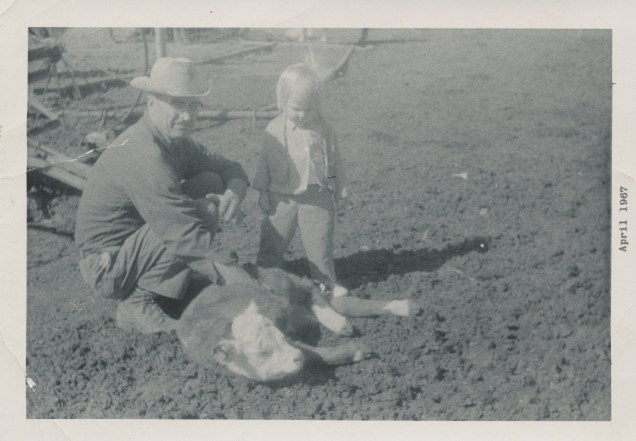
It would have been his birthday today, my grandfather. For three years, I lived just one small town away, and I suspect – based on all I know of him – that for those three years, I spent much of my life draped comfortably over his arm (where babies were most content), held gently on his lap (where toddlers were most relaxed), or settled happily alongside him at ‘work’ (where children were most eager to be).

When my family plucked itself up from the Nebraska soil and migrated east to the suburban cement, the distance between me and my grandfather might as well have been from here to the moon. Holiday and summer visits, whether 10 hours in a stuffy car or 14 hours on the click-clacking Zephyr, were much too far apart. A child can’t possibly wait a whole year to see again that tall figure, measured gait, broad grin, and leathery hands, all carefully sheltered from the glaring sun by a hat that set my grandfather apart from all other grandfathers in my suburban desert. Cowboy. Farmer. Man of the land. That he was. I was proud he was mine.

Photo: CKIrgiss – ‘Working’ with Grandpa

In the 1940s, while my grandfather was working the land (to feed the people), his brother – a United States Lieutenant Colonel – was stationed in Europe (to free the people). I knew this brother, my great-uncle, but not well. He looked like my grandfather. Smiled like him. Spoke like him. Strangers could have pegged them for brothers with nothing more than a passing glance.

A long while ago, I was back at the farm for my grandfather’s funeral … the man I’d always lived too far away from and missed too much. In search of a quiet, alone, crying place, I climbed the creaking stairs of a battered shed into the upper storage rafters that were empty but for some stacks of crumbling newspapers, piles of rotting rags, and a neatly bundled, carefully saved packet of handwritten letters. Real letters. From my great-uncle to his parents during World War II … people he was too far away from and missed too much.

For the next two hours, while I cried for the grandfather I’d lost, I read those letters. All of them. Every word. And then I cried for this other man, who I’d never known well enough, who’d lived through hell on earth, and who’d been much too far away from the place he loved and the people he adored. I was sad for all he’d lost, all he’d seen, all he’d experienced, all he’d known. Sad that I’d never thought to thank him for what he’d done. Sad that I’d never realized my great-uncle was set apart from so many other great-uncles across the land. Soldier. Veteran. Defender of freedom. That he was. I am proud he was mine.

Photo: CKirgiss

The unvoiced linguolabial trills of the Eucharist (in which a baby blows raspberries while I take, eat, and remember)

The sounds of silence (Photo: CKirgiss)

Yesterday morning, in preparation for partaking of the Lord’s Supper, the congregation was invited to be still and know that He is God. I adore being still and knowing. My soul delights in stillness, silence, and peace, so I gladly partook of these before partaking of the bread and wine.

While I intently invited God to examine my heart and expose my soul (which He always does to a degree that I am rarely prepared for) – while I meditated on the grace-filled miracle of the Cross (which is astounding in its depth of humility and love) – while I focused on the body and blood of Christ, broken and shed for the likes of even me (which is so far beyond deserved that I sometimes cannot fully grasp its reality) – the still and peaceful silence was cast aside by the babe three rows back who understandably has no understanding of still and peaceful silence but certainly does understand the joy of being fully alive.

A babe’s way to celebrate the joy of being fully alive has little to do with still and peaceful silence (unless he sleeps). Rather, a babe’s way to celebrate the joy of being fully alive is to coo and gurgle and giggle and blow continuous raspberries (also known as “unvoiced linguolabial trills” for those who care about that kind of thing) until his tongue and lips give out. Which doesn’t happen often (the giving out, that is).

I think perhaps I heard the young mother stifle a giggle or two in response to her child’s version of silent reflection. I stifled a giggle or two of my own, not to express judgmental silence (as so often happens between grown-ups and children) but rather to create expansive uncluttered space for everyone to enjoy the coos and gurgles and giggles and blown raspberries – for those were the sounds of angel choirs and deserved to be heard in all their fullness.

I think perhaps those babe sounds coming from three rows behind me were the most beautiful and sacred Eucharistic sounds I have experienced in a very long time, in part because of their joyfully pure energy, in part because of the reminder that the Savior, fully divine and willingly broken for the sins of all, was once a cooing, gurgling, giggling, raspberry blowing babe himself, a babe within which God in all his fullness was pleased to dwell.

Because of that pleased indwelling, I, the cooing babe behind me, the congregation around me, and the souls of all who do, have, and will ever live – we all of us can be forgiven, made new, made complete, filled with Christ who himself is filled with the fullness of God.

The babe behind me may not fully fathom this mystery, but he can indeed fully celebrate it. Amen.

It’s Friday, Friday, Friday (or: some real reasons to rejoice)

If you haven’t heard Rebecca Black’s 2011 song “Friday,” let me offer a condensed version:

Friday, Friday, Friday, Friday, Friday (etc.)
Weekend, weekend, weekend, weekend, weekend (etc.)
Yeah, yeah, yeah, yeah, yeah (etc.)
Partyin’, partyin’, partyin’, partyin’, partyin’ (etc.)
Fun, fun, fun, fun, fun (etc.)
Etc.

These are (cough) the important reasons to be happy when Friday arrives yeah yeah fun fun yeah.

Well, today is Friday.

And so I rejoice (which has no direct relation to feeling happy), but not because of weekend partyin’ fun oo-ooh-ooh hoo-yeah yeah (that last little bit is straight from the official lyric sheet).

I rejoice because of things that can’t be measured (and things that can be measured but aren’t by those who have grown accustomed to them) – because of things that are mundane (but are in fact miraculous, especially for those who rarely or never experience them) – because of things that are overlooked (at least by those who see them on a regular basis) – because of things that simply are (except when they aren’t, which is far too often in far too many places).

Tonight I will sleep on a comfortable bed, covered with blankets, in a warm room, under a functioning roof.

This evening I will eat fresh food, sitting at a table, drinking clean water, in the company of others.

Farmer's MarketFarmer's MarketFarmer's Market
Purdue Farmer's Market (Photos: CKirgiss)

This afternoon I will drive away from my job, on paved roads, alongside river and fields, towards my home.

Flowered FieldFlowered Field
River Road (Photos: CKirgiss)

Each and every day – including Friday – I have clothes to wear, water to bathe in, air to breathe, food to eat, books to read, people to love, hope for tomorrow, and grace beyond measure.

It is, indeed, Friday. And it is worth celebrating for the same thousand reasons that every other day is worth celebrating – because in the midst of brokenness, suffering, despair, pain, sorrow, fear, heartache, loneliness, worry, and death there is love, life, hope, healing, restoration, comfort, encouragement, beauty, grace, and Jesus.

Truly. It is as complicated and simple as that.


Of rest and death, humility and life: October grace

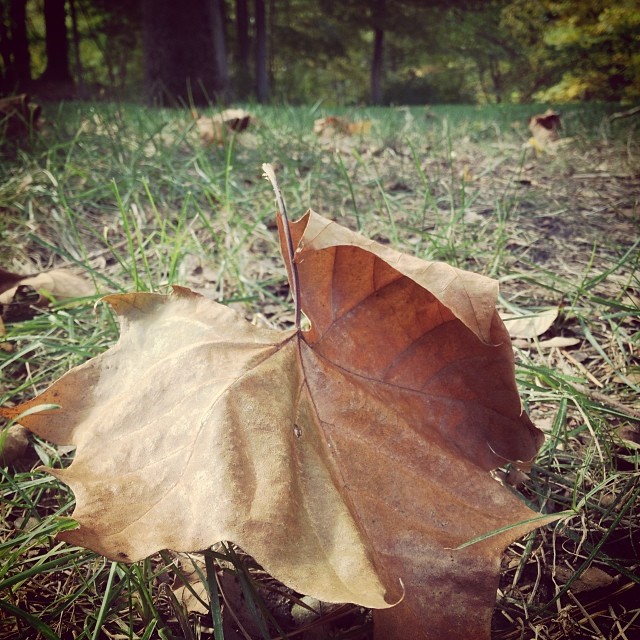
October leaves (Photo: CKirgiss)

Welcome to late October.

In the midwest, the ground and her children are a brilliant display of green, yellow, orange, and red. And brown. Mostly brown. Brown and brittle. Brown and dry. Brown and blown, end over end, to and fro, until finally shredded into crumbs or else settled for one last rest before all is covered with a blanket of wintry frost.

‘Tis the season to celebrate death – not untimely, unexpected, unnatural death, but rather death that marks the end of a complete cycle, death that finishes a full life, death that spills over with the sweet promise of new life.

The earth is preparing to rest, to breathe, and to sabbath so that she can flourish and thrive and fill the land with her goodness yet again. She is, perhaps, pruning herself – removing that which was once vibrantly alive but has become worn and tired, and making space for that which will be new and fruitful.

It’s important, this little detail: the brittle and brown dying things are not bad, nor diseased, nor rejected. They are not being cast off as an act of judgment or condemnation. Rather, they are being put to rest as an act of humility and worship by an earth that recognizes its limited power. For all of its gracious nurture and protection of life, the earth is not itself an all-powerful creator of life.

I suspect that we people miss all the fullness of life when we fail to rest, when we bypass sabbath, and when we do not offer ourselves up with humility and worship in order to be willingly and wisely pruned, during which our roots, grown deep into the endless love of Christ, remain deep and true.

And then after the rest (sweet, soothing, and sacred) and after the pruning (particular, precise, and purposeful) comes a season of new life and fresh hope, the kind of season we all crave but cannot have without first welcoming and embracing death – death worth celebrating, death that is a beginning, death that is a foretaste of life.


Nebraskan I am (or: how I navigated the Cornhusker-Boilermaker football game)

For only the second time ever, Nebraska and Purdue met today on the football field.

The first time was in 1958. Purdue shut out Nebraska 28 – 0.

Purdue vs. Nebraska, 1958 (from the Purdue Special Archives)
Purdue vs. Nebraska, 1958

That was then. This is now.

In case you hadn’t heard, Purdue is not currently a football powerhouse. They have been in the past. They might be in the future. But right now they are a team with a lot of hard work in front of them in order to be taken seriously as a Division I contender.

That’s okay with me.

I’ve been a Boilermaker for 8 years now. I have several Boilermaker degrees. I have Boilermaker offspring. I have Boilermaker friends. I have Boilermaker colleagues. I have Boilermaker gear. I tend to be a faithful fan, especially when it comes to football. So I can be patient and gracious while this Boilermaker football team works hard to rebuild itself.

In other words, I’m a genuine Boilermaker fan.

But there is this: I am also a 4th-generation Nebraskan. 5th if you count all those Wendell boys and Pearson girls who arrived long ago from Sweden and then decided that the difficulties often associated with extended families could be avoided if the three Wendell brothers each married one of the three Pearson sisters. It was so entirely practical. (And, one hopes, eminently romantic.)

So though I am at present a Boilermaker, I was first born a Nebraskan. And when someone is born a Nebraskan, it doesn’t matter if they live in the state for 3 years, 30 years, or until their last breath. They are in some inexplicable way a Nebraskan through and through.

So though I own lots of Black and Gold gear, I wore red to today’s football game and felt neither out of place nor traitorous. It would have been impossible to feel out of place – even in the home-seating sections – because there was red everywhere I looked. It would have been impossible to feel traitorous – even when cheering loudly for Nebraska – because I didn’t wish any ill-will on the Boilermakers. In fact, I cheered loudly for both teams – even though there wasn’t anything like an equitable distribution of cheering moments between the two teams.

At the next Boilermaker home game, I will be wearing black and gold. Proudly. Even if the team struggles with growth-and-development pains. Even if the team doesn’t win. Even if the team stumbles and falls on its way towards what I hope will be excellent awesomeness. 

But at the next Nebraska-Purdue game, I will be wearing red. In Lincoln. Along with pretty much everyone else. Because no matter how long I live in West Lafayette, or how many degrees my family accrues at Purdue, or how deeply my Boilermaker friendships run, or how often I don Black and Gold for various competitions, underneath it all there is still something about Nebraska that runs very, very deep. It can’t be explained. It just is. 

And that’s very okay with me.


All that is right and wrong with the world (in which a 5-year old speaks truth)

While flying from the midwest to the West Coast yesterday, I met Jackson.

Jackson is 5. Old enough to play spelling games on the iPad. Young enough to be extremely fidgety when he really needs to use the bathroom but the seatbelt sign is illuminated.

For two hours, I watched Jackson play games, listened to Jackson chatter with his mom, wondered what Jackson what thinking as he stared intently at other passengers, laughed at Jackson when he delivered his opinions about the other passengers, and smiled at Jackson when he spoke enthusiastically about how much he loved pretty much everything in the whole entire world.

I rejoiced in my soul because it was such a lovely little picture of all that is right with the world.

Until 5 minutes before landing. When Jackson decided to look at the laminated emergency landing brochure in the seatback. The brochure that shows a plane landing on grass. And in the water.

I heard Jackson ask his mom, “Is it better to land on water or on grass? Why do planes land in the water?”

To which his mom said, “Planes don’t land in water. They land at airports. But if a plane ever did need to land in the water, these pictures show you what to do.”

Jackson was quiet for a minute or two. And then said this:

“Do planes need to land in the water when someone shoots one of the… one of the… one of the… one of  the… (long pause while he searched for the right word) … gadgets?”

He pointed out the window at the engine.

I’d been so afraid that the word he was searching for had been pilots. But engines really wasn’t any less tragic.

I think Jackson has a good life. His mother is patient, kind, fun, caring. The grandparents he was traveling to see are (in his estimation) awesome and great and wonderful. He is part of a family that has the means to travel. He is healthy and smart and creative.

But even so, at 5 years old, he can articulate his awareness that people might shoot at engines and airplanes might have to land in water (if only it were that simple).

And I wept in my soul because it was such a heartbreaking reflection of all that is wrong with the world.

Oh dear Jesus – we so desperately need your transforming love and redeeming grace and sacred hope.

The truth about taking short breaks (in which I contemplate distractibility)

It turns out that if you need a short break from oh I don’t know grading several hundred short assignments in a class you teach on the perils of using run-on sentences in business documents and you decide now would be the perfect time to season the new cast iron grill grates you bought let’s say a few months ago to replace the rusting crumbling ones you’ve been cooking on for maybe the last two years and you wisely choose to wear those long pink-left-purple-right kitchen rubber gloves because smearing Crisco on new cast iron grill grates is meh-see business and because the pink-right and purple-left kitchen rubber gloves have been lost for as long as you’ve had both pairs but who cares because this isn’t a fashion runway kind of household and you notice as you walk out to the very back of the backyard to properly dispose of the rusting crumbling cast iron grates that maybe a few of the spaces around some of the trees could use a little weeding because it turns out that while you were gone for pretty much the whole summer the yard didn’t weed itself – well, it turns out that those kitchen rubber gloves work pretty well for pulling out those weeds roots and all.

Because of the traction.

Also, it’s pretty muddy out there today, so I’d suggest wearing shoes.