[This post is sixth of a series in which I reflect on spending a month at camp for Wyldlife (middle schoolers) and YoungLives (teen moms). You can follow by subscribing to this blog below. All posts are categorized as ‘Michindoh 2013’.]
The famous Round Table of Arthurian legend has got nothing on the infamous Round Table of Camp.
In short, we eat at Round Tables. Every meal. Every day. Banquet tables would hold more people. And they could be set up in neat rows.
But we prefer Round Tables. Of 8 people. Set up in free-flowing pods.
Pre-meal Round Tables are nothing to write home about. They would never grace the pages of a slick home and garden mag.
Adding bread and water livens things up a bit and is entirely lovely since the conversations and interactions that take place at the Round Tables are blessed and consecrated by the Bread of Life and the Living Water.
Pre-meal round table, plus bread (Photo: CKirgiss)
Feeding everyone at all of the Round Tables is not quite as miraculous as feeding the 5000 – but it surely is as beautiful.
Serving the Round Tables (Photo: CKirgiss)
The Round Tables are a perfect place to eat with friends, to look at one another face to face, to be part of a circle that is mightier by far than any group of Arthur’s noble knights.
Being at the Round Table (Photo: CKirgiss)
In a world where Round Tables – or any other shaped tables – are becoming more and more rare, the chance to gather around one several times each day is a blessed gift indeed.
If there is any disadvantage to Round Tables, it is only this: half of the people must turn in their chairs…
Round Table entertainment (Photo: CKirgiss)
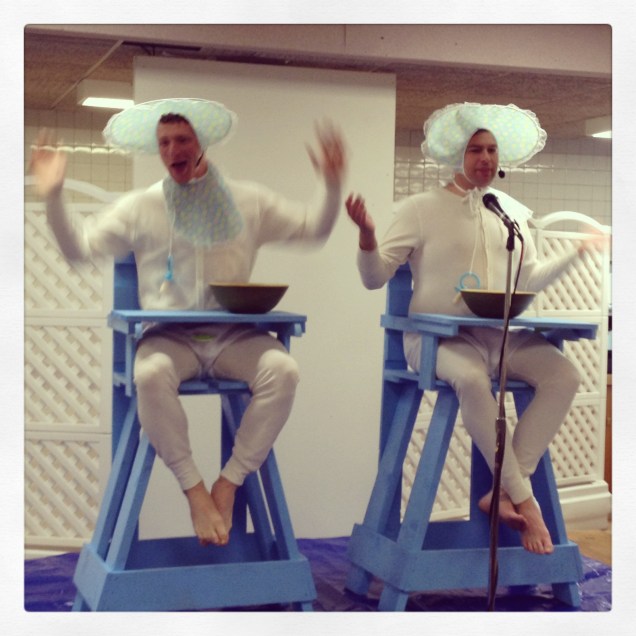
…in order to see such momentous upfront events as…
Baby and Baby’s Playtime (Photo: CKirgiss)
…Baby and Baby blowing Coco-Puffs. Out of their noses. Into buckets. For points.
You might not be surprised to hear that Baby won (with 12) while Baby lost (with 8).
But at the Round Tables, there are no losers. Ever. Each and every middle-schooler circled around each and every meal is loved. Listened to. Cared for. Encouraged. Believed in. Prayed for. Delighted in. And so much more.
The shape of the table matters indeed.
But more importantly:
The hearts of the people eating around the table matter beyond measure.
[This post is fifth of a series in which I reflect on spending a month at camp for Wyldlife (middle schoolers) and YoungLives (teen moms). You can follow by subscribing to this blog below. All posts are categorized as ‘Michindoh 2013’.]
Dateline: Wyldlife at Michindoh, Week 2, Day 1
Today is Day 1, second time over. 350 new campers and leaders. Eight separate welcomes. First round of scheduled rides. First leaders meeting. First all-camp meal. First club. First late-night event.
I’m not responsible for any of it – yet I’m tired just thinking about it.
The second leg of the relay race is difficult. The newness of Week 1, Day 1 is long worn off. The excitement of serving has settled down into the reality of a daily routine. The new friendships and relationships among staff are no longer new.
But these campers don’t know that, and shouldn’t be able to sense that. They deserve all the excitement of the first Day 1, and they will get the added benefit of a seasoned team who already knows the steps to the Day 1 Dance.
We look ahead with excitement. We also look back to learn.
On the last full night of camp Week 1, I saw this miraculous reflection of the moon on a still and sacred lake.
Reflected moon (Photo: CKirgiss)
I was reminded of what all Believers are called to do: reflect the love and glory of God as clearly and brightly as possible.
Our attitudes and actions reflect only that which we know and love. It seems to me that there are three possible things to reflect – the world, the self, the Lord.
The first is easy. The second is natural. The third is impossible – on our own.
But still, it is our daily call and our lifelong challenge. As Solomon wrote, “As a face is reflected in water so the heart reflects the real person.”
Too often, the real person we reflect includes little of Jesus. Self so happily and naturally takes center stage.
Still, we pray and strive and strain to do this – to reflect Jesus well so that others see his love and grace and life through us (somehow, miraculously, amazingly).
But reflecting Jesus is not the ultimate goal.
If people only see Jesus as reflected in us, they have gained nothing.
The real goal is that people see Jesus himself.
I saw the beautifully reflected moon from a distance, from high up on the bank, behind a grove of trees. The beauty of what I saw drew me forward, one step, two steps, three steps, until I stepped out from under the trees, looked up, and saw this:
Moon (reflected) (Photo: CKirgiss)
The real moon. The source.
We reflect Jesus so that others can see Jesus, period. So that they are drawn forward one step, two steps, three steps, until they step out from behind the trees, look up, and see the Real Thing. The Source. The Lord Jesus Christ, maker of heaven and earth, lover of my soul, saviour of the world.
Whenever someone turns to the Lord, the veil is taken away. For the Lord is the Spirit, and wherever the Spirit of the Lord is, there is freedom. So all of us who have had that veil removed can see and reflect the glory of the Lord. And the Lord – who is the Spirit – makes us more and more like him as we are changed into his glorious image. 2 Corinthians 3:16-18
Amen. Amen. And amen.
[This post is fourth of a series in which I reflect on spending a month at camp for Wyldlife (middle schoolers) and YoungLives (teen moms). You can follow by subscribing to this blog below. All posts are categorized as ‘Michindoh 2013’.]
Being a grown-up at camp for middle-schoolers is a rather magical thing. (Also entirely exhausting, but we’ll save that for another day.)
Of the various grown-up populations at middle-school camp, two in particular require an extra measure of inherent childlike joy and wonder – along with a willingness to expose oneself to all manner of ridicule and mess – in addition to limitless wisdom, maturity, and grace.
Exhibit A: The Leaders. These two particular leaders are husband and wife who willingly sleep in separate bunked quarters for a week (one with a group of squirrelly, aromatic, hair-gelled boys, the other with a group of giggly, chatty, accessorized girls – and yes, I admit those are loaded generalizations that are certainly not equally true of every individual member within said aromatic [read: smelly-ish] and chatty [read: what you will] groups).
The Joy of Marriage at Middle School Camp (Photo: CKirgiss)
These leaders – like every other leader here this week – will never get rich doing what they do. They will never get famous doing what they do. They will never advance along the path of commercial success and achievement doing what they do.
Rather, they will be plastered with mud, smeared with shaving cream, dusted with flour, dangled from ropes courses, flung from inner tubes, buried in sand, kept up late, woken up early – and they will Love (if not like) every single moment of it because in the process they will have earned the singular privilege of sharing their lives and hearts with a group of squirrelly and giggly folk that are rarely considered worthy of such time and commitment.
These leaders – like every other leader here this week – are my heroes. I am in awe of who they are and what they do.
Exhibit B: The Program Peeps. These two particular program directors are educated, experienced, gifted men who could each pursue any number of socially approved and culturally sanctioned paths to success. (They are also over 6′ tall, a fact that will enhance your interpretation of the photo below.)
“Baby and Baby” – Michindoh 2013 (Photo: CKirgiss)
These program people – like every other program team this summer – will never get rich doing what they do. They will never get famous doing what they do. They will never advance along the path of commercial success and achievement doing what they do.
Rather, they will dress, dance, sing, and speak like fools (beloved fools, to be sure), sacrifice their vocal chords (along with their dignity), expend every ounce of creativity with which their Creator endowed them, get up early, stay up late, eat on the run, stand in the sun, organize the chaos – and they will Love (if not like) every single moment of it because in the process they will have helped create a space in which the similarly exhausted and expended leaders (see exhibit A above) can share their lives and hearts with a group of squirrelly and giggly folk that are rarely considered worthy of such time and commitment.
For every grown-up in the wide world who doesn’t get kids and doesn’t get life and doesn’t get Jesus there is a God-fearing kid-loving grown-up in the even wider Kingdom who does.
[This post is third of a series in which I reflect on spending a month at camp for Wyldlife (middle schoolers) and YoungLives (teen moms). You can follow by subscribing to this blog below. All posts are categorized as ‘Michindoh 2013’.]
It’s Monday. In the non-camp world, that means a whole host of things (as whined about here, reflected on here, celebrated here). In the 5-day-week-Wyldlife-camp world it doesn’t mean all that much. Unless it happens to fall on Day 3 in which case it means workcrew wash day.
At Michindoh, we have a trim and lean work staff of 23- just 15 Servers in the dining hall, 4 Special Project Peeps in the outdoors, indoors, and everywhere else, 3 in Retail, and 1 Sound Tech.
We have no laundry crew. But we sure do have laundry. Even after just 3 days of camp life.
So today Christina and I hoisted a stack of laundry bags into the car trunk, drove around to the other side of the lake whence is found the laundry facility, and started in on what should have been an easy task for two seasoned laundry veterans.
Laundry Day (Photo: CKirgiss)
And it would have been easy except for this: lots of the clothes weren’t labelled with the owner’s initials (camp laundry rule #1) so we had to, you know, keep track of which bag the clothes came out of. And one of the dryers was down for repairs so we had to, well, wait for the other three power-operated-with-five-optional-settings dryers to keep pace with the four similarly power-operated-with-infinite-settings washing machines. Plus the room was terribly hot and humid so we had to, um, sit outside in the fresh air beside the pine grove while we visited and read and journaled during the wash- and rinse- and spin-cycles.
You can just imagine what a terrifically challenging task the whole thing was for, er, two seasoned laundry veterans.
The day wasn’t really about broken dryers or stuffy laundry rooms or un-initialed clothes (maybe it was a little bit about that). It was about washing clothes clean. Of course, it wasn’t really even about washing clothes clean since Christina and I didn’t actually have to wash anything – we just had to dump stuff into one machine, transfer it to another machine, fold it, and put it back into the appropriate mesh laundry bag.
Cleaning clothes takes almost no work at all, even if the clothes are really dirty and especially if the clothes are barely dirty.
But whether barely or really dirty, the clothes do both need cleaning. They both go into the same machine. They both go through the same cycles. They both get agitated back and forth and back and forth and back and forth and also around and around and around.
It costs the same to wash the clothes that are really dirty as it does to wash the clothes that are barely dirty. The machine doesn’t charge more for the really dirty clothes – nor does it charge less for the barely dirty clothes.
Really dirty and barely dirty are in fact both dirty, both not clean, both in need of washing.
In that hot, humid, one-dryer-down laundry room, standing among the piles of initialed and un-initialed clothes alike, I thought about this:
Unlike washing clothes on Day 3 of Wyldlife camp, washing human hearts is a labor-intensive and difficult task that only one Person is seasoned-veteran-(and-fully-Divine)-enough to successfully complete.
And human hearts, whether really dirty or barely dirty, surely do need washing.
And the cost to wash human hearts, whether really dirty or barely dirty, is just the same – no more for the really dirty and no less for the barely dirty.
And the cost is astonishing to consider because the cost is nothing less than absolutely everything.
Indeed, Jesus paid it all, for all, on the cross so that both the really dirty and the barely dirty – a distinction that ultimately has no significance – can be washed clean and made new.
And after being washed clean and made new, the formerly (really) dirty or (barely) dirty human heart is newly named . . . not with initials on a tag, but with an identity of the soul:
child of God . . . daughter . . . son . . . heir . . . beloved.
So there’s that: human laundry. It’s good for what ails us all. And sometimes – oh gracious and glory be – it happens at camp. For human hearts. Inside of middle school students. Who are beloved by the Father. Who washes us all. Just because He loves. Just because He can.
[This post is the second in a series in which I reflect on spending a month at camp for Wyldlife (middle schoolers) and YoungLives (teen moms). You can follow the series by subscribing to this blog. All posts will be categorized as ‘Michindoh 2013’.]
Announcement: I love middle school boys.
(I considered opening with Confession instead of Announcement because it carries a certain amount of sophisticated narrative weight, especially in today’s memoir-crazed literary culture. But it also has certain pejorative implications that would be both unfair to and untrue of middle school boys. They already get enough bad press. Hence I will announce.)
I am living in the midst of 150-ish middle school boys this week. And while I do feel a certain genetic affinity for the 200-ish middle school girls in whose midst I am also currently living, I am most definitely drawn to the boys in greater measure for reasons quite beyond my comprehension.
It might be because at this age they are (for the most part) not yet entirely caught up in the swagger that looms just over the horizon.
It might be because at this age they are (at least some of them) seriously trying to engage in the whole confident-solid-handshake thing.
It might be because at this age they are (in some cases) still willing to try things that will be considered totally lame in another year or so.
Or it might be because underneath all of the nascent manhood that they are tentatively donning in various forms there still exists a boy who is not beyond needing – and often accepting – love, comfort, and protection.
One of the 7th-grade boys here is homesick. Seriously homesick. To such an extent that his body aches, his stomach churns, and his head throbs. This afternoon, while his cabin mates enjoyed the lake, he lay on the bank, knees drawn up, arm over his face, desperately missing his family.
I love that he wasn’t afraid to cry about it. That he didn’t feel the need to swagger and sway in falsely tough skin. That he didn’t worry what his friends and cabin mates would think of him. Not every middle school boy would be so transparently honest about his feelings. And not every group of friends would be wise enough to realize that the true issue was sadness rather than weakness.
But these friends were. They neither mocked him for being a baby (he isn’t) nor assumed that a barrage of encouraging words — or well-placed punches, which are sometimes the same thing in middle-school-boy-world — would eliminate the issue (they wouldn’t). Instead, they simply sat by him in turns, first one, then another, letting him know they noticed, they cared, and they weren’t leaving him to deal alone.
If only we would all be so vulnerable with the Lord as that 7th-grade boy was with his friends. If only we would let Him see our tears, would reject disingenuous swagger, and would cast aside the fear of being perceived as too weak. Or too broken. Or too hopeless. Or too lost.
If only we would all be so discerning with those who hurt as that group of boys was with their friend. If only we would offer first and foremost our presence, rejecting the desire to fix, casting aside the need of being perceived as very spiritual. Or very wise. Or very wonderful. Or very awesome.
I thought about these things today only because of what I saw happen in a group of middle school boys hanging out by the lake.
[This post is the first in a series in which I reflect on spending a month at camp for Wyldlife (middle schoolers) and YoungLives (teen moms). You can follow the series by subscribing to this blog. All posts will be categorized as ‘Michindoh 2013’.]
Yesterday (June 8) 350+ middle school students and their leaders pulled into a beautiful and sacred space known as Michindoh, located in the mitten state, specifically the lower mid-palm region. It would be cooler to say “in the thumb” or “on the ring finger.” But we are where we are, which is the lower mid-palm region. I would argue that in real life, the lower mid-palm region is where it’s at.
So what if it can’t point, can’t oppose, can’t wear a ring, can’t snap, can’t tap, or any of those other things that fingers and thumbs do.
Without the lower mid-palm region providing a place from which fingers and thumbs can do their business by connecting them to the arm to the shoulder to the body to the brain that tells them what to do, fingers and thumbs would be entirely pointless, really.
Michindoh – like every other camp run by God-loving Jesus-following folk – is nothing more than a place from which those who are the hands and feet (or fingers and thumbs) of Jesus can do their business, which is loving God and following Jesus among (in this case) middle schoolers and teen moms in the hopes that they see something about the Christian life that is so utterly attractive, appealing, and sweet they can’t help but notice.
If it were by our own power that God-loving and Jesus-following folk hoped to reflect an utterly attractive, appealing, and sweet life with Christ, all would be lost (which, in fact, is exactly what all God-loving and Jesus-following folk once were). For there is nothing about the inherent essence of anyone that could ever possibly accomplish such a thing. On our own, we are appalling, repellant, and (I suspect) as far from being a sweet aroma as the east is from the west.
But with the Spirit’s presence drenching our souls in His love, grace, forgiveness, and re-creation, suddenly (miraculously, undeservedly, assuredly) the beautifully attractive, appealing, and sweet Jesus can shine through – even if just a tiny bit – into a world that is far too dark and much too broken.
That’s why we are here, joyfully settled into this lower mid-palm region of the kingdom, working together to be the fingers and thumbs of a hand that will (by God’s grace) point people to the face and feet of Jesus. Should they choose to look, in His face they will see his endless love for them reflected in His eyes. Should they embrace that love, at His feet they will fall in sweet surrender to the God-man who gave up everything in order to give new life.
I cannot image being any other place doing any other thing for any other reason – being in the lower mid-palm region of the hand of Jesus is really that big of a deal.
Week 1, night 1, 8:29 p.m. (Photo: CKirgiss)Week 1, night 1, 8:37 p.m. Let’s do this. (Photo: CKirgiss)
During the past five weeks, this blog has been silent for all kinds of reasons. Important reasons. Significant reasons. Meaningful reasons.
Reasons that amount to less-than-piffle in the grand scheme of the grand universe, a grandness that is often best realized in the most un-grand of places during the most un-grand of times, say, the lawn’s border bushes at 9:07 on a Sunday morning.
During the past five weeks, I finished a dissertation. Defended a dissertation. Was hooded by an esteemed academic.
. . . while each morning, the dew fell to the ground, landing on leaf and rock and web alike, a miniature miracle reflecting God’s power, creativity, and joy.
All of which had absolutely nothing to do with my significant, important, and meaningful things.
Not even the tiniest bit.
What manner of grace is this that God would (does) allow a world full of supremely legit, significant, important, and meaningful folk enjoy, revel in, and (if all goes well) be humbled by the drops with which he paints the morning ground in a dazzling splendor of diamond dew?
What manner, indeed.
The silence brought on by significant, important, and meaningful busyness (whether we like it or not) does nothing more than reveal the empty spaces and confused graces of our lives.
The silence embodied in God’s elegant, astounding, and breathtaking creation (if we allow it) fills our empty spaces with unspeakable joy and boundless hope.
Of these two silences, the world esteems the first and disdains the second.
May Day rarely registers on my radar screen. Especially if I’m drowning in something I call #deathbydissertation.
(I thought I’d invented this particularly witty and dramatic hashtag, but it turns out that approximately 36,472.8 people are also currently drowning in #deathbydissertation, which kind of weakens its snappy snarkiness. Hence my new hashtag: #mydeathbydissertationisbetterthanyourdeathbydissertation. Or maybe #worsethanyours. Comparatives can be tricky.)
But May Day takes on new significance when the delightfully precocious 3 and 6 year-olds from down the street unexpectedly knock on your front door, bob their bouncy-curled heads back and forth and say, “Hello! We’ve missed you so verymuch. Welcome home. We just love your dog. See my doll? She’s new. I loveher. Here are some flowers for you and I drew three red hearts and a giant yellow sun and lots of green grass on the card and do you just really love these flowers!?”
Of course I do. I love them. Very much. Because there is nothing like bobbing bouncy-curled heads and fresh flowers and a homemade card (with three red hearts and a giant yellow sun and lots of green grass) to help a person remember that #deathbydisseration (even if it is worse than someone else’s) is just about the most selfishly ridiculous whine ever.
“Consider the lilies of the field (that neither toil nor spin). Welcome the little children (who inhabit the kingdom of heaven). Still your soul and remember you are loved (in spite of yourself).”
The voice may be only a whisper, but it’s always there, lingering just behind and beyond the clammer of foolish hashtags.
May Day 2013 was a good day to silence the complaints, settle the unrest, and ditch the sense of doom. #livebygrace
May Day Flowers (Photo: CKirgiss)May Day Flowers (Photo: CKirgiss)May Day Flowers (Photo: CKirgiss)
Though a wordsmith and a talker at my core, I readily concede that sometimes a picture says what words cannot.
And so, these pictures from the past days:
Sun-kissed (Photo: CKirgiss)Wind-blown (Photo: CKirgiss)(bath)room with a view (Photo: CKirgiss)Up the lighthouse (Photo: CKirgiss)Down the lighthouse (Photo: CKirgiss)Ocean grace (Photo: CKirgiss)Walk with me (Photo: CKirgiss)Structured order (Photo: CKirgiss)Constructed disorder (Photo: CKirgiss)Beyond the clouds (Photo: CKirgiss)
Sometimes when we are far from home we see more – not because there is more to see, but because our eyes are more widely open and more clearly focused.
Such far-from-home seeing — if we allow it — helps recalibrate our spirit and soul so that when we are finally home once again (and home is such a very, very sweet place to be) we continue to see widely, clearly, carefully, joyfully.
Our souls may have been blind once, but now they see. And what they see, if they really look for it, is a world filled with faith, hope, love, and beauty beyond compare.
Compared to other holiday day-afters, Easter day-after is an odd post-holiday day, with vague purposes and undefined parameters.
On Halloween day-after, we pillage all the (childrens’) candy bags in search of chocolate-covered and peanut-butter-filled goodness.
On Thanksgiving day-after, we eat leftovers (because apparently we are still hungry) and prepare for a long and holy day of football.
On Christmas day-after, we make pilgrimage to the reliquary Returns and Exchanges Department. And then wage battle on Some-Assembly-Required blessings. And conclude with the fray known as Detangling All The Power Adapters.
On New Year’s day-after we enjoy a quiet cup of coffee (for various reasons) in the stillness of our homely houses wherein we slept a solid 7 or 8 hours in perfect peace and stillness (or not) and wonder what all the fuss next door is about.
But on Easter day-after, we awake to a new week because always, always, always this day-after is a Monday which seems a serious mis-calculation. There are no candy bags (the seasonal trimming known as The Easter Basket is, for a pillager, not worth the effort.). There is noNFL (and possibly no March Madness because of Easter’s calendar fluidity). There is no commercialism mania (which is as it should be). And for a very few pathetic folk, there is no coffee.
Instead, a new week has begun. Monday morning in all its ridiculous glory has arrived. Again. Here we go. Oh joy.
But this is the day after the day that gives all days meaning. The day after the day that defines all other days. The day after the day that life truly begins. Surely it should be a day-after to define all other day-afters.
And so it is. For this is not only the day after the morning that Christ arose. It is also the day after the night that Christ breathed on his disciples, a little detail that gets very little attention or coverage.
That long-ago Sunday evening, the disciples were meeting behind locked doors because – as was so often true of them, and is so often true of us – they were afraid.
Suddenly Jesus – crucified just days before – was standing there among them. A dead-but-now-living man. A walking, talking, speaking dead-but-now-living man. A real live, present, visible, actual dead-but-now-living man.
And to those frightened, weak, shocked, terrified, bunkered-down men, He said this: Be at peace. (Much like He did when they were in a boat, on a lake, in a storm, sure beyond sure that they were going to drown. Wrong. Relax, boys. Be at peace.)
And they went from being afraid to being filled with joy when they saw Him – the Lord. Or more likely they went from being just afraid to being afraid and joyful. (This is an important detail. Too often we overlook joy when we are troubled because we assume they cannot co-exist. And too often we overlook our own and others’ trouble when we are joyful and so fail to experience life in all its fullness.)
And then – most amazing of all the amazing things that happened on the day after the day Jesus rose – he breathed on them the Holy Spirit.
God’s fullness is surely heard in the thunder, felt in the wind, and seen in the fire. But it is sometimes most evident in the gentle whisper of air that Jesus breathes on us the moment we first set eyes on His living presence and hear Him say: Be at peace. It is I. I am here. And I am Lord.
The resurrection changes everything for us. Absolutely. But even more so does the day-after breath.
Because of the first, we know He is alive. Because of the second, we know He is here. Breathing onto us. Breathing into us. Breathed onto us. Breathed into us.
Today marks the day we are filled with His breath because he began breathing again after he had breathed His last for lost and sorry sinners into whom He long ago breathed the very breath of life.
Easter day-after (even though a Monday) is a day to live. A day to shout. A day to sing. A day to dance. A day to breathe the Holy Spirit into our souls so deeply and fully that He spills onto the world around us where He is oh so desperately needed.




















 Breathe