Four years ago, I drove six miles south and voted on the campus of a sprawling Big Ten university. Walked past blocks of election signs, banners, and posters. Entered a stately building of architectural interest. Stood on marble floors between panelled walls. Waited in line for over three hours, along with hundreds of other Americans, mostly of the academic intellectual demographic. Listened to students discuss the meaning of life, unfair grading policies, and next weekend’s hottest parties. Listened to faculty analyze the economy, current social policy, and various threats to higher education. Voted my conscience. Went back to work.
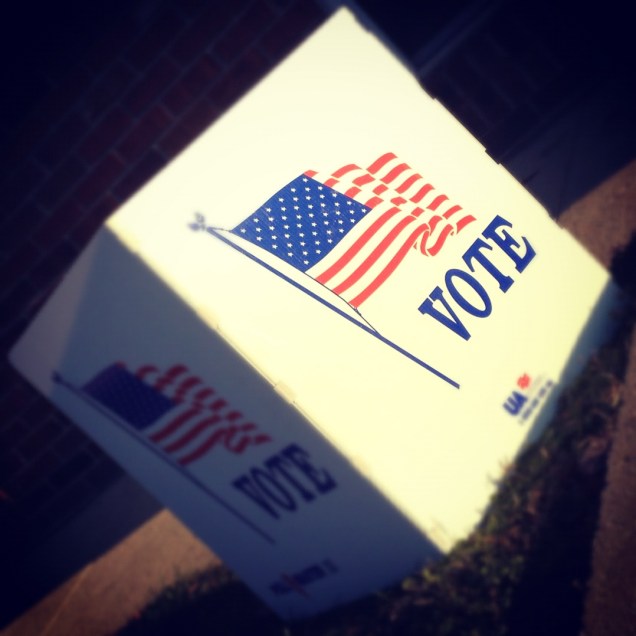
Today I drove three miles east and voted in the city buildings of a small town. Walked past this single cardboard sign on the dew-dropped lawn.
Photo: CKirgiss
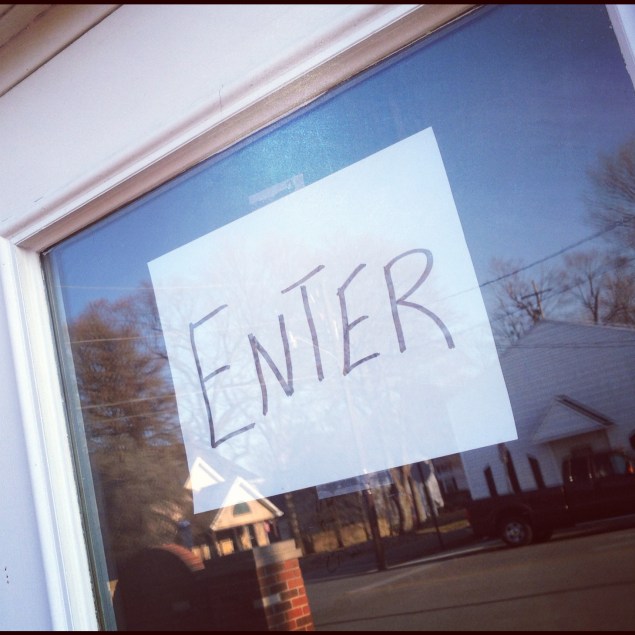
Entered the built-for-a-practical-purpose fire station.
Photo: CKirgiss
Stood on concrete floors alongside an impressive fire truck. Waited in line for eight minutes, along with 14 other Americans, mostly of the small-town senior-citizen demographic. (Lots of seed company logos blazened across the jackets. And the hats.) Listened to women discuss dropping temperatures, holiday plans, and next weekend’s church pot-luck. Listened to men analyze harvest yields, fuel prices, and various threats to local farming. Voted my conscience. Went back to work.
I live on the border of two worlds. Two disparate worlds. Two vibrant worlds. Two worlds that, for all their quirky distinctions, are inhabited by fellow Americans – “socially constructed identities of gender and class” in the first; “neighbors” in the second – each and every one uniquely privileged to vote their individual conscience for what they sincerely believe to be the collective good.
I’m not a card-carryiing flag-waver. But today I remember why I am proud (and grateful) to be an American. Not primarily because of the political and pragmatic republic it represents, but because of the breathtaking and beloved humanity it embraces.
As October winds down to its last day, the weather has kicked into a frenzy that is leaving everyone a bit upended.
Sandy has already begun wreaking havoc on the East Coast. So much for humanity being in charge of the world. Every now and then, we are faced with the reality of What Lies Beyond, and our only response is to batten down all the hatches. And also shut down Wall Street.
In my own little corner of the world, the past six months have wavered between drought and drenching rains, seasonal dog-days and early chills, and now seasonal frosts and surprising heat. Last week it was 70 degrees. And also 34.
Photo: CKirgiss October hydrangeas
The hydrangeas in my front yard are playing by the seasonal rules (those rules of nature that we humans know are beyond us but that we still like to nod at and murmur over, as though we somehow devised them ourselves). They are dried out, appropriately bronzed, and extra crunchy to the touch. They’ve settled into a dignified state of horticultural rigor mortis, no longer in peril of bending and bowing, blown this way and that, tossed and twisted by the air that blows around them. Instead, like the aged who droop with elegance and grace, they are at risk of being snapped off in a flash, torn from the stalk that roots them to the ground.
All is as it should be there in my front yard. I have successfully ushered my hydrangeas through another season of life. Just look at them. Really, I am quite something.
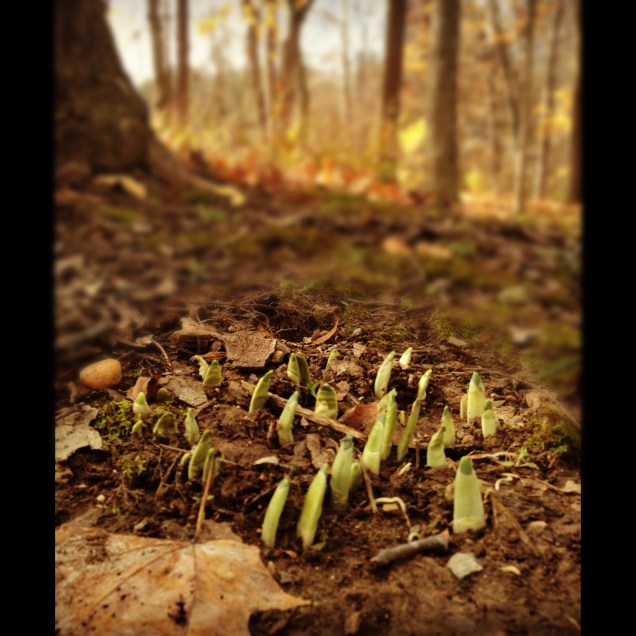
My back yard is another story. Amidst all the naked trees, withered leaves, and shriveled perennials (who are compliantly following all of the seasonal rules), there is this:
Photo: CKirgiss October daffodils
Green among the brown. Growth among the decay. Life among the death.
If the context were anything other than the late-October nature cycle, this scene would be cause for rejoicing, would it not? For these little daffodils of mine are a delightfully poignant metaphor of the spiritual life. Rejoice! Give thanks! All is new! Amen.
I love spiritual metaphors as much as the next person. Sometimes more.
But these are my daffodils, thank you, not my soul. I look to them for miracles and messages – in season. I want them to do their regular old daffodil-thing so that I can, in small measure, fancy myself to be a green-thumber who works wonders in her little plot of dirt. I need this from my daffodils because, truth be known, my thumb is as ungreen as it could possibly be. Embarrassingly so, being of good farm stock. On both sides.
These rogue daffodils are doing it all wrong. They are making a mess of things. They are threatening my springtime feelings of humble smugness and self-congratulations. Springtime! Blooms! Look what I grew! Amen.
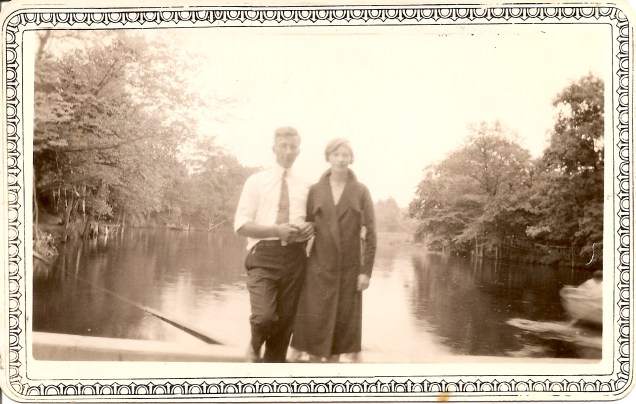
Eighty years ago yesterday, my Norwegian immigrant grandparents were wed in Orange, New Jersey – separated from their parents by both an ocean’s roaring expanse and a generation’s widening gap.
My bestefar died when I was only seven, my bestemor when I was eight. That was a long time ago. So long that I don’t remember much about them. Hardly anything at all, in fact. What I do remember certainly doesn’t look anything like the picture above.
Grandparents have a certain something that identifies them from a distance. A look. A gait. A tip of the head. A style. An air. It has little to do with age in some cases, and much to do with wisdom in most cases.
The people in this picture are not my grandparents. They are strangers to me. I don’t recognize their youth. Their style. Their poise. Their intimacy that is so mysteriously visible it makes my heart ache. With joy. With sadness.
Who are these people?
I want to meet them. To hear their story. To ask them questions. To know who they were before they became my grandparents, before they were the quiet man who carefully peeled his boiled potatoes and the kindly woman who gently cared for the quiet man.
The years make little sense. Youth. Age. Past. Future. Then. Now. Was. Is. Here. Gone.
It all starts to jumble together after awhile. We wake up one day and realize that we are no longer grandchildren (but will always feel like we are), that our own children have grown (how did this happen?), and that with each breath, we move ever-so-slightly closer to becoming someone’s memory, whether in fact or photograph. (Yes – the seasons of the year often mirror the seasons of my soul.)
This would all be desperately heartbreaking if not for the promise of new life and new breath that waits for us not just on the other side of this world but in the here-and-now. The sadness of my grandparents’ deaths does not define my soul. The weight of my own mortality does not measure my existence. The reality of all life’s fragility does not color my faith.
Rather, it fills me with wonder. With awe. With expectant pause. Because though I will never really know the people in this picture (and oh, I would so very much like to know them), the Almighty Creator knows me.
Photo: CKirgiss 2012 Apple Popcorn Festival, Brookston, IN.
A few weeks ago, I saw these pumpkins while walking small-town streets during a small-town festival.
And I rejoiced because I love everything about this time of year. The crisp air. The changing leaves. The crunchy earth.
The impending death.
Weird, I know.
Most discussions about being, whether humanistic or religious, are framed by the precisely ordered phrase “life and death” for good reason. The one so obviously follows the other.
Except when it doesn’t.
Coming as it does between summer (the season of life) and winter (the season of death), autumn treads in both worlds, displaying a bold embrace both of that which is flourishing and that which is dying. In these early days of autumn, the dying can be beautiful to behold – shocking red that is so rich I can (almost) smell it, feel it, taste it. And on the same branch, a green so deep I can (almost) hear it breathing, singing, growing.
Photo: CKirgiss October leaves of Indiana.
We tend to view autumn as the season following life (summer) and leading into death (winter). And we tend to view that transition from life to death as a completed cycle, the final stage, the end of something.
Except when it’s not.
Because of course, winter is not the end. Spring follows on its heels, each and every year without fail, leading into summer’s riotous burst of life.
I love autumn for all the reasons listed above, and like all other autumn lovers, I’m thrilled to be wearing sweaters, eating soup, and wrapping myself in wool blankets again. But I’ve learned that my autumn-love is about so much more than that.
It’s about celebrating “death and life” in that precise order. My redeemed but still-sorry soul is so desperately in need of death – pruning, refining, purifying, cleansing – so that life can flourish in its place.
Autumn helps remind me of this, helps settle my soul into a place of spiritual expectancy in preparation for the much-needed, oft-repeated, sanctifying process of dying to self so that I can live for Christ. Such death is not the enemy, not to be feared, not to be avoided, and certainly not to be mocked. Such death is miraculous, renewing, and breath-taking. Such death is a gift, really, an invitation from Jesus himself to enter the re-creation story of my own spirit that he began on the cross.
I need to die. I really do. In so many ways. How unspeakably wondrous that such death is really a birth, which is a paradox typical of life with Jesus Christ.
And how even more unspeakably wondrous that nature’s season of death, stretched across the long, dark winter months, is momentarily pierced with the greatest Birth of all. Such is the grace of God that though life leads to death, death also leads to life. Over and over and over again.
Photo: CKirgiss Homemade journals. **Details at bottom of post.
Confession: I’m a journal freak. A blank-book maniac. Whatever.
I like journals. I need journals. I crave journals. (And pens to go along with them. Lots of pens. Lots and lots of pens.)
Over the years (like every other journal-freak-blank-book-maniac-whatever) I’ve worked my way through more pages than I can count, shifting from composition books to sketch books to notebooks to whatever happens to be on sale.
In the process, I’ve learned there are only two non-negotiables for this slice of my life.
One: no lines. I want the freedom to write sideways, crossways, or diagonal; to doodle, sketch, or chart; to meander, march, or stall; to shout, chat, or whisper; in short, to write or draw in any direction and in any size I want. I totally get that lines help keep things straight and neat and orderly. Not interested. That’s what closet organizers are for. And calendar apps. Journals are for life, and life is usually unpredictable, messy, spontaneous, and slightly (or greatly) out of control. A journal is meant to reflect that, not cure it.
Two: sewn binding. I want to know that my pages aren’t going to fall out. (Journals are meant to reflect life’s messy spontaneity, not mimic it.) I want my pages to lay conveniently flat. (Just because I want the freedom to write up, down, sideways, and around doesn’t mean I want to write over the side of a tumbling paginated cliff or into a valley of stiff binder’s glue.) I want the comfort of knowing my pages are each connected to another page just across the row of signature stitches. (If journaling is an exercise in solitary discourse, it’s reassuring to know that the pages upon which the discourse lives are not themselves solitary but rather sewn permanently into a larger community.)
If this sounds weird or obsessive or (gasp) even a tad neurotic, well (cough), yep.
It is.
Too bad for me, unlined sewn-binding journals aren’t easy to come by. At least not if a person cares even just a little bit about style and flair and appearances. And cost. Which means there are actually two more non-negotiables for this slice of my life.
Three: looks matter. At least a little bit.
Four: cost matters. A lot.
Even more too bad for me, cheap, stylish, unlined, sewn-binding journals aren’t easy to come by. So I’ve started making my own.
If this sounds silly or time-consuming or (gasp) even a tad snobbish, well (cough), yep.
It is.
But it is also thrifty, rewarding, and even a tad delightful. Wrong. A ton delightful. Oh my, yes indeed.
****
Photo: CKirgiss
These journals are made from the boards of old, discarded, rejected Readers Digest Condensed Books. You can find them anywhere. Everywhere. Often for free. Free is good. Spines are made of Tyvek tape (right) and duck tape (left). People who know what they’re talking about say you should never use duck tape for this. I used it anyway. (And my needle got kind of sticky.) Innards are made of printer paper, folded, cut to size, sewn into place.
Photo: CKirgiss
These journals are made from old leather wallets. You can find them at thrift stores for cheap. Cheap is good. Gutting them takes a while. A long while. To do it right you really need to rip out all the seams and then resew the edges neatly. Innards are made from printer paper. My good friend Joanna Benskin gave me this idea. (Her innards are made from lined composition paper. We are still very good friends.) This idea is probably out there on Etsy or Pinterest, but I don’t look at those sites. Sensory overload. I’m sick just thinking about it.
Photo: CKirgiss
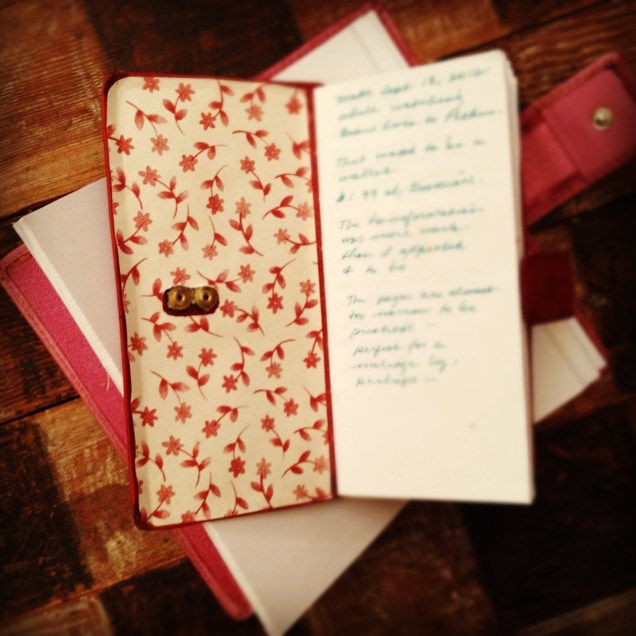
Inside view of wallet journals. (I should mention that part of the motivation for these is that a good piece of leather shouldn’t go to waste. Ever.) Endpapers may or may not adhere. I left the pink one plain because really, what screams competent-and-independant-jeanswearing-thrifty-egalitarian-nonprincessloving-moderndaywoman more than a PeptoBismal Pink Journal-Wallet free of any design distractions?
Photo: CKirgiss
Confession: I didn’t make this journal. It’s a Moleskin skinny, which is neither cheap nor stylish (non-negotiables #3 and 4). But since I already owned it and didn’t go out to buy it in order to retrofit it, it’s sort of like I got it for free during the makeover stage. Really. This idea wasn’t mine. I saw it at a craft fair. Which had only ten exhibitors due to torrential rains. Ten exhibitors was enough to send me into sensory overload. No, that’s not the original old photo sewn onto the cover. What do you take me for? And yes, I know the people in the photo. The one on the left is an amazing mother and grandmother. The one on the right is a journal freak. A blank-book maniac. Whatever.
**Top photo: these journals are made from covers of old books. Look – I love (adore, collect, cherish, fondle, drool over) old books as much as anyone I know. I would never sacrifice one if it had even the barest hint of life, value, or that delightful fusty smell so many of us love. But these books were on their past breath – cracked, torn, crumbling, and unhinged. Really, their covers were all that remained of their former glory. I like to think I saved them from the grave and gave them a brand new life. Innards are either printer paper or unlined-and-sewn innards of cheap sale journals with seriously bleh covers, sliced out of their sad and sorry homes (which will be remade into happy, schnazzy book boards at some point), then rebound into these delightful covers from long ago. Spines are made from (variously) Tyvek tape, duck tape, or scraps of leather salvaged from thrift store stuff – you know – jackets, pants, vests, boots, bags…
I wrote these words 11 years ago, but could have written them yesterday – not just about the events of that day, but about all of life when it is lived outside of God’s immeasurable, forgiving, majestic, jealous love. (Please silence your outcry for that last element. God’s jealousy is not humanly petty. It is gloriously divine. It is for us…all of us…, and nothing could be more breathtakingly astounding) .
______
Regarding September 11…
I have a thousand questions I want answered.
I have a thousand fears I want quelled.
I have a thousand thoughts I want sorted out.
I have a thousand concerns I want soothed.
I have a thousand things I want changed.
I have a thousand people I want saved.
I have a thousand places I want seen.
I have a thousand songs I want sung.
I have a thousand steps I want walked.
I have a thousand prayers I want uttered.
I have a thousand bridges I want crossed.
I have a thousand roads I want traveled.
I have a thousand books I want read.
I have a thousand poems I want whispered.
I have a thousand birds I want freed.
I have a thousand trees I want honored.
I have a thousand skies I want admired.
I have a thousand oceans I want remembered.
I have a thousand eyes I want dried.
I have a thousand ears I want opened.
I have a thousand voices I want heard.
I have a thousand wrongs I want forgiven.
I have a thousand mountains I want climbed.
I have a thousand stars I want named.
I have a thousand lives I want lived.
I have a thousand fields I want sown.
I have a thousand rivers I want blessed.
I have a thousand children I want born.
I have a thousand sorrows I want healed.
I have a thousand days I want begun.
I have a thousand years I want danced.
I have a thousand clouds I want explored.
But I have only one God, who is true from the highest depths to the lowest valleys, from the farthest east to the farthest west, and from the beginning of always to the end of never.
The god for whom people were willing to die last Tuesday is no god at all.
The true God does not say, “Die for me.” He says, “I’ve died for you.”
The true God does not say, “Hate others.” He says, “Love others…as much as you love yourself.”
The true God does not say, “Crucify the enemy.” He says, “Crucify your heart so I can create in you a new one.”
Would that the entire world could live in the contented peace of such simple truth as this.
The bottom basket of my freezer is bare. Nothing in it. Nothing at all.
This is a problem because that basket is supposed to be full of frozen overripe brown bananas.
Bananas that – when thawed – can practically be poured out of their peel.
(Bananas that – when frozen – can break a toe if dropped on it.)
Bananas that are absolutely perfect for baking projects.
Bananas that yield domestic gold.
Bananas that ooze culinary delight.
Bananas that are THE single most important ingredient in banana bread, of which I must bake three loaves every Wednesday night for a very particular and discerning crowd.
It’s Wednesday.
I have no overripe brown bananas.
None. At. All.
And the twelves pounds of partly-green-mostly-yellow-with-barely-a-hint-of-brown bananas that I just scrounged during a desperation run to the grocery store won’t be transformed into genuine baking gold for another week. At least.
This is just the kind of crisis that threatens to destroy my immediate existence for reasons that aren’t entirely clear. Or rational.
Bottom line: I should have been better prepared. I should have checked the bottom basket of my freezer last week, bought twelve pounds of partly-green-mostly-yellow-with-barely-a-hint-of-brown bananas then, and had plenty of frozen overripe brown bananas now. But I didn’t. And so I don’t.
In a world that can beam data signals halfway across the world in a millisecond, you’d think there’d be a way to fix this. A way to make these bananas ripen quickly. A way to turn at least a small part of this depressing morass of partly-green-mostly-yellow-with-barely-a-hint-of-brown into a lovely pile of mushy-smooshy-runny-oozy-deep-dark-brownness now. Right now. This minute. Immediately.
Huh. How ironic. My little bananas crisis (little, indeed) and the resulting sense of despair and doom and frustration and irritation isn’t really about bananas at all.
It’s about my response to human limitations. To the fact that the world is not mine to orchestrate. To the fact that I cannot control most of what happens around me. To the fact that I am, after all, a created being existing in a created world that – for all of our human advancement and innovation and progress – is not under my authority.
I am only human. Miraculous and beloved and blessed, to be sure, but fully – only – human nonetheless.
The divine does not inherentlyexist within me. Enlightenment and perfection are not merely a matter of tapping into my own inner reserves of power and strength and wisdom. (Left to itself, my inner reserves are desperately wicked and include nothing of value or merit or worth.)
But…
beyond all reason and comprehension
the Divine doesgraciouslydwellwithin me. Salvation and redemption are freely offered, poured out at the cross and filling my soul so that I can learn love and humility and obedience. (Left to itself, my soul is filled with my own self which knows nothing of love or humility or obedience.)
This year, what with the drought and all, my raspberry bushes were a bust. Nary a single blossom or berry did we get.
Sometime in mid-summer, just when things normally begin to get exciting in the berry patch, the bushes simply fell over into a collective droopy heap of dry, shriveled, sad, exhausted, and bare canes. Where berries should have been was nothing more than small, darkened, hardened, undeveloped blossoms.
We don’t harvest enough berries to brag about – just an added dash of bright red in fruit salads or atop ice-cream treats. But that’s enough to make us feel productive, farm-ish, and connected to the earth in some small way. That’s enough to marvel at the sweet burst of flavor. That’s enough to revel in the mystery of dirt-plus-rain-plus-sun-equals-bounty. That’s enough to be reminded of God’s goodness.
That’s enough to make this year’s non-harvest a source of disappointment.
It was – and still is – quite heartbreaking. I need to get out there and prune back the dead canes so next year’s berry crop stands a chance. But it’s depressing to look upon that pile of despair, to think about what could have been, to realize that the miracle and mystery of nature doesn’t always have a joyful ending.
I don’t particularly like the image.
It hits rather close to home.
It echoes the truth about my humanity.
It reflects what too often happens in my own life.
Droopy heaps of dry, shriveled intentions…of exhausted, bare emotions…of hardened, undeveloped thoughts…of dead, fruitless endeavors…these are the natural result – the only possible result – of a soul’s drought.
Bearing spiritual fruit is a miracle so far beyond dirt-plus-rain-plus-sun-equals-bounty that it’s nearly impossible to comprehend. How can broken creatures such as we produce beautiful things such as love, joy, peace, patience, kindness, goodness, faithfulness, gentleness, and self-control?
We cannot, of course. On our own, left to our own devices, life is nothing more than a perpetual, deadly drought.
Thank God we are not consigned to live on our own, to scorch and shrivel and droop and rot in a pile of dry death.
Thank God we are invited to plant ourselves along the riverbank, to drink deeply of the water of life, to fill our souls with the truth of Christ, and to experience the breathtaking miracle of a fruit-filled life.
Thank God we are not subject to nature’s shifting weather patterns but instead are showered with the endless grace of Jesus.
Thank God we are loved and redeemed and transformed and cultivated in spite of ourselves.
But that doesn’t mean I don’t pin. I’m not legalistic that way. In fact, I’ve been pinning (actually) long before Pinning (virtually) came into vogue – with actual, not virtual pins. The wooden kind. For clothes. Maybe you’ve heard of them.
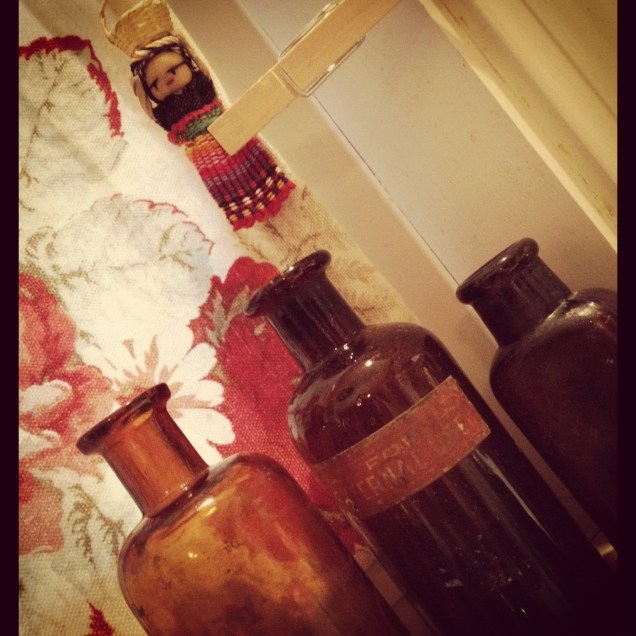
They’re perfect for pinning that tiny homemade Guatemalan doll onto the kitchen curtains.
Photo: CKirgiss
Or for pinning a cardinal’s feather onto the edge of a robin’s nest that graces an end table with its presence.
Photo: CKirgiss
Or for pinning a quirky ornament onto the quirky tree branch in the quirky pot in the corner of the living room.
Photo: CKirgiss
Or for pinning old family photos to the clothesline (used for Christmas stockings during the holiday season) strung across the mantle.
Photo: CKirgiss
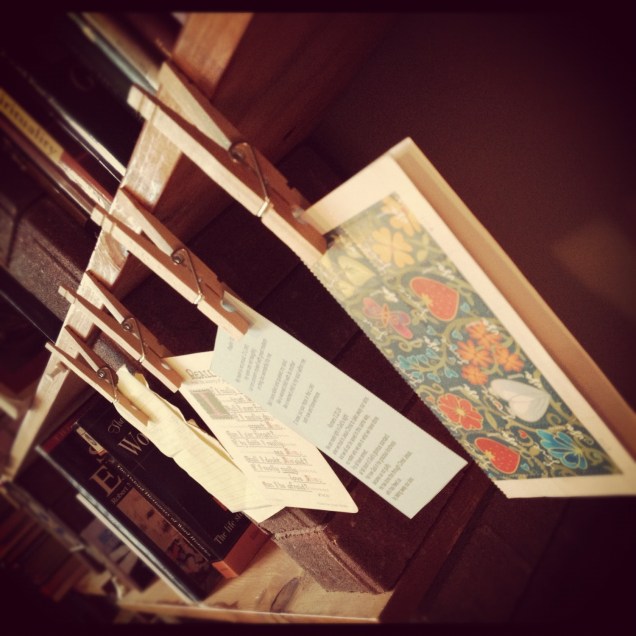
Or for pinning stamps and receipts and notes and other important things to the front of bookshelves.
Photo: CKirgiss
Or for pinning a lovely, wondrous, magical dedication page (torn long ago from an unknown book and saved in a drawer because, well, it’s so lovely, wondrous, and magical) onto a tree branch in the backyard where perhaps the wildlife will appreciate it.
Photo: CKirgiss
Or for pinning necklaces onto a flimsy, useless-for-towels towel rack.
Photo: CKirgiss
Or for pinning the recently opened bag of cinnamon-and-sugar pita chips (which is rarely done because, let’s be real, these chips tend to be consumed in a single sitting even though, if one serving equals one sitting, the bag should last eight times longer).
Photo: CKirgiss
(And yes, that is a box of Red River hot cereal lurking in the background.)
Clothespin pinning may not be as fancy or flashy or fast as the other kind of Pinning, but it has a charm all its own, for this kind of pinning extends beyond what one pins to how and where one pins. In that sense, the possibilities are endless. The pins, however, are not, and that’s good news for a person who lacks her own moderation.
a shoe catalog (addressed to the previous homeowner)
an Extended Service Plan offer for my 5-year old washing machine (LAST CHANCE!)
a flyer for Sear’s 1-Day Sale (HURRY IN!)
a “Customer Appreciation” letter from a car dealer (WE WANT TO BUY YOUR CAR!)
a Special Financing announcement from an appliance store (ZERO DOWN! NO INTEREST!)
a credit card offer (YOU’RE PRE-APPROVED!)
a utility customer service questionnaire (WE WANT YOUR FEEDBACK!)
an offer for prescription insurance (SAVE EVEN MORE!)
In other words, nothing.
In other words, a big stack of recyclable junk.
In other words, another let down.
I remember the days of waiting expectantly for the mail to arrive, an event that looked different as the years passed. While growing up it meant reaching just outside the front door to the small black box mounted on the house. In college it meant walking to the main campus building, descending to the basement level, and peeking into box 992. In apartment one, it meant unlocking box #3 in the main floor entryway. In house one, it meant walking to the end of a long gravel driveway. In apartment two, it meant driving to the post office and unlocking box #73. In house two, it meant waiting for the loud “CLANK” of the brass mail slot door in the front entry (along with a blast of cold Minnesota air in the middle of winter). Now it means walking to the end of a short paved driveway and wrangling with the honeysuckle growing up and around the mailbox post.
“Mail’s here!” has always implied a certain amount of junk mail, even when I was a kid. But it also referred to real mail. Letters. Notes. Cards. Today, though, “Mail’s here!” is pretty much synonymous with, “Meh. Why bother?”
I love technology. I love cyber communication. I love social media. But I bemoan the death of real mail, the excitement of receiving a colorful postcard, the joy of ripping open a hand-addressed envelope, the delight of reading and savoring and re-reading a lengthy letter from a friend or relative.
I have five shoeboxes of letters stashed away in a dresser drawer. Some are my own, some have been passed down from relatives now deceased. Each one is a treasure in so many ways. I can hear the writer’s voice in the lilt of the phrases, the slant of the words, the rhythm of the thoughts. The letter – held in my hand, read with my eyes, consumed with my soul – keeps the writer alive in a small way (or, in the case of the New Testament epistles, in a large way).
This is what came in the mail today:
the schedule for a 2013 conference (BE SURE TO REGISTER!)
a coupon for an oil change (BE GOOD TO YOUR CAR!)
a collection of recipes from a local grocery store (KEEP YOUR FAMILY HEALTHY!)
a reminder to renew my driver’s license (TIME IS RUNNING OUT!)
a 12-page mattress ad (THE BIGGEST SALE OF THE YEAR!)
a flyer for a new area dentist ($25 GAS CARD FOR NEW PATIENTS!)
a mortgage refinancing offer (YOU QUALIFY!)
… and … a letter – a real-live, genuine, hand-written letter from the only friend I have who still writes such things.
The dishes can wait. The laundry can wait. My email can wait. My voice mail can wait. Even my favorite book can wait.
I will be busy for awhile, soaking up the lilt of the phrases, the slant of the words, the rhythm of the thoughts. And then I will soak them up again, several times over, before folding up the pages neatly and storing them away in one of my shoeboxes. The hand-written word (oh, thank goodness) isn’t dead quite yet.










 Breathe