Thrifted yarn: (in which I contemplate unraveling, knitting, and redemption)

It’s been a long winter. A desperately long winter. A maddeningly long winter. A (re)learn-how-to-knit winter, because when it’s dark and dreary and snowy for days and weeks on end, there are only so many ways to keep from tumbling over the edge of rational existence.

Knitting helps.
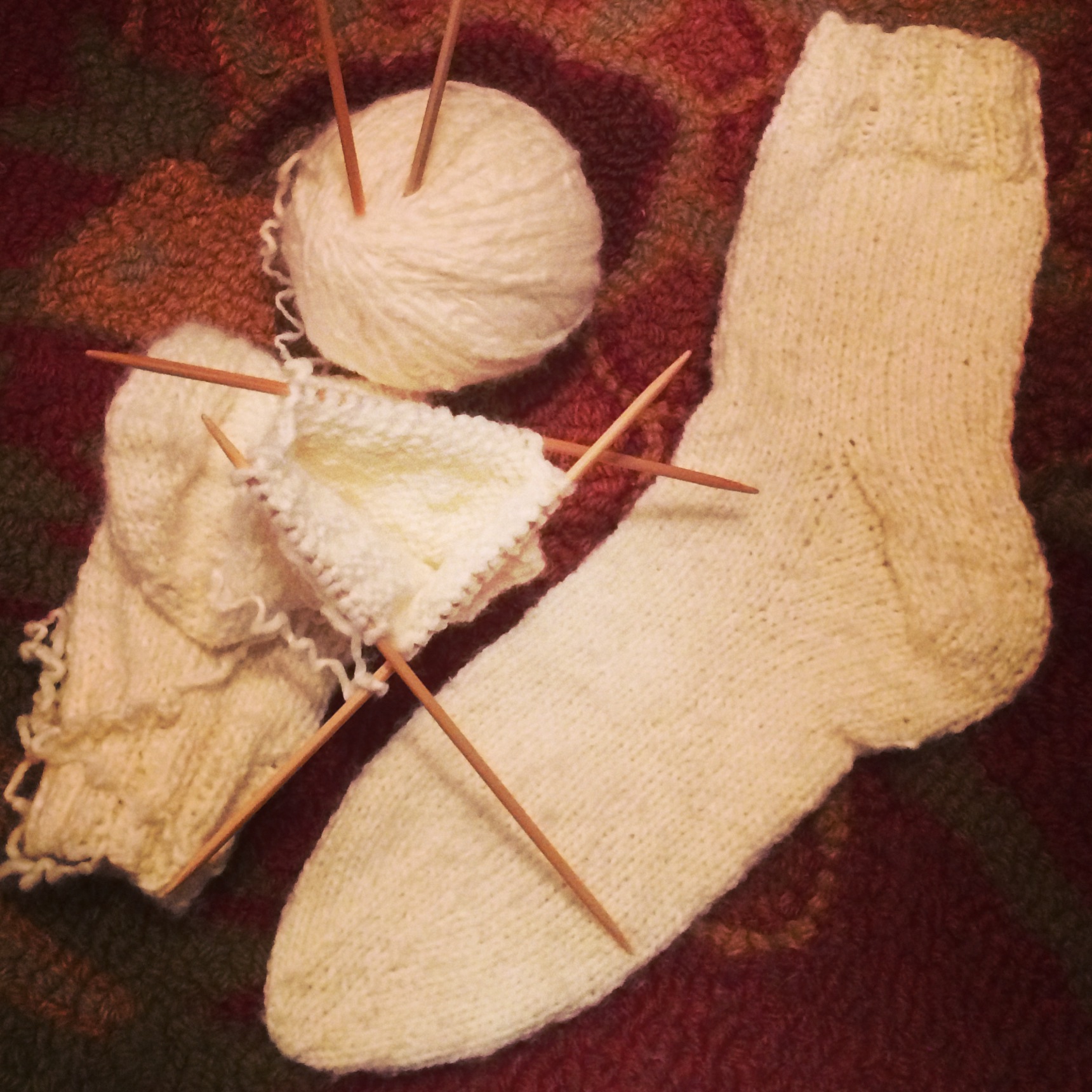
Socks from thrifted sweater yarn (Photo: CKirgiss)

But knitting – unlike me – is not cheap. So I am forced to thrift my yarn, which is to say that I rescue knitted things from the thrift store and then dismantle them into reknittable balls of lovely yarn.
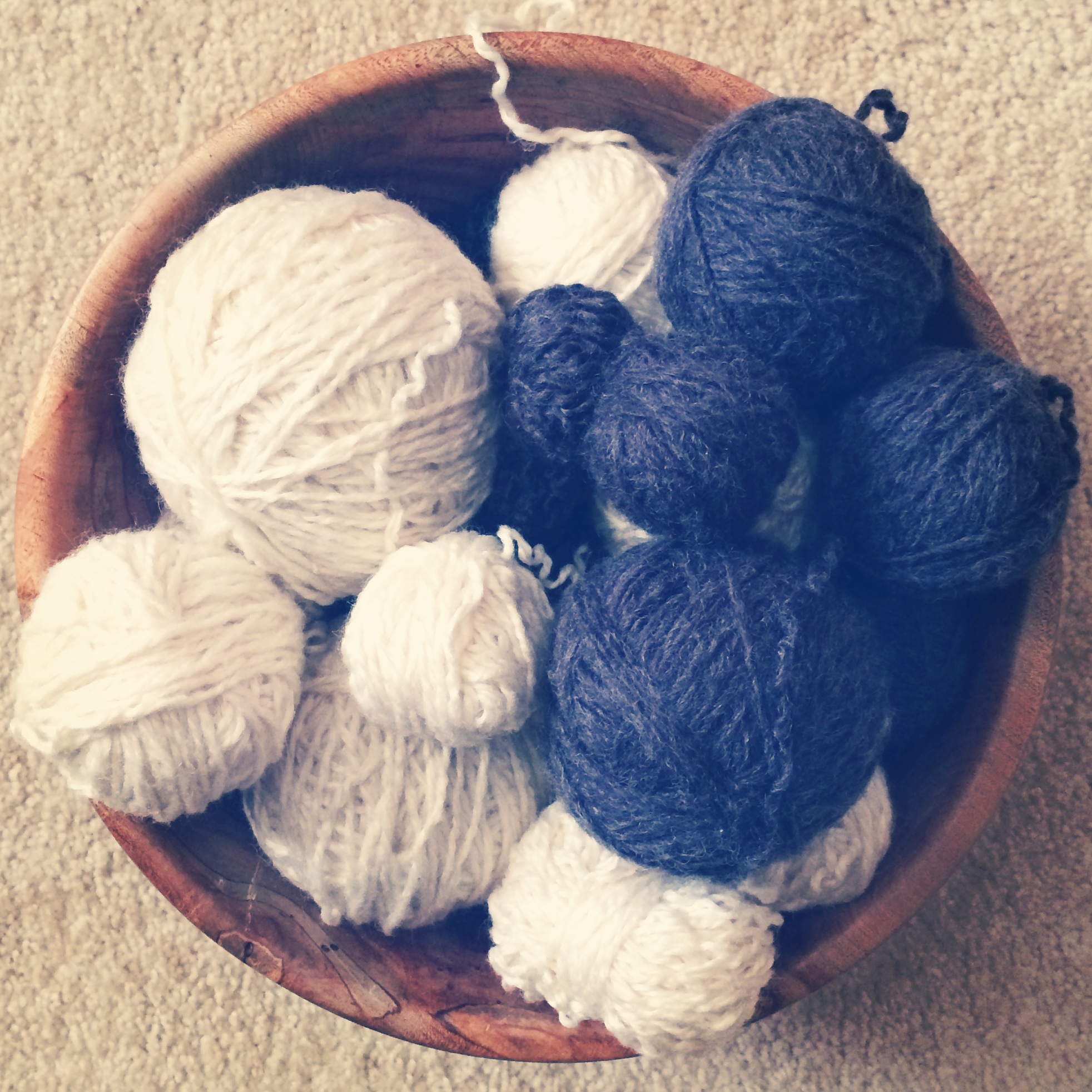
Thrifted yarn (Photo: CKirgiss)

The dismantling is neither fast nor easy.

These are the rules:

1. The knitted things must be worthy of dismantling. That is, they must be so out of style that they have no chance of being bought and worn. Or they must have a noticeable flaw – a big hole, a tragic snag, an irreparable run. Or they must be obviously unusable – a sweater shrunk to smithereens, a pair of socks stretched too large for Bigfoot, a winter scarf worn down to the weight of dragonfly wings – in other words broken, damaged, discarded. Knitted things in perfect condition are best left alone. They don’t want rescuing.

2. The knitted things must be the best of knitted things – “best” referring to how they are formed and made, not to their perceived social value – because only the best of knitted things can be dismantled, unravelled, and unmade with any success, for only the best of knitted things are formed with carefully shaped individual pieces held together with elegantly envisioned and precisely placed sinews.  Knitted things made from violently serged pieces that were cut from larger shapeless swaths are best left alone. They don’t want dismantling.

3. The knitted things must have redeeming qualities (in addition to redeemable faults: see #1). A beautiful color. A pleasing texture. A warm weight. A light caress. A workable thickness. Look beyond the ugly sweater, beyond the misshaped scarf, beyond the worn cap, beyond the tired skirt to see the underlying grace and inherent value. But beware: the most exclusive and haute couture knitted things, if made from stiff, stubborn, and abrasive threads, are best left alone. They don’t want disrupting.

Thrifted yarn (Photo: CKirgiss)

I’ve become an expert unraveller of sorts, which is to say I’ve done a fair bit of unravelling this winter. All of that unravelling has set me to thinking.

These are the thoughts:

1. Unravelling hurts. If my rescued knits had feelings, there’d likely be a whole lot of crying, complaining, weeping, and whining going on. A whole lot. Because being unmade is neither easy nor natural nor fun. Being unmade is neither glamorous nor enchanting nor sexy. Being unmade is not something after which the masses clamor. Rather, being unmade is uncomfortable. Bothersome. Tedious. Humbling. Emptying. This being entirely unmade, piece by piece, row by row, stitch by stitch, thread by thread – entirely, thoroughly, completely unmade – is not the stuff of fairy tales.

2. Some things cannot be salvaged. The process of unmaking reveals things beyond repair. Things that must be cast aside. Things that must be left behind. Things that must be discarded.  Every now and then, the process of unmaking does more than simply reveal things beyond repair. Sometimes the process of unmaking leads to new unsalvageables. Sometimes a thread must be cut – completely severed – in order to unravel and salvage many other threads. Sometimes a whole section must be sacrificed – completely given up – in order for another section to be saved. If the standard unravelling causes discomfort, I suspect the necessary severing and the intentional sacrificing causes pain – deep, biting, shattering pain – that seems beyond surviving.

3. Glory! The uncomfortable, bothersome, tedious unravelling and the deep, biting, shattering pain are not lasting things. Rather, they are the early stages of transformation. The beginning of the new. The start of the grace. Going from broken, damaged, and discarded to beautifully remade requires more than simple rearranging and resorting. It requires restoration. Going from unmade to made new requires more than simple patching and repairing. It requires transformation, re-creation. From the bottom up. From the inside out.

And that is my life. My wholly broken life. My totally unravelled and thoroughly tangled life. My undeservedly, gently, lovingly recreated life.

I am broken, then rescued. Discarded, then chosen. Dismantled, then transformed. Unmade, then remade. Pruned, then sanctified. Dead, then alive.

I am created anew.

(Knitting is indeed a finely spun truth.)

 

The only thing that really matters this year

January the first has passed, which means that approximately 99.9% of the resolutionary-minded demographic has already called it quits.

Calling it quits is so terribly easy to do. It requires nothing of a person except, you know, quitting, stopping, and giving up –unless the thing being quit is something one habitually does, in which case calling it quits requires nothing of a person except, you know, carrying on, maintaining the status quo, and not quitting.

I’ve called it quits enough to know that I hate being a quitter. It causes my soul to feel empty, my spirit to feel abandoned, and my selfhood to feel compromised.

But as surely as I was born a sinner, I was born a quitter – which sounds so sadly pathetic when it’s put into words that I’m tempted to stop writing right now, to crawl back into bed, and to (sigh) call it quits.

And that’s exactly what I probably would do if it weren’t for Jesus —

  • sinless Jesus who refused to quit a task that was beyond absurd, i.e. redeeming the lives of each and every sinful quitter that ever did walk on this earth —
  • loving Jesus who refused to give up on the least deserving and the most pitiable of us, i.e. each and every human being
  • selfless Jesus who willingly abandoned his rights and privileges for countless individual reasons, i.e. you… and you… and you…and you…and me.

Too many Christians think that the opposite of quitting is doing, accomplishing, being active, living busy. We are often expert (and frenetic) doers. To be sure, it is supremely important to be more than simply hearers of the law. The proof, says Jesus, is in the doing.

But the saving is not in the doing. The value is not in the doing. The being is not in the doing.

By all means, do. Often, it’s exactly what’s needed.

But doing isn’t the goal. Nor is it the antidote to quitting. For that, we need something more. Something bigger. Something bolder.

For that, we need finishing.

On the seventh day of creation, God had finished his work of creation, so he rested from all of it. He stopped working — which might look the same as quitting but in fact is sacred stillness.

One day during his public ministry, Jesus finished teaching the people, so he returned to the quiet countryside. He stopped being with people — which might look the same as standoffishness but in fact is sacred solitude.

In the ninth hour of his crucifixion day, Jesus cried out, “It is finished,” and hung his head upon his chest. He stopped breathing earthly air — which might look the same as death but in fact is eternal life.

Because of all that, today we can be certain that God, who has begun his good work within us, will continue that work until it is finally finished on the day when Christ Jesus returns — which might look entirely impossible (being the sorry sinners we all are) but in fact is the blessed assurance upon which we build our lives.

For as long as I walk on this earth, I will wage battle against being a self-deprecating quitter just as much as I will wage battle against being an over-zealous doer. In the end, they are equally empty and destructive.

This year, we would all be wise to confess the quitting, admit the over-doing, and stop obsessing about both. Ditch the resolutions and instead, ask God for a gracious portion of wisdom, strength, and humility as he transforms us into people who finish the race set before us.

The unvoiced linguolabial trills of the Eucharist (in which a baby blows raspberries while I take, eat, and remember)

The sounds of silence (Photo: CKirgiss)

Yesterday morning, in preparation for partaking of the Lord’s Supper, the congregation was invited to be still and know that He is God. I adore being still and knowing. My soul delights in stillness, silence, and peace, so I gladly partook of these before partaking of the bread and wine.

While I intently invited God to examine my heart and expose my soul (which He always does to a degree that I am rarely prepared for) – while I meditated on the grace-filled miracle of the Cross (which is astounding in its depth of humility and love) – while I focused on the body and blood of Christ, broken and shed for the likes of even me (which is so far beyond deserved that I sometimes cannot fully grasp its reality) – the still and peaceful silence was cast aside by the babe three rows back who understandably has no understanding of still and peaceful silence but certainly does understand the joy of being fully alive.

A babe’s way to celebrate the joy of being fully alive has little to do with still and peaceful silence (unless he sleeps). Rather, a babe’s way to celebrate the joy of being fully alive is to coo and gurgle and giggle and blow continuous raspberries (also known as “unvoiced linguolabial trills” for those who care about that kind of thing) until his tongue and lips give out. Which doesn’t happen often (the giving out, that is).

I think perhaps I heard the young mother stifle a giggle or two in response to her child’s version of silent reflection. I stifled a giggle or two of my own, not to express judgmental silence (as so often happens between grown-ups and children) but rather to create expansive uncluttered space for everyone to enjoy the coos and gurgles and giggles and blown raspberries – for those were the sounds of angel choirs and deserved to be heard in all their fullness.

I think perhaps those babe sounds coming from three rows behind me were the most beautiful and sacred Eucharistic sounds I have experienced in a very long time, in part because of their joyfully pure energy, in part because of the reminder that the Savior, fully divine and willingly broken for the sins of all, was once a cooing, gurgling, giggling, raspberry blowing babe himself, a babe within which God in all his fullness was pleased to dwell.

Because of that pleased indwelling, I, the cooing babe behind me, the congregation around me, and the souls of all who do, have, and will ever live – we all of us can be forgiven, made new, made complete, filled with Christ who himself is filled with the fullness of God.

The babe behind me may not fully fathom this mystery, but he can indeed fully celebrate it. Amen.

“In the beginning”: when poetic truth meets scientific conjecture

I have a lovely little sewn-binding book about space that starts like this:

“In the beginning, say most scientists, there was nothing. Then about 15 billion years ago, the universe – the Earth, Sun, Moon, and all the planets, stars and galaxies – came into existence in a cataclysmic fireball known as the Big Bang. The universe has been expanding from that moment, pushing against the inexorable pull of gravity which may one day lead to the Big Crunch.”

Since I wasn’t there 15 billion years ago when (say most scientists) the cataclysmic fireball resulted in the Earth, Sun, Moon, and all the planets, stars, and galaxies, I can’t speak to the factuality of these lines. It might be worth noting that pages 56 and 57 discuss Pluto, “a little planet we still know relatively little about” (wrote the authors in 2000) and which we now know is not a legitimate planet at all (based on a scientifically democratic, or maybe a democratically scientific, vote) but is instead a mere plutoid (according to scientists who can now definitively state that there are absolutely only 8 planets, no matter what anyone said before).

Aside from the fact that planetary “facts” have changed in the 12 years since the book was first published – which might call into question the very definition of “fact” – I have little to offer by way of scientific reader-response to the opening In the beginning lines. I’m not a scientist. I do know some scientists, and I could ask them whether my lovely little sewn-binding book about space starts out factually sound, but I’m not sure that’s really the point.

The point is that, poetically speaking, the opening lines of the book are atrocious.  Big Bangcataclysmic fireballthe inexorable pull of gravity – it’s enough to make any writing instructor curl up into a tightly wound fetal ball, reduced to meaningless simpering. And just in case she hasn’t quite toppled over the hypothetical edge of literary sanity, there is the equally hypothetical impending Big Crunch. You know. Like the Big Bang. But not alliterative. Please excuse the writing instructor while she chews on glass and pierces her eyes with a fork.

Maybe the authors of the space book wanted to draw on the emotional sensibilities of the reader – certainly the inexorable pull of gravity is not a strictly scientific phrase. Maybe they wanted to take a gentle (or not) swing at another poetic account of the Earth, Sun, Moon, and all the planets, stars, and galaxies, an account that begins with the same three words.  Sadly, they fail in poetry by their own hyperbolic clunkiness. Ironically, they fail in science (present Plutoidian science, at least) by, of all things, the advancement of science itself. What was a definitive fact just a few short years ago is, alas, no longer factual.

If someone is interested in the poetic beginning of all things – and since none of us was actually there, the poetic beginning is the only beginning we really have – might I suggest these lines instead, also taken from a lovely little sewn-binding book, and which are quite obviously the lines upon which the space book is patterned :

“In the beginning,
God created the heavens and the earth.
Now the earth was formless and empty,
and darkness covered the surface of the watery depths,
and the Spirit of God was hovering over the surface of the waters.
Then God said, ‘Let there be light,’ and there was light.
God saw that the light was good.
Then He separated the light from the darkness.
God called the light ‘day’ and He called the darkness ‘night.’
Evening came, and then morning: the first day.”

It seems to me that when poetry tries to be science or science tries to be poetry, we run into all kinds of problems. The theologians who insist that the first day definitively, factually, unequivocally, and absolutely equates to a passage of 24 hours are on no more solid ground than the scientists who poeticize the nothingness of eons ago into a non-deistic cataclysmic fireball. Similarly, the scientists who insist that a spontaneous and purposeless big bang is more likely and believable than God’s voice are treading in dangerous waters.

There are solidly scientific reasons to believe that the earth is very, very, very old. There are solidly sensible reasons to believe that God – powerful, creative, intentional, and knowable – was the intelligent and powerful source of all creation. These two things are not mutually exclusive. Science and truth can co-exist. Though science can reasonably theorize about the when of the beginning, it cannot speak at all about the who or why.

When science has faded away – perhaps in the Big Crunch it so boldly predicts, perhaps in some kind of Plutoidian consensus – truth will still be ever-present, just as powerful, creative, intentional, and knowable as always. At that point, facts and data will cease to exist, swallowed up in the expansively elegant truth known as Love. Can I prove it? Of course not. Can I know it? Absolutely. For though it may not be measurable, Truth is indeed knowable.

From social media to Sacred Mediator: reclaiming “follow me”

So.

Here we are in the two-thousand-and-teens, all of us thoroughly networked, connected, and socially mediated.

Theoretically, things should be nearly perfect because, you know, we are all so desperately in need of being networked, connected, and socially mediated.

[We are also desperately in need of eye contact, sincere empathy, meaningful conversation, and maybe also unstrained opposable thumbs, but we’ll save those for later, shall we?]

In fact, we all know that things are not quite so nearly perfect as many would like to believe.

[Nor are they quite so absolutely desperate as others would like to believe because, let’s admit it, Google and Skype have, on more than one occasion, proven extraordinarily useful.]

I take issue here with neither the staunch proponents nor the strident naysayers of social media. Nothing and nobody is going to change either of their minds.

Rather, I take issue with the linguistic loss that socially mediated connectedness has wrought on our discourse. Specifically, I mourn the fact that follow has been co-opted, flattened, emptied, and sucked dry of all its inherent power, depth, and gravity.

For the first time in history, follow denotes passivity rather than activity, and follow me is a plea for shallow popularity rather than an invitation to disciplined humility.

Rather than try to minimize the linguistic damage, we instead add to it our own unique brand of self-centrist carnage: “Follow me, I follow you. Unfollow me, I unfollow you.” Mm. It simply drips with relational grace and kindness.

I do sometimes wonder how technology is reshaping our lives, how smartphones are rewiring our brains, how Facebook is redefining our relationships, and how Twitter is re-energizing our addictive tendencies.

But of more import than my periodic wonderings are my increasingly persistent concerns:

  • that an obsession with gaining more followers will divert attention from the only One worth following ;
  • that carefully counted likes will obscure infinitely expansive Love;
  • that the demands of social media will clamor more loudly than the grace of a personal Mediator;
  • that the need to constantly refresh will weigh more heavily than the need to be continually refreshed;
  • that a vast web of virtual friends will crowd out a small circle of close community;
  • and ultimately, that follow me will no longer be heard as the radical invitation of a loving Savior but merely as the needy plea of a lonely (but fully networked) soul.

I know that we will never wrest follow me away from its two-thousand-and-teens context. To try would be decidedly futile.

But please, let’s never allow its newly mutated form to replace – or even minimally influence – its two-thousand-year-old meaning. To do so would be desperately fatal.

On being old(er)

So.

In the humble (errant) opinion of AARP – who sent me a complimentary trial membership card this past week – I’m now old. Or at least old enough to join the club.  Just like that. One day, not even an invited guest. Next day, a card-carrying (trial) member headed (one presumes) straight to the retirement community.

Schmeh.

What do they know?

After living for a certain number of years – during which each and every day I was turning older than the day before – I’ve learned a few things.

1. Going to camp with middle-schoolers is a blast. Period. No questions asked.

2. College students are profoundly philosophical. They ask all the right questions – and too often receive all the wrong answers.

3. There is always enough time to take a nap.

4. Age has nothing to do with the calendar year and everything to do with the spirit.

5. Parenting is more work than any of the books tell you.

6. Most books on parenting aren’t worth reading.

7. Staying married is more work than any of the books tell you.

8. Most books on marriage aren’t worth reading.

9. Sometimes there’s just no explaining one’s dietary cravings.

10. Relatively speaking, I’ve learned practically nothing. Or: I have a whole lot still to learn.

That last one is perhaps the most unexpected twist in this whole growing-up thing: the closer I grow to the Lord and the more I get to know Him, the more aware I become of just how very far from Him I am and just how very little I actually know.

The more I encounter His grace the more aware I become of just how little of His grace I’ve actually encountered.

The deeper I sink my roots into His love the more aware I become of just how shallow my rootedness really is.

The firmer I anchor my life into His strength the more aware I become of just how susceptible I am to a slow and gentle drift.

The more I experience significant change in my life the more aware I become of just how much more change needs to happen.

The more I am filled with His love the more aware I become of just how empty my soul tends to be.

It’s a little bit like discovering that the inside is bigger than the outside, and the farther inside a person goes, the more endlessly expansive it becomes – much like the stable in Narnia’s final days and the manger’s babe in Christendom’s first days.

Growing up, it turns out, is not really about growing old. Instead, it’s a lifelong process of discovering just how much more growing up there still remains to do.


Of God’s deep love and dew-dropped webs

A drop of grace, a strand of love (Photo: CKirgiss)

When broken anger rages in your heart –

when empty pain presses on your soul –

when bitter shame surges through your mind –

then (and every other “when”) you must stop and breathe and listen, because God is there, quietly and firmly cradling both the universe and you.

In the overwhelming flood of fear and the tangled web of worry there is (indeed) a cleansing drop of grace resting on a delicate strand of love, if only you will look carefully and listen closely.

Do you see? Can you hear? It is saying this:

“Hush, child. No murmurs now. Listen for a moment ( or ten or a thousand) in silence. Listen to My voice – the whisper of truth, the breath of love, the wind of peace. Be still and know. Behold and believe.

Believe that I designed you, then knit you together in the depths of love. Believe that I formed you from the source of life, then brought you into being. Believe that you are meant to be.

I have heard your cries for help. I have rescued you from the pit. I have redeemed you for new life.

I Am. I Am your healer. I Am your savior. I Am your rock. I Am your refuge. I Am your supply. I Am.

I Am the Lord your God. I Am your Abba, Father. There is none other. I alone Am the creator and sustainer of all the exists. Of you.

If you seek to follow other gods, you will be disappointed and discouraged – they are not me.

If you strive to live for yourself, you will be empty and alone – you are not me.

I generously offer undeserved grace within unmeasured love – you may have all of Me.

I jealously desire an undivided heart within a humbled soul – I do want all of you.

When I look at you, I am silenced. I am moved beyond expression. I am amazed and filled with wonder.

I spun the sun. I spoke the moon. I placed the stars. I breathed the universe. And it is good. Indeed it is.

But you – you – are a wonder to me. You are my child. My beloved. My own. More breathtaking than all of creation.

Feel my holy embrace. Trust my joyful presence. Taste my whispered love. Drink my gentle grace. Hear my sacred voice. And believe these words I speak:

You take my breath away.”

Did you hear? Did you taste? Did you see? Do you know? All is changed for one who believes that you take God’s breath away.

Veritas.

Copyright Crystal Kirgiss 2013


Miley does not define 20-year olds (or: six people you should know)

Well.

Fifteen hours after millions of people watched 20-year-old Miley Cyrus offer friendly benefits to a foam hand while twerking in the presence of life-sized teddybears – and fourteen-and-three-quarter hours after the entire world began tweeting about it – I find out that there was a bit of a to-do at the VMA awards last night.

Shocking.

I didn’t watch the VMAs last night. Not even as a way to keep pace with the most recent cultural trends. Instead, I rested after spending a weekend away with six Miley-aged college-student youth workers. And by “youth workers” I mean people who minister to teenagers, regardless of whether they get paid for it or not, which in this particular case happens to be “not.”

Fifteen hours after no one watched us sit around an open fire and talk about things as divergent as C. S. Lewis, Herb Brooks, and satellites, no one is tweeting about those particular 20-year olds – which is really a shame because they are the 20-year olds that are going to change the world, sans cable broadcasting, million-dollar budgets, and infinite wardrobe changes.

Instead, they are going to change the world through persistence, patience, and countless live appearances at such extolled venues as the middle-school cafeteria, the high-school track, and the public city park.

I might like to say a few things to Miley – as a musician: “Please work on your rhythm.” -as a mother: “If you keep hanging your tongue out, it will freeze that way.” – as a mentor: “Maybe we should meet more often.”

But I’d rather say a few things about the six 20-year olds that I spent the weekend with and that most of you will never meet.

I’d like to tell you about how they love middle-school and high-school students with their whole selves.

I’d like to tell you about all the ways they invest in teenagers, just so they will know that someone genuinely cares about them.

I’d like to tell you about how much fun they have, how much joy they exude, how much laughter they share.

I’d like to tell you about how they intentionally choose to live life differently than so many of their peers.

I’d like to tell you about how every day they seek to reflect Jesus in all they say and do.

I’d like to tell you about all of the minutes and hours and days and weeks and months and years that they commit to being the hands and feet of Jesus in the lives of teenagers.

I’d like to tell you about how they lead and encourage a large community of other 20ish-year-olds, all of whom are equally committed to knowing and loving and showing Christ’s love to middle- and high-school students.

I’d like to tell you about how much they give up in order to gain the privilege of doing kingdom work in a ministry setting.

I’d like to tell you all of that – and so much more – because those are things that matter. Immensely.

The twerking, the profanity, the lewdness, the degradation, and the mockery seen and heard by millions will all pass away.

But the faith, hope, and love of these six (plus fifty) 20-year olds will remain.

That’s a story (within a Story) worth knowing and being part of.

20-year olds worth knowing (Photo: CKirgiss)

Update: After posting this, I realized there is one more thing I might like to say to Miley – as a minister: “You are fearfully and wonderfully made, deeply and eternally loved. Believe it.” Really, that would be the most important thing of all.

Prayer stars

Paper prayer stars (Photo: CKirgiss, Folding: LTenBrink)
Paper prayer stars (Photo: CKirgiss)

At some point, every pray-er — no matter how devout — struggles to pray, sometimes for surprisingly pathetic reasons. One would think that shutting oneself up in a dark and quiet closet in order to listen to the Almighty would be a delightful gift to oneself, especially in a world that is spilling over with glaring and blaring distractions.

But it turns out that sometimes the dark and quiet closet is its own distraction. So much darkness. So much silence. So much closeness. The simplicity and sparseness can be quite overwhelming.

And then instead of praying, we end up thinking in spirals and worrying along rivulets and wandering through mists.

So we pinch our arms, reprimand our souls, nag our chattering minds, and get back to it. Diligently. Mercilessly. Stoically. Because, well, we should; we must; we ought; even though it’s so much work and requires such sternly disciplined singleness of mind. (And by “sternly disciplined singleness of mind” I mean “something that looks quite a bit like joyless self-martyrdom”.)

But – if you are very fortunate and very willing to listen and very emptied of self – something might break through the joyless self-martyrdom. You read a book that helps you understand prayer in a new way. You have an experience that peels back all the false layers of piety. You sense the Spirit gently whispering within the holy breath of life.

Or maybe even this: you receive a box of 8 small folded stars (that are beyond comprehension) and a note that says,

When I prayed for you I made these.

What manner of miraculous friendship is this, that someone not only prays for us but at the same time creates anew (from the old) something that reflects not just us but also the very One who made us?

In that moment – and everyone should have such a moment as this – prayer becomes something much sweeter and larger and more miraculous and divine and beautifully disciplined and creatively focused.

To the star-making pray-er: thank you for making prayer and creativity and friendship even sweeter and more brilliant than they already were.

To the rest of us pray-ers, including myself: what could be more unspeakably amazing than that we are invited to converse with the Almighty Creator (of the individually named and intentionally placed Stars), who is also Abba Father (of the undeserving and helpless flock known as humanity)?

Let us all find our own manner of star-making so that we will joyfully and often enter that sacred space to utter sacred words in the presence of the Sacred itself.

I’m baaaaaack….. (or: Why Middle-Schoolers Are the Awesomest)

Wyldlife boys Wyldlife girls

It’s been a long summer. A long and full summer. A long and full and amazing summer. Mostly because I got to spend 5 of the 10 weeks with awesome middle-schoolers.

That’s right: “middle-schoolers” and “awesome” – all in the same paragraph, same sentence, same phrase.

The reactions I get to spending half my summer with middle-schoolers range from eye-rolls to offers of sympathy. The reactions I get to the fact that I spent half my summer with middle-schoolers – and loved every single second of it – range from disbelief to concern to condolences, as though there’s a direct and quantifiable connection between my love for middle-schoolers and my impending mental demise.

To which I say: phooey.

And phooey again.

Middle-schoolers are simply delightful beyond words, and if I could bundle them all up and bring them home with me, I would (though that would require a pretty big supply of Axe and neon nail polish).

To every middle-schooler I met this summer: thank you for being you.

And to every middle-school doubter out there: you don’t know what you’re missing. Fact.