Being small (in which the Perseid meteor shower and Indiana corn give perspective)

By all accounts, last night was the peak viewing time for the Perseid Meteor shower (per here and here and here and here and a hundred other places). I would give almost anything to see a real Mrs. Whatsit, Coriakin, or Ramandu for even just a split second*. Since that’s unlikely (in this lifetime at least), a meteor shower seemed like a good option. So we set the alarm for 2:00 a.m., climbed into the pickup with our pillows, blankets, and dog, and headed north on 43 in search of glory.

Mostly, we found corn.

Meteor Corn (Photo: CKirgiss)

To be fair, corn is a glory of Indiana, and I surely do glory in it as much as any other devoted Midwesterner.

Regular Corn (Photo: CMartin)

Fact: corn makes me feel small.

Even with my arms stretched to the sky, I am dwarfed by those solemn stalks of jade leaves drooping gracefully towards the earth below and those delicate tassels of filagreed gold reaching elegantly towards the sky above. All of that majestic height – row after row after row sweeping across the endless countryside – is stunning not just for its immensity but also for its unexpected smallness; each of those towering stalks gives birth to a single ear of corn (twins and triplets occur sometimes).

One ear of corn. All of that height and hugeness and majesty for just one ear.

It’s ludicrous in a way. What a (seeming) waste of plant.

Which brings me back to the Perseid meteor shower that (by all accounts) peaked here in corn-covered Indiana last night.

We laid in the truck bed, wrapped against the chill (and also against the hard plastic of the truck liner made of dent- and scratch-resistant plastic molded into an innovative ribbed design – or: bad for the back), eyes wide open, prepared for glory, waiting for majesty.

Here’s the thing about glory and majesty: you can’t capture it in words, or in a photo, or in the largest corner of your mind, because words and photos and large corners of the mind are too small to speak or see or comprehend glory and majesty.

Fact: the night sky – even without a meteor shower – makes me feel small.

Even though I can block out a large swath of invincible lights with my outstretched hand and can compress infinity behind my closed eyes, I am dwarfed by that canopy of heavens reaching down to the earth’s firm edge and soaring up to the sky’s endless cosmos. All of that incomprehensible magnitude  – layer after layer after layer sweeping across the endless universe – is stunning mostly for its immensity but also for its unexpected smallness: many of the meteor shower particles dragging streams of trailing light behind them are the size of a pea – as in the vegetable that is much much smaller than a stalk of corn.

How can this be? How can a speck of dust stream across the night sky in a blaze of energy that makes you catch your breath and clasp your hands for the sheer beauty and unexpected joy that it brings?

That is me. A speck of dust. Tumbling through life, tossed here and there, one of 7 billion souls on the planet, desperately seeking a way to blaze across the sky – not in fame or renown or majesty, but in glory – not the glory of self but the glory of the Almighty.

There are (by all accounts) 1 octillion stars in the night sky. That’s 1 plus 29 zeros. Try to fathom that for a minute. Words and pictures and thoughts can’t begin to compute such an incomprehensible number. Even 7 billion (which has only 9 zeros and which [by all accounts] is how many people currently live on this tiny ball of earth) is beyond my ability to compute.

So sit in this truth for a moment or a day: each and every one of those 1 octillion stars is named, known, and placed. Each and every one. Surely God has enough on his universe-sized hands to consider small and paltry us not worth his time.

Now sit in this truth for a moment or a lifetime: when He considers the night sky, the work of His own fingers, the moon and stars He set in place, He considers them as nothing compared to small and paltry us. Nothing. Nothing.

New math rule 1:

7 billion people > 1 octillion stars.

New math rule 2:

1 single soul > 1 octillion stars.

Sit in that for a bit and see how it stirs up your soul.

*A Wrinkle in Time and Voyage of the Dawn Treader. Read them. Now

Writing a Better Life Story Is Not the Best Answer

Last summer I mused here about our innate human desire to live an adventurous life-story. Sadly, this is often equated with a high measure of circumstantial thrills, personal charisma, and self-fashioning that serve primarily to elevate and soothe the self. If along the way others are deflated and God is reduced, so be it.

Alongside the desire for an adventurous life story is the drive for what has been called a wholly authentic and fully genuine life story – which is perhaps more like a self-directed and self-starring biopic (the ultimate human endeavor) than anything like a Real Story.

Stories continue to be The Thing. In today’s zealously narrative culture, the tepid “Tell me about yourself,” has become wholly passé. Anyone who knows anything and who is even the least bit Christo-hipster knows that “Tell me your story” is the singular way to start a legitimately intentional conversation, after which a person can then tell her own story in return while drinking deeply from the well of transformative vulnerability, all of which will lead to deeper relationships and a more meaningful life.

Amen.

To be sure, telling one’s story is a meaning-filled act. Our stories do matter – just maybe not in the way we think or have been told.

We are daily bombarded with stories, each one more exciting and colorful and dramatic than the one before. And while it can be exhilarating to be bombarded with exciting and colorful and dramatic stories, it can also be depressing and dangerous. What if my story pales in comparison? What if my story doesn’t measure up? What if my story is entirely unexciting, uncolorful, and undramatic?

Even worse: what if my story isn’t as self-satisfying, self-revealing, self-directed, self-actualizing,  and self-controlled (as in controlled by self rather than in control of self) as those other stories?

The world (and sometimes those in the Church) would say: well then, go out and write a better story for yourself, a story that excites you, a story that suits you, a story that serves you – as if an ear for narrative, an eye for revision, and a taste for self-fulfillment (as in filling myself rather than fullness of self) are the answers to what ails us.

Having a better story sounds lofty. Noble. Spiritual, even.

But I think that having – or rather living, which is not quite the same thing as having – a real and true story (as in true to God rather than true to self) is the thing that actually matters, and real and true stories – however unexciting, uncolorful, and undramatic they may seem on the surface – and however difficult, challenging and sacrificial they may be in the soul – are the only stories worth living.

The problem with ‘writing a better story for ourselves’ is that we are all of us pitiful life-story authors. We fumble around with plots and conflicts and settings and characters, hoping to somehow weave them into a tale for the ages. But we are not life-story authors, not a single one of us. Rather, we are one character (a character who does not get to determine the actions and attitudes of other characters, which is a bitter disappointment, indeed) in a much larger Real Story (a story into which we are graciously invited as a full-fledged and beloved player but not the major protagonist, which is a beyond-bitter disappointment, decidedly).

Though personal stories matter, and though desiring to live a better story is perhaps a fine goal, it is exceedingly trite for people of faith to reduce God to being merely the Author of My Story, or more grandly The Author of Life. Rather, God is the only Authority of life. All of life. Every single life. Life now and forever. (Lest we think God does not notice or care about our skewed understanding of ourselves in relationship to him, read Job 38-41. And lest we think God is a patronizing and distant deity whose sole discursive and creative practices are theocentric, read Job 42. Then contemplate the cross.)

Further, inviting God (however humbly) to be the author of my life leaves open the door (indeed widely) for me to then be the eager and knowing editor of my life who will zealously reorganize, revise, and rewrite the story more to my own liking. If we are pitiful life-story authors, then we are even more surely blundering life-story editors.

I will live a better story – a better life – only if I recognize God’s authority, fully embracing it with both heart and mind (Christ abiding in me), and fully embedding both heart and mind in it (I abiding in Christ).

On paper, it may not sound like much. But we are not paper stories. We are living stories. And a living story composed and centered around the Authority of Christ is surely and absolutely a story for the ages – and the only kind worth living.

Easter and the Breath of Life

Friday is about the embrace of Christ as he wraps our sinful selves – each and every one of us muddy beyond measure – in his infinitely loving arms, taking our sins upon himself while hanging on the shockingly sacred cross.

Saturday is about waiting with bated breath for the time to pass and for the Christ to breathe again. Knowing how the story ends does not lessen its glorious unfolding, and so Saturday is marked by holy suspense and wonderment.

Sunday is about life, hope, joy, disbelief, deep belief, new clothes, and a feast to end all feasts.

(Luke 15)
When that stinky, filthy, sorry and soiled son – just returned from a life of utter independence, and also utter pig stench – was embraced by his gracious, forgiving, gentle, and loving father, the story was not ended.

Not even close.

That son needed cleaning up (done by the father) and new clothes (provided by the father) and a joyous welcome home party that blew the roof right up off the house in a burst of wild celebration (hosted by the father).

The older son – who had never left home outwardly but had surely left it inwardly – wasn’t at the party, not because he missed it or wasn’t told. He skipped it. Entirely. Totally. Even after being warmly welcomed and invited. The older son didn’t want hugging. He didn’t want cleaning up. He didn’t want reclothing. He didn’t want rejoicing. He didn’t want a party – not that party, at least. And what we don’t want is not forced upon us. Ever.

The lost son was found, and the family partied like there was no tomorrow (even though there were endless tomorrows.)

(John 20)
When Jesus hung on that cross – dripping with the stink and stench and filth of the world’s sins – and held all of humanity in his embrace while breathing his last, the story was not ended.

Not even close.

Less than 48 hours after he’d been nailed to the cross, and maybe just 36 hours after he died – really and truly and totally died – Jesus’ tomb was empty. Really and truly and totally.

This is rather a big deal. A stupendously, shockingly, and stunningly big deal, in fact.

Resurrection doesn’t just happen every day (though a little part of me is brought to life each day after it has first died out really, truly, and totally).

And of course, no matter how much he’d told them it would happen, his best friends weren’t expecting their really, truly, and totally dead leader to ever be anything other than really, truly, and totally dead.

They didn’t know the end of the story yet. Their suspense and fear were real. Truly and totally.

So you can imagine their surprise when just 50 or so hours after watching him take his last breath, they saw Jesus right there with them – where they huddled behind locked doors for fear of what might happen to guys who were friends with the man who had turned the world upside down really and truly and totally.

Understandable.

Also understandable: their fear of what might happen to them was nothing compared to the shock of what did happen to them. Seeing a dead guy, that is. Who was really, truly, and totally no longer dead. He spoke. He embraced. He laughed. He comforted. He breathed in and out, in and out, in and out, no more breathing his last, now re-embodied in flesh and blood – flesh no longer just human and blood no longer merely shed.

And then the unthinkable: the risen Christ, breathing in and out, in and out, in and out – really and truly and fully alive – breathed in and out right onto his friends, much like God breathed into the first of humanity, eons and ages and lifetimes ago.

“Don’t fear,” he said. “It’s me,” he said. “I’m here,” he said. “Be at peace,” he said.

Then he breathed on them and said, “Be. Be born. Be new. Be mine. Be filled with the Spirit of holiness and life.”

So you see, there is no doubt that we all – each and every one of us – takes God’s breath away – not by force, but by the depth of his own holy love: first on the cross, where he breathed his last; then at the party (for that’s what happened behind those locked doors on Sunday night – a party indeed), where he breathed their first. Our first.

The Lord is risen. The tomb is empty. We have been cleansed. Our spirits are full.

We know how the story ends. Let’s now live into its glorious unfolding – really, truly, and fully.

The Cross of Christ, the Savior’s embrace, breathtaking love

(June 1989)
When the child was still not three, the only outdoor rule was this:

You may not go outdoors by yourself. Ever.

It could not have been simpler, clearer, or more reasonable. Stay in with mom or go out with mom. Those were the options.

On that particular Wednesday night when the dinner hour arrived – for which I had miraculously cleaned up, not a small thing in the days of small children –  I could not find the child. Anywhere. Which was not entirely new or unexpected. He had no great love for being found.

I methodically checked inside closets, under beds, down basement stairs, and behind the shower curtain. I rechecked inside closets, under beds, down basement stairs, and behind the shower curtain.

The child not-yet-three was in none of those places because he was here instead:

Child swims in mud.
Child swims in mud.

Front-crawling through the mud puddles he was, because there is nothing better than swimming if you are not quite three.

He’d gone outside. Without me. Which was against the rules. And then he swam in a mud puddle because it was there, calling his name, and I had never said:

You may not swim in the driveway mud puddles. Ever.

Dinner was late. I was clean. The child was dirty up and down and all around. And the child had done wrong – much or little didn’t matter. He was a muddy mess indeed. I could have said:

Do you know what happens to little boys who sneak outside to swim in mud puddles? They turn into mud pies and spend their whole lives living in muddy muck, eating dirt and slime, crying because they are locked out of the house forever and ever and ever. That’s what.

I considered it. I really did. After all, I was clean. That doesn’t happen every day when the kids are not-yet-one and not-yet-three.

But it was chilly out. And people were getting hungry. And there are no beds or books or blankets out in the mud. And he was a child, – my child.

The only option: to go out myself, walk through puddle after puddle until arriving at his puddle, bend down to eye level, and say:

Here I am. I’ll help.

He was not interested in being helped.

Child swam in mud.
Child swam in mud.

I wrapped my arms around him anyway – because sometimes mothers must; cringed as the muddy slime smeared all over the clean me – because where else could it go; felt that precious not-yet-three boy against my body – because that’s right where it belonged; and caught my breath – because, gracious sakes alive, mother love will take one’s breath away, no matter how much muddy slime drips around the edges.
_______________

(Luke 15)
When the boy was not quite a man, there were rules aplenty, but more importantly there was this:

Home, security, family, love.

Which was more than enough. More than more than enough.

But not enough for the boy. Not nearly enough. What he wanted was a dead dad. Because that meant money. And money meant power and freedom and life. Everyone knows that.

But the power, freedom, and life drained out dry, leaving behind nothing but the slimy filthy stink of hopeless disgrace and shame-filled self that dragged on and on and on until even the disgrace and shame was sucked dry, a lifeless shadow of its lifeless self.

When the son came back, dirty up and down and all around, stenched through and through, having done wrong beyond measure, the father could have said:

You? Here? You?? Here?? YOU ARE DEAD TO ME!

But he never considered it. Not even once. Not even though he had every right to. This was not a child in a puddle. This was a soul in a tempest.

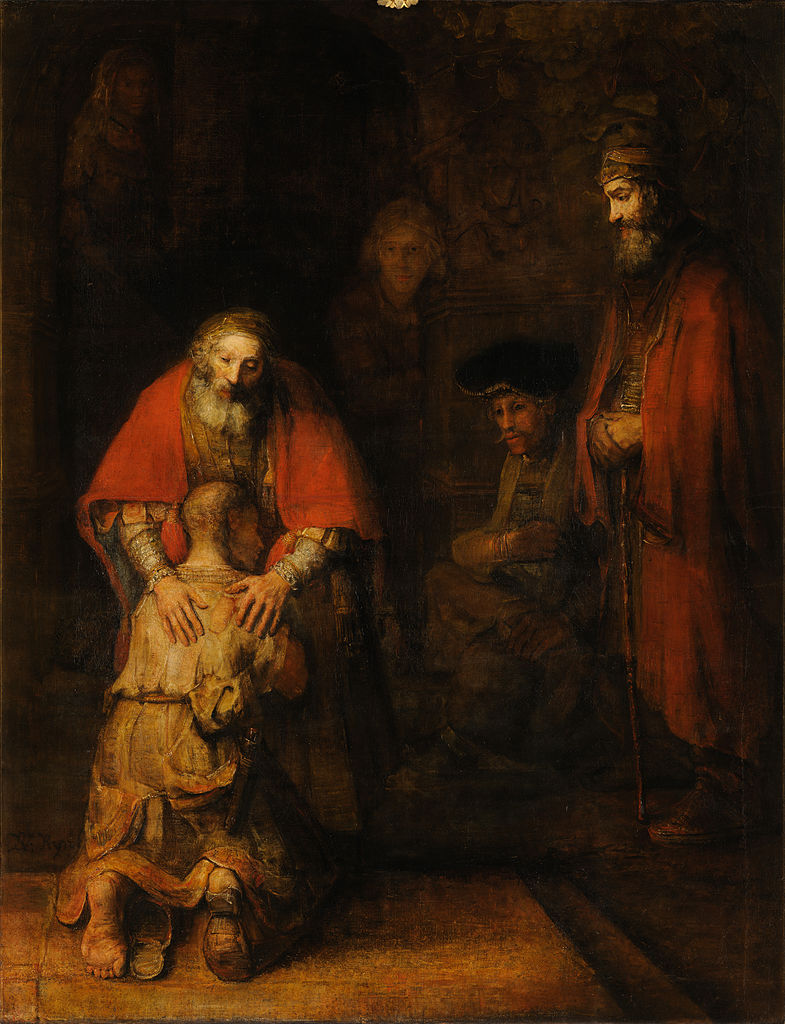
So: filled with love and compassion, he embraced the boy; and when that filthy stench of death and shame smeared all over his own unsullied self, he did not cringe, draw back, cover his eyes, or hold his breath to keep out the stench.

Rembrandt: the father embraces the son.

But indeed, he did catch his breath – because gracious sakes alive, a holy love will take the Savior’s breath away, no matter how much sin drips around the edges.

And drip it did. Drip and smear and suffocate, all over the Savior while he hung there on that gloriously death-drenched cross, holding us in his breathtaking embrace, hugging us from death to life.

Eugene Delacroix (c. 1845)

(I Peter 2)
He personally carried our sins – dripped and smeared all over his holy soul – in his body on the cross so that we can be dead to sin and live for what is right. And having carried them there, and nailing them there, and hanging them there on himself, he said IT IS FINISHED,

And then he breathed his last.

Because we really do take God’s breath away – that day, this day, every day.

On Millennials Leaving the Church (in which I consider the problem with talking about the problem)

Four years ago, David Kinnaman’s book You Lost Me: Why Young Christians Are Leaving Church…and Rethinking Faith was published. What followed, and follows still, is a steady stream of opinions about what has become The Single-Most Definitive Problem of Christendom. That is, countless people have offered any number of reasons (3, 5, 7, 11, 13) about why they (the Millennials) are leaving it (the church).**

Here’s the problem with our discussions and rants and musings about this issue: lumping such a large population of people (everyone born between 1980 and 2000) into a single demographic (The Millennials) essentially reduces all of them into a single it. One of the reasons some people claim Millennials are leaving the church is because it neither welcomes nor fosters a sense of meaningful unique identity. Surely if opiners lump-sum Millennials it is no less depersonalizing than if the church lump-sums Young Adults in the Pews (or chairs, or couches, or whatever).

In the same way, lumping such a large number of congregations (of every denomination and size) into a single entity (THE church, or the CHURCH, depending on who’s lumping) essentially reduces all of them into a single it. Some people claim Millennials are leaving the church in part because it too often paints with broad strokes, invoking simplistic generalizations and damning judgments about infinitely distinct things that are much too nuanced for such narrow pigeonholing. Surely if opiners lump-sum The Church it is no less broadstroked and simplistic than if the church lump-sums Sexual Sin and Being Really Mean (or lying, or cheating, or whatever).

There is an abundance of lump-summing all around. There is also an alarmingly confident presumption of guilt that has taken center stage as opposed to, oh I don’t know, humble dialogue. On both sides.

While it might be helpful for whoever it is that makes all the decisions for all the people to know why all the Millennials are leaving all the churches – which is how the opining is often framed – I think it might be more helpful, and far more important, to know why 24-year old Shane is leaving First Community Church because if in fact Shane is leaving that church then Shane already has left that church. It’s a done deal. It is not present progressive. It is present perfect. It is not theoretically general. It is specific.

I would suggest that “Shane has left First Community Church” is far more significant and worrisome than “Millennials are leaving the church.” Shane is a real person. First Community Church is a real congregation. Something real has happened. Mightn’t it be helpful, wise, and progressively Biblical for Shane and those of First Community Church to talk about this?

I fear that we have so lump-summed the larger demographic and the larger institution that we have lost sight of individual souls and particular congregations, which means we have also bypassed any hope of specific resolutions.

It is easy to have an opinion about Why All the People Are Leaving All the Churches. One can comfortably opine and diagnose from a distance. It carries no responsibility, no investment, no humility, and no commitment – on either side.

But when it is Shane and he has left a specific church, the time for opinions and judgments is past, regardless of whether Shane is 13 or 25 or 39 or 54 or 71 and regardless of whether First Community Church is big or small, mainline or non-denominational, pewed or chaired, sanctuaried or auditoriumed, hymned or chorused, organed or guitared.

If your own church preaches a gospel other than Jesus Christ, that is reason to leave.

If your own church boldly exhorts people to gossip, lie and steal, that is reason to leave.

If your own church condemns people for loving their neighbor, that is reason to leave.

If your own church encourages you to serve your own desires before all else, that is reason to leave.

If your own church sometimes struggles to balance love and exhortation, sometimes fails at demonstrating unconditional compassion, sometimes tries too hard to please everyone because it forgets that the gospel is offensive, sometimes offends because it forgets that the gospel is love incarnate, sometimes falls short of being all that we want and expect it to be, sometimes disappoints because it is so very, very far from perfection – then before leaving, might it not be worth first asking, “How can I be part of helping my church better express and demonstrate its true mission and identity?”

The church is not perfect. Neither are Millennials – or the middle-aged, or retirees, or children, or clergy – which isn’t an excuse, but is important to keep in mind. Really, it’s a miracle beyond measure that the church – both collective and specific – manages to limp along at all. That anyone stays and sinks deep roots into a community of quirky, distinct, unpleasant, incorrigible, narrow-minded, irritating, enchanting, engaging, off-putting, and wholly undeserving humans is more miraculous yet.

But that is the gloriously difficult joy into which we are all called.

The collective Church is here to stay. The embodied church of congregants is here to stay.

So I have questions, not about the “problem” of Millennials leaving the church but about the problems with how we talk about the problem.

If (some) Millenials are leaving the church for profoundly insightful and authentically heartfelt reasons, shouldn’t we also ask for what profoundly insightful and authentically heartfelt reasons some other people are staying? Or do we assume that those who stay are merely too stupid to recognize and too unsophisticated to acknowledge the weaknesses and faults inherent in every congregation?

Why do we talk of people leaving the church – a broadly general signifier that can be vaguely and theoretically applied by both the leavers and the stayers? Why don’t we talk of people leaving a congregation (that is, other people) – a specific signifier that requires both the leavers and the stayers to engage in honest self-evaluation and gracious other-centeredness?

Why do we so reduce and restrict our analysis of the situation to “the church always” or “the church never” or “the church did” or “the church didn’t”?

Do we care enough about both the people who leave and the congregations from which they leave to go deeper than “you should” and “you shouldn’t” so that we might build a sacred space of mutual humility, trust, and love?

After four years of frantic angst and strident rhetoric, do we really want meaningful dialogue between Millennials (both those who stay and those who leave) and congregations (both those that are imperfect and those that are even more imperfect), knowing this will necessarily require difficult self-assessment on both sides? Or do we just want to keep wallowing, bemoaning, and wringing our collective hands in pathetically gleeful misery?

After four years of Millennial-centric discourse, has the embodied church failed to carefully notice and intentionally know distinct individuals of other age groups?

I believe the current crisis of the church is real – but the church is always in some state of crisis. It is the nature of being broken yet redeemed humanity living in the tension of the now and not yet.

Unless we decide to move past talking about the situation in generalities and determine to talk with real people in real churches about our mutual commitment to the broken, struggling, fragile, imperfect, precious embodied church, we all run a very real risk of betraying our costly redemption, no matter how much we each blather to the contrary.


**[Here is where I should include lots of links to the best, worst, most popular, most debated, and most egregiously pompous posts about this subject. But there are simply too many of every category. And since most people have probably already read at least one or two or seventeen or forty-three of those posts, I’m foregoing the standard list of Really Important Links You Absolutely Must Read. I sometimes wonder whether if we all read fewer up-to-the-minute posts about Pressing Problems and more old books about Theological Truth we might not all be better off. In that spirit, I include this link to C. S. Lewis’s introduction to De Incarnatione Verbi Dei, thereby fulfilling my blogging obligation.]


Listen! (in which I consider the Shema; or Love, Learn, Live)

Deuteronomy 6:4 (Westminster Leningrad Codex)

Shema yisrael Adonai eloheinu Adonai echad.

Hear, O Israel, the LORD is our God; the LORD is One.

Last night we gathered, the girls and I, first around the table (which is where the best fellowship and most sacred moments happen, even if the table is a kitchen island and the meal is waffles), and then around each other:

sprawled on the couch, the chairs, the floor;
settled under blankets of woven wool, quilted blocks, sweatshirt material;
surrounded by Bibles, journals, pens, markers, paper, all manner of glorious things.

And we read Deuteronomy 6:4-9.

Just six verses.

Just one hundred words.

A lifetime of truth and wisdom and grace and exhortation.

We read it, listed it, drew it, sorted it, organized it, prayed it, considered it, breathed it.

And then summed it up thus:

Hey! Listen!
All of me must
LOVE all of God and
LEARN all of his word and
LIVE all of his truth and love
in all the ways
in all the places
at all the times.

It was a very, very good night.


The truth about Purdue’s shooting tragedy [one year later]

Exactly one year ago, things changed at Purdue University. Today, I wonder just how lasting that change really was. Do people still remember? Do they still mourn? Does the shocking reality of what happened on January 21, 2014 still run as high, long, wide, and deep as it did in those first days? For a few, no doubt yes. For most, assuredly no. The daily realities of life have settled into the space where the shock once was. That’s to be expected. Else how would life carry on?

But there is one reality that must not be forgotten – one reality that can begin to make sense of last year’s pain – one reality running so much higher and longer and wider and deeper than any other that we dare not forget it. (The following post was first published January 21, 2014.)

Image
Purdue Memorial Mall, 1-21-2014 (Photo: CKirgiss)

It was sunny today at Purdue. Sunny and snowy. Sunny and snowy and freezing. Sunny and snowy and freezing and beautiful. Which is to say, it was a day pretty much like every other wintry day on campus the past two weeks.

Except that it wasn’t.

At 11:00 a.m. when I walked across Memorial Mall, I was struck by the peaceful stillness. By some footprints in the snow. By a brilliant sky. By the hushed atmosphere. Even on this typically busy, bustling day at a Big 10 campus, there was a measurable sense of calm and comfort. Things were much as they should be.

Except that they weren’t.

At noon when I walked back across Memorial Mall, nothing had changed. Not visibly, anyway. There were the footprints. There was the brilliant sky. There was the hushed atmosphere. There was the sense of peaceful stillness amidst the busy, bustling crowd.

And then, ripping through the stillness, slashing through the peace, there was an emergency siren. Screeching. Wailing. Shrieking. On and on and on and on. And the unexpected text message: “Shooting reported on campus. Bldg Electrical Engineering; Avoid area; Shelter in place.”

What place is this? Where am I? Have I stepped into another time and place? Because, you see, these things do not happen here. In other places, perhaps. But not here.

Except when they do.

It has been a devastating day. Someone’s son has died. Someone else’s son has killed. Both families are forever changed. It is one more bitter reminder that we live in a very broken world (all of it), among very broken people (all of us).

That’s right – all of us. We are all broken. Entirely, very, thoroughly, quite broken. That truth manifests itself in different ways, to different degrees, and not just in the midst of tragedy. It is a truth easier to ignore than acknowledge, easier to deny than accept, easier to protest than admit. Nonetheless, we are all – each and every one of us – in need of a Savior who loves, forgives, and transforms broken people.

Which he does.

The sun shone brightly today on a very dark and desperate place. Can you see it there, powerful and radiant?

Image
Electrical Engineering Building, Purdue University, 1-21-2014 (Photo: CKirgiss)

And tonight, the light of thousands shone brightly on a very sad and wounded place. Can you see it there, brave and hopeful?

Image
Candlelight Vigil, Purdue University, 2-21-2014 (Photo: Reddit User 8bitremixguy, http://voices.suntimes.com/news/photos-from-purdue-universitys-candlelight-vigil-for-andrew-boldt/)

Both lights – sun by day and candle by night – are glorious, comforting, indescribably beautiful.

But they are nothing – absolutely nothing – when compared to the one light that really matters, the one light that is truth, the one light that is life, the one light that is love, the one light that is hope, the one light that saves.

“I am the light of the world.” The light shines in the darkness, and the darkness has not – and will not ever – overcome it.

Oh, sweet Jesus – we need your love, your compassion, your grace, your humility. Mostly, we need You. Each and every day. Today (and every other day, in truth) is a fresh reminder of this.

[My continued thoughts, written on the third day – January 23, 2014 – are here.]

A single thanks for a Single Life (in which I consider Thanksgiving and redemption)

I suspect that God’s view of such things as injustice, hatred, war, murder, dishonesty, lying, greed, pride, bitterness, anger, gossip, selfishness, abuse, stealing, and vengeance are not of a single kind or degree.

I believe that his reactions to the vast range of shortcomings and sins of humanity cover an equally vast range of disgust, wrath, disappointment, grief, sorrow, regret, and mourning.

Certainly this week there has been plenty for Him to mourn, plenty for Him to decry, plenty for Him to denounce, and plenty for Him to reject. On all sides.

I know for certain that each and every one of us, if we dig deep enough, has done things, said things, and thought things that do not reflect the image of God in even the smallest degree or measure.

And yet, against all odds and in spite of all our manifold undeservedness, He loves humanity and ushers in redemption for all who would claim it. And though His views and reactions to our individual and communal sins may be broad, the cost to forgive them is the same: a Single Life, sacrificed willingly and completely, bearing the weight of an entire world’s less-than-image-of-God-ness.

It seems as though there are a thousand reasons to not be grateful today, a thousand reasons to question humanity’s soul, a thousand reasons to selfishly ask where God is in the midst of sorrow and pain, and a thousand reasons to begrudge others, whether for their fortunes or their foolishness.

But those thousands upon thousands upon thousands of reasons crumble away into less than dust when held up against this single reason to give thanks: we are beloved by God Almightyoffered new life – real life, embraced with the powerfully just and gentle arms of Abba, Father. 

And oh, sweet Jesus, how much we need Your love and life and grace.

For this one thing – this single, immeasurable, infinite, boundless, incomprehensible (and entirely undeserved) gift, we give thanks. Thanks upon thanks upon thanks.

Now thank we all our God…

Not just another school shooting

For those who live there and know the people, the greatest tragedy of last Friday’s school shooting in Marysville, Washington is that there was a shooting at all; that people died; that parents are aching for their children; that teens are weeping for their friends; that a community is reeling with questions; that a place once thought safe and secure has been ripped open, exposed, and rattled to its inner core.

For everyone else, the greatest tragedy of last Friday’s school shooting in Marysville, Washington is that it has already become last week’s news; that we have moved on to the next shocking and shattering event; that the names and details have started becoming vague; that we have become so accustomed to hearing about such things that they are identified by place rather than by people – Columbine, Virginia Tech, Marysville.

As onlookers, our inherent tendency is to gawk, then move on. It is how we cope. It is how we survive. It is how we avoid having to make sense of a world that is very, very broken – not just over there, where a tragedy took place, but also right here, in our own hearts and souls. For we have all hated. We have all been angry. We have all been frustrated. We have all felt helpless. We have all felt hopeless. We have all hidden the way things really are, down there in the depths of our selves.

In other words, we are all capable of doing unspeakable things. It is the human condition. It is the truth of who we are, deep down inside, where dark things that should be thoroughly routed and ripped out are instead left to rot and fester or even take root, luring us to tend and care for them with all due diligence.

Someone from Marysville – someone who is understandably grasping for hope and grace and light from a place of desperation and despair – said of the healing process, “We just have to reach for that human spirit right now.” Which sounds lovely and hopeful and true.

But isn’t.

Unless the human spirit (selfish and proud and greedy and false) is infused with the Spirit of God (loving and humble and giving and true) there is nothing in it worth reaching for. The reality of the human spirit in its natural state is undeniable. The world screams its reality every day, providing irrefutable evidence for sin and evil.

And yet we also see glimpses of goodness – moments of undeniable grace and love pouring out from hearts in the worst of circumstances, unexpectedly reflecting the light of Christ in the shattering darkness. Those glimpses of grace do not emanate only from people who follow Jesus. And people who follow Jesus do not always reflect the light of Christ. The reality of the world and our hearts is not so easily pigeonholed into neat categories of behavior and belief.

Still, I know this to be true. The only true and lasting hope in life will never be found by reaching for the human spirit. It will only be found in seeking and surrendering to the one true God who – miracle of miracles! – deeply loves and freely redeems a world of undeserving people. 

We are all the least deserving of such grace. And yet we are all showered with it, daily, infinitely, thoroughly.

I don’t know how to rightly remember the tragedy of Marysville. I don’t know how to carry all the pain and suffering and horror of this world. I don’t know how to honor the victims. I don’t know how to encourage the survivors. These things are far beyond my wisdom and comprehension.

I only know this: hope and healing are found only in Christ – perhaps not quickly (especially in the deaths of children), and maybe not fully (in the now, that is, but absolutely in the not yet). But assuredly, they are found there. And only there.

Marysville has tasted the bitterest of sorrows. We should all ache for the communal loss of life. We should also all look deep inside ourselves, not to find answers, but to face truth.

Come, Lord Jesus – for we need you more than we know.

9/11 (in which I consider life, loss, pain, God, love, forgiveness, and hope)

I wrote these words 13 years ago but could have written them yesterday – not just about the events of that day (because the events of that day are repeated over and over and over again throughout history, in a thousand places and in a thousand ways) but about all of life when it is lived outside of God’s immeasurable, forgiving, majestic, jealous love. (And please do silence your outcry regarding God’s jealousy, for it is not humanly petty. It is gloriously divine. It is for us – all of each one of us – and nothing could be more breathtakingly astounding.)

Some say that 9/11 forever changed our world. God says that today (and every day) He will forever change me. I choose the second.

______

Regarding September 11…
I have a thousand questions I want answered.
I have a thousand fears I want quelled.
I have a thousand thoughts I want sorted out.
I have a thousand concerns I want soothed.
I have a thousand things I want changed.
I have a thousand people I want saved.
I have a thousand places I want seen.
I have a thousand songs I want sung.
I have a thousand steps I want walked.
I have a thousand prayers I want uttered.
I have a thousand bridges I want crossed.
I have a thousand roads I want traveled.
I have a thousand books I want read.
I have a thousand poems I want whispered.
I have a thousand birds I want freed.
I have a thousand trees I want honored.
I have a thousand skies I want admired.
I have a thousand oceans I want remembered.
I have a thousand eyes I want dried.
I have a thousand ears I want opened.
I have a thousand voices I want heard.
I have a thousand wrongs I want forgiven.
I have a thousand mountains I want climbed.
I have a thousand stars I want named.
I have a thousand lives I want lived.
I have a thousand fields I want sown.
I have a thousand rivers I want blessed.
I have a thousand children I want born.
I have a thousand sorrows I want healed.
I have a thousand days I want begun.
I have a thousand years I want danced.
I have a thousand clouds I want explored.

But I have only one God, who is true from the highest heights to the lowest depths, from the farthest east to the farthest west, and from the beginning of always to the end of never.

The god for whom people were willing to die last Tuesday is no god at all.

The true God does not say, “Die for me.” He says, “I’ve died for you – though you did not deserve it.”

The true God does not say, “Hate others.” He says, “Love others – as much as you love yourself.”

The true God does not say, “Crucify the enemy.” He says, “Crucify your heart – so I can create in you a new one.”

Would that the entire world could live in the contented peace of such simple truth as this.

copyright 2013 Crystal Kirgiss