Keeping God in a box: or, maybe paradigms aren’t the problem

In the 60s and 70s, Thomas Kuhn challenged the scientific world to make some paradigm shifts. This was simplified to phrases like “shaking things up” and “challenging the status quo.” Soon thereafter, the church grabbed the bait and decided she needed to shift some paradigms of her own – which she determined (with the help of the world’s opinion) had atrophied over time.

In the 70s and 80s, management gurus challenged the business world to think outside the box. This was simplified to soundbites like “taking a new angle” and “looking through a new lens.” Soon thereafter, the church caught the bug and decided it was time to stop putting God in a box – which she determined (with the help of media outlets) she’d been doing for a long while.

I’m not entirely convinced that the original diagnoses of stuck-in-the-mud paradigms and God-boxing were fully correct, at least not to any greater degree than normal. Stuck paradigms and God-boxing are part and parcel of living in the Kingdom while inhabiting a finite earth. They are tendencies we must continually recognize and counter.

But I wonder if – in our efforts to absorb the scientific and business models, and in our desire to prove the world and media outlets wrong – some of us have gone far past merely countering the paradigms and boxes. I wonder if – in our desire to be both edgy and smart, both sophisticated and trendy – some of us have ditched the paradigm and the box entirely, leaving the church bereft of any structure, form, and definition, not perhaps in its daily practices but in its underlying foundation. In other words, I am not primarily talking about worship style and programmatic practices. I am talking about the stuff that really  matters: dogma; doctrine; theology; catechetical truths. Stuff that at least some people hate to consider and loath discussing.

I am the last person who wants to be associated with something trite, obtuse, provincial, or stale. Certainly I do not want my church – The Church – to be any of those things.

But what if trite, obtuse, provincial and stale are merely lexical stabs at what is in fact unchanging, simple, solid, and true? What if the reaction to trite, obtuse, provincial and stale leads not to deeper discipleship but to a dismantling of the framework of our faith?

[On a side note: trite, obtuse, provincial and stale are flung just as readily by The Important Voices on contemporary non-denominational congregations as on traditionally liturgical congregations. Equal opportunity disdain is prolific.]

As foolish and backwards as it may sound, I believe that ditching the box and shifting the paradigm – which has occurred in all manner of congregations – has done serious damage to Christianity. It has opened the door for each one of us to define God, Christ, salvation, redemption, reconciliation, transformation, sacrifice, and obedience as we choose – per our own box, via our own paradigms.

It has not been a healthy experiment.

“Putting God in a box” started as a cliche in Christendom, often directed at people whose faith was too little and too small to believe that the Almighty Creator could do whatever He wanted, wherever He chose, at whatever time He determined – though I’m a bit fuzzy on how one person actually determined that another person’s faith was too little and too small.

Today, “putting God in a box” has become a straw man. It is a way of telling people that if they are not open to an ever-evolving theology, they are frigidians of the faith. It is a strategy for pronouncing people’s beliefs to be narrowly anti-intellectual. It is a tool for defining certain congregations as unwilling to embrace God in all his mysterious and adventurous majesty.

That little church on the corner that is dying a slow death because they do not understand how to attract youth? – they are putting God in a box by not embracing his love for all ages.

That megachurch down the street that livestreams its sermons and runs programs every night of the week? – they are putting God in a box by limiting his transformative work to something that can be planned and implemented.

That mid-size mainline church across town that eschews newer worship music in favor of traditional hymns? – they are putting God in a box by refusing to celebrate his full artistic expression.

That average-size evangelical church across the street that eschews hymns in favor of new worship music? – they are putting God in a box by refusing to embrace the strong traditions of history.

That’s what they – someone, somewhere – says.

Guess what? We all put God in a box. We all understand less of Him than we can because – surprise – our brains are small and our souls are even smaller. We all limit what God can do, if not in holiness then in scope: on one hand we say God is infinitely powerful, beyond all human comprehension while on the other we say He cannot possibly be working in those people over in that church. Apparently that is too much for Him.

I think God might prefer if we stop worrying so much about the proverbial boxes and paradigms and instead focus on Him.

But as we focus on Him, it is eminently important to have a paradigm of truth upon which to stand and a box of doctrine within which to practice our faith.

Doctrine does not box God in. Rather it helps us understand him clearly and rightly. Without it, we are doomed. Doctrine does not limit God. Rather it gives us a framework within which to experience and understand God’s immensity. Without it, we are unanchored. Doctrine does not reduce God. Rather it provides an elegant space of sacred intellect that allows us to stand in awe of Him. Without it we ourselves become smaller than we already are.

We desperately need a paradigm of strong theology and a box of solid doctrine. We need them to guard and expand our faith. We need them to shelter and shape our souls. We need them to protect and engage our minds.

Without them, God will shrink to little more than a man-made power whose sole purpose is to serve our whims and desires.

With them, God will become more and more known to us even as he becomes more and more mysterious; God will become more and more near to us even as he becomes more and more immense; God will become more and more holy even as he becomes more and more personal.

Only within an unshifting paradigm of strong theology and a strong box of unshifting doctrine can we hope to glimpse God as He really is rather than as we make Him. And I’m quite sure that what we will find with each passing day is that within the paradigm and the box, God will grow ever and ever larger in our understanding until finally we see that what is on the inside is in fact much, much larger than what we originally thought was on the outside.

**Dorothy Sayers – though primarily a scholar of Dante and creator of Lord Peter Wimsey – has some beautifully elegant thoughts about this. See her essays “The Dogma is the Drama,” “Strong Meat,” “Creed or Chaos,” et al.

Meeting God Where He Isn’t Supposed to Be: in which I visit one of “those” churches

While traveling Way Down South recently I visited a church that, were it to be measured against the standards of today’s loudest progressively sympathetic Christian voices, should have been fully devoid of the One True God, the Resurrected Son, and the Holy Spirit.

It had no stained glass. No middle aisle. No pews. No hymnals. No narthex. No prayer labyrinth. No organ. No choir. No robes. No passing of the peace. No Eucharist. No liturgy. No church-calendar readings. No congregational responses. No worship folder. None of the things, in fact, that 50 years ago people poo-poohed en masse as being the killers of real faith, only to now become the frame from which people poo-pooh the other end of the tunnel from whence they recently evolved.

Instead, this church had a coffee bar. Comfy lounge chairs. Three large screens. Two Hollywood-caliber cameras. A sound-booth. Head-sets. Stage. Stage lights. Fog machine. Full band (contemporary worship, mind you; not marching or concert). Plexiglass cage for the drums. Projected lyrics. Advertising-flyer style bulletins. Lots of denim. Lots of middle-aged white people.

But: also lots of non-middle-aged non-white people. Lots. Lots of people who should obviously know better than to attend a non-traditional non-sacramental non-denominational pseudo-psycho-church that caters to contemporary styles and issues in a way that leeches the gospel dry of all its power and beauty and meaning while also robbing the kingdom of its beautiful diversity and mystery.

Right? We all know that churches like this have sold their souls to something devilish, have nothing of substance to offer anyone, and are entirely bereft of anything sincere, heartfelt and holy.

We know this because people have told us this. In no uncertain terms. Over and over and over again.

This church was so obviously the quintessential failure of 21st-century Christendom – nothing but a deep pit of hypocrisy hiding behind a shallow facade of religiosity guaranteed to suck the very life out of any who are stupid enough to cross its threshold.

And if that weren’t bad enough, the preacher was a partially balding white dude with a hipster goatee, wearing distressed jeans and a dress shirt, both untucked at the bottom and unbuttoned at the top, who started his sermon with a funny personal anecdote. Somewhere out there, his name is probably entered into The Book of Those Who Are Inherently Patriarchal and Entirely Obtuse (especially in regards to all significant social issues of both his immediate context and the larger world; tantamount to a Pharisee of the worst kind even on the best of days).

Here clearly was a full-blown loser of a church, a gathering of people that exemplify all that is sickly wrong with God’s kingdom today.

So you can imagine my surprise when I noticed the congregation’s diversity, both in age and ethnicity; you can imagine my shock when, after parking in some remote out-lot, the middle-aged white guy who stopped to offer me a ride in the official people-mover turned out to be quiet, kind, self-unimportant, and entirely gracious; you can imagine my confusion when the loud and foggy stage music was overshadowed by the passionately engaged voices around me; you can imagine my bewilderment when the (obviously self-centered, attention-seeking, power-hungry) preacher opened his Bible to the book of Luke and began reading, then exegeting, the Holy Scriptures; you can imagine my surprise when I heard about the various satellite campuses, each with its own distinct preaching pastor (because, um, Livestream of the Famous Guy?), each committed to the spiritual formation of its younger members; you can imagine my disbelief when there was not a single mention of the straight-to-hell-ness of certain members of society; you can imagine my incredulity when the pastor asked for personal responses (while eyes were closed and heads were bowed) just once before quickly moving into a meditative benediction; you can imagine my skepticism when there was not a single self-promoting self-congratulating self-righteous declarative pronouncement from the front (or back or side for that matter).

And I hope you can imagine my delight and joy when I met and sensed and heard from God at that supposedly God-forsaken place, worse (they say) than all other God-forsaken places precisely because of its claim to being God-centered. You can imagine my deep satisfaction at having worshipped in spirit and in truth in that warehouse-ish block of a building that is (they say) obviously bereft of anything sacred or profound. You can imagine my humble chagrin at having realized I was not in a church that is (they say) indubitably infused with deep levels of insincerity that beckons and then subsumes the vapid souls of its automaton members.

I hope you can also imagine my utter self-disappointment and disgust when I realized I’d been ready to blindly accept the well-crafted and distinguished-sounding words of a few people who project the intellectual ability and spiritual discernment to accurately pronounce scathing judgements on all the other people.

Perhaps one of the things that is most wrong with the church today is how swiftly and thoroughly so many of us are willing to loudly point out what is most wrong with the church today. (Perhaps that is exactly what I am doing here…)

There will always be things wrong with the church. Always. There will always be need for honest examination by individuals and selfless reformation by congregations. Always. There will always be a journey of additional sanctification and wider revival. Always.

But I doubt whether we need many more analyses, diagnoses, assessments, or indictments of the Church-at-Large. There is plenty of ill-will to go around already. What we need is more evangel, in doses and degrees that only the Spirit can provide, and only when the people of the church invite and embrace it.

Let’s get to it, shall we?


Sorry, but C. S. Lewis never said that there (in which I begrudge the alarming glut of authoritative misquotes)

Isn’t it funny how day by day nothing changes, but when you look back, everything is different… – “Prince Caspian”

This pithy quote, attributed to the pages of Prince Caspian, the second installment of C. S. Lewis’s Narnian chronicles (that’s right, second, no matter what HarperCollins says),* appears all over the authoritative world wide web.

And when I say all over I mean ALL OVER. 

And when I say ALL OVER, I mean ALLTHEFREAKINGOVER!

Pinterest. Tumblr. Facebook. Goodreads. Yahoo answers. Etsy. Twitter. Finance blogs. Focus on the Family. Amazon. Numerous self-published books.

And approximately 6 million other pages.

It is quoted in mainstream publications. It is quoted in AP History presentations. It is quoted by pastors. It is quoted on every Lewis-loving-blogger’s blog known to humankind. (I hyperbolize.) It is quoted on every quote site in existence. (I exaggerate.) It is even quoted by C. S. Lewis himself on his personal Twitter account. (I joke not.)

At the risk of bringing down all the authoritative walls of Jericho, Google, Yahoo, and Bing in one fell swoop, I regret to inform all the many millions of people who have lauded this quote as meaningful, life-changing, heart-warming, wise, inspiring, eloquent, and other empty blathery things, that C. S. Lewis did not write these words in Prince Caspian, or any of the other Narnian Chronicles.**

It’s true that when Shasta, Aravis, Bree and Hwin race against time across the desert, the view behind them seems to stay the same no matter how long they trot-walk-trot-walk-trot-walk.

It’s also true that when Pole, Scrubb, Puddleglum, Snowflake and Coalblack climb up from the underworld, the view behind them seems to stay the same no matter how long they clop-clop-clop-clop carefully uphill and underground.

And when Caspian, Lucy, Edmund, Eustace, Reepicheep and the others are on the last leg of their outbound voyage, it seems that little changes except for the inherent essence of the sun.

Too, when Peter, Susan, and Edmund are finally wise enough to follow Lucy who is following Aslan who is invisible to all but her, it seems like forever until the other three finally see his golden self walking in front of them.

But the confidently posted, quoted, blogged, tumbled, tweeted, grammed, and pinned quote is no quote at all. Not Lewis’s quote, anyway.**

Still, it has become a 6-million-hits-authoritative fact. No one questions it. No one bothers to look it up. No one takes the time to confirm or fact check or wonder if just maybe – since the quote is never referenced by a page number or given a context or framed within a larger narrative, it might be, well, FAKE – FALSE – UNTRUE – MADE UP – CONTRIVED – NONSENSE  – BLATHERY FOO FOO.***

Confession: I do admire Lewis and love his books, and can tend to get unreasonably bothered and bent out of shape when people toss around his words and ideas without ever having read more than a handful of his 50-plus books and countless articles, notes, letters, reviews, and other writings. (“I’ve read Amos and Jude. Let me tell you everything you wanted to know about God.”)

But this isn’t about Lewis. (Okay, maybe it is a little – but not mostly.)

This is about language and thought and reason and creativity and honor and intellect and caution and so many other things.

It’s about how quickly and carelessly something becomes accepted fact.

It’s about how quickly and carelessly we swallow what the Information Age grazers and snackers share with us.

It’s about how quickly and carelessly we jump on whatever train is currently barreling down the cyber track.

It’s about how quickly and carelessly we discard and surrender our brains, assuming someone else has already done the necessary thinking for us.

Wrong. No. Bad form. Dumb idea. Stop it. Now.

All of us. Just stop it. Else our brains, rather than making thoughtful, adventurous, mindful, and exhilarating use of the vast knowledge now at our fingertips, will simply shut down and take a snooze that soon eclipses mere laziness and instead threatens our very ability to reason, to think, and therefore to be.

Quite frankly, as much as it irritates me, a wildly popular Lewis misquote is nothing more than a symptom of something much deeper, something that should worry us all.

And when I say worry us I mean worry us greatly.

Greatly, indeed.

© 2015 Crystal Kirgiss

* Reading order (also known as “publication order for as long as Lewis lived and beyond”):
Lion, Witch and the Wardrobe
Prince Caspian
Voyage of the Dawn Treader
Silver Chair
Horse and His Boy
Magician’s Nephew
Last Battle

** I am 99% certain that I have never seen this phrase in any of Lewis’s books. To be fair, there are some I have read only once (English Literature in the 16th Century, Excluding Drama, for example). I would happily stand corrected about this quote, by way of a specific title (including publication date, edition, and page number), which would then force me to self-rant about the dangers of publishing a blog post without first meticulously reading and exhausting every possible counter-response.

***Dishearteningly, I have even found uploaded book report about Prince Caspian that include this quote. Dear me.

For when it’s time to dump the butterfly narrative

 (Photo: CKirgiss)
(Photo: CKirgiss)

I am a firm believer in the power of stories to not only bring joy and pleasure (and oh, they surely do) but also to re-right things that have become slightly upended in my obstinate struggle against the fog of everyday living.

Of course there is only one Story – both historical reality and eternal truth – that redeems and transforms. But there are many stories that pull back oppressively heavy curtains and push open stubbornly creaky doors so that a sliver of light smacks us in the face and says, “You there – wake up, would you? Listen and see and taste again what you once did so deeply and fully. Best for you to exit the fog, young one. The days are sweet and many, if you would have them.”

“Trees think we humans are mostly little, flashy creatures, rather the way we think of butterflies.”*

Er. Um. Well. Oh no. Bloody bother.

Thus did a single line in a 300-page story wrestle with my curtains and doors today, curtains and doors that be heavy-hung and tight-locked for any number of days now.

Little? Flashy? Me? Oh no. Surely not. That is not the butterfly story I know. I love Jesus, so of course I will be a butterfly – meaning I will be beautiful, bright, born anew from a blunderingly dull ground-crawler devoid of all wonder. It is so very sacred to be a butterfly, yes? To change from the repulsive mundane into the beautifully spectacular? I choose that. That will be my story. (And we shall skip the oozy putrid muck in the cocoon because in my story, the caterpillar will be gently and magically transformed from one thing to another without the disgusting obliteration and grossness that never gets mentioned – too messy and unevangelium.)

Plus: I will be an intelligent butterfly, thank you, and also a deeply profound butterfly who lives faithfully and wisely for many long years instead of a month like butterflies usually do. And also who flies with purpose and grace. Because I want a better story (don’t we all) that stars butterflies-as-I-create-them, and so I will fiddle with levers and buttons and pedals and engines back here behind the tight-locked doors and heavy-hung curtains (hiding out with other Kansas carnival vagrants who also want a better story that is perhaps a bit or a lot more concerned with what others see and perceive than what I actually live and am).

The butterfly narrative is too lovely to give up. I want to keep it, but also remake it into something better, which is so typically foolish and smarty-pants of me.

The butterfly narrative is woven deep into our transformation psyches and theologies. It’s quite lovely to thus imagine oneself. We do not easily surrender our narratives. Nor do we easily surrender our illusions and schemes and dramas.

But today, the line in the story in the book in my hands smacked me right down on the ground and rattled my bones (and maybe also my teeth) and said, “I am a good story, and I thank you for loving me and reading me. But might I remind you that little and flashy is neither your soul nor your calling. Trees, my dear — trees are the thing. Think about that while you finish reading me.”

Trees. Planted by streams of living water. With roots sunk deep deep deep into Almighty love. Growing so slowly that one almost can’t notice it at first. Uncurling green leaves and bearing fruit. Resting seasonally as if life itself depended on it. Drawing life from unseen waters that flow with no end. Made of the same stuff on which Christ was hung  – which is forever my humiliating shame and also my humbling glory.

You there, the one fumbling through the days with no more purpose or direction than a little flashy flitting thing. Yes, you. The flash may be beautiful and impressive, my dear – but it is short-lived, even shorter than you know. Set it aside. Set it forever aside and instead plant yourself. Plant yourself and live.

Blessed are those who trust in the LORD and have made the LORD their hope and confidence. They are like trees planted along a riverbank, with roots that reach deep into the water. Such trees are not bothered by the heat or worried by long months of drought. Their leaves stay green, and they never stop producing fruit.” (Jeremiah 17:7-8)

Rose Daughter by Robin McKinley

Easter and the Breath of Life

Friday is about the embrace of Christ as he wraps our sinful selves – each and every one of us muddy beyond measure – in his infinitely loving arms, taking our sins upon himself while hanging on the shockingly sacred cross.

Saturday is about waiting with bated breath for the time to pass and for the Christ to breathe again. Knowing how the story ends does not lessen its glorious unfolding, and so Saturday is marked by holy suspense and wonderment.

Sunday is about life, hope, joy, disbelief, deep belief, new clothes, and a feast to end all feasts.

(Luke 15)
When that stinky, filthy, sorry and soiled son – just returned from a life of utter independence, and also utter pig stench – was embraced by his gracious, forgiving, gentle, and loving father, the story was not ended.

Not even close.

That son needed cleaning up (done by the father) and new clothes (provided by the father) and a joyous welcome home party that blew the roof right up off the house in a burst of wild celebration (hosted by the father).

The older son – who had never left home outwardly but had surely left it inwardly – wasn’t at the party, not because he missed it or wasn’t told. He skipped it. Entirely. Totally. Even after being warmly welcomed and invited. The older son didn’t want hugging. He didn’t want cleaning up. He didn’t want reclothing. He didn’t want rejoicing. He didn’t want a party – not that party, at least. And what we don’t want is not forced upon us. Ever.

The lost son was found, and the family partied like there was no tomorrow (even though there were endless tomorrows.)

(John 20)
When Jesus hung on that cross – dripping with the stink and stench and filth of the world’s sins – and held all of humanity in his embrace while breathing his last, the story was not ended.

Not even close.

Less than 48 hours after he’d been nailed to the cross, and maybe just 36 hours after he died – really and truly and totally died – Jesus’ tomb was empty. Really and truly and totally.

This is rather a big deal. A stupendously, shockingly, and stunningly big deal, in fact.

Resurrection doesn’t just happen every day (though a little part of me is brought to life each day after it has first died out really, truly, and totally).

And of course, no matter how much he’d told them it would happen, his best friends weren’t expecting their really, truly, and totally dead leader to ever be anything other than really, truly, and totally dead.

They didn’t know the end of the story yet. Their suspense and fear were real. Truly and totally.

So you can imagine their surprise when just 50 or so hours after watching him take his last breath, they saw Jesus right there with them – where they huddled behind locked doors for fear of what might happen to guys who were friends with the man who had turned the world upside down really and truly and totally.

Understandable.

Also understandable: their fear of what might happen to them was nothing compared to the shock of what did happen to them. Seeing a dead guy, that is. Who was really, truly, and totally no longer dead. He spoke. He embraced. He laughed. He comforted. He breathed in and out, in and out, in and out, no more breathing his last, now re-embodied in flesh and blood – flesh no longer just human and blood no longer merely shed.

And then the unthinkable: the risen Christ, breathing in and out, in and out, in and out – really and truly and fully alive – breathed in and out right onto his friends, much like God breathed into the first of humanity, eons and ages and lifetimes ago.

“Don’t fear,” he said. “It’s me,” he said. “I’m here,” he said. “Be at peace,” he said.

Then he breathed on them and said, “Be. Be born. Be new. Be mine. Be filled with the Spirit of holiness and life.”

So you see, there is no doubt that we all – each and every one of us – takes God’s breath away – not by force, but by the depth of his own holy love: first on the cross, where he breathed his last; then at the party (for that’s what happened behind those locked doors on Sunday night – a party indeed), where he breathed their first. Our first.

The Lord is risen. The tomb is empty. We have been cleansed. Our spirits are full.

We know how the story ends. Let’s now live into its glorious unfolding – really, truly, and fully.

The Cross of Christ, the Savior’s embrace, breathtaking love

(June 1989)
When the child was still not three, the only outdoor rule was this:

You may not go outdoors by yourself. Ever.

It could not have been simpler, clearer, or more reasonable. Stay in with mom or go out with mom. Those were the options.

On that particular Wednesday night when the dinner hour arrived – for which I had miraculously cleaned up, not a small thing in the days of small children –  I could not find the child. Anywhere. Which was not entirely new or unexpected. He had no great love for being found.

I methodically checked inside closets, under beds, down basement stairs, and behind the shower curtain. I rechecked inside closets, under beds, down basement stairs, and behind the shower curtain.

The child not-yet-three was in none of those places because he was here instead:

Child swims in mud.
Child swims in mud.

Front-crawling through the mud puddles he was, because there is nothing better than swimming if you are not quite three.

He’d gone outside. Without me. Which was against the rules. And then he swam in a mud puddle because it was there, calling his name, and I had never said:

You may not swim in the driveway mud puddles. Ever.

Dinner was late. I was clean. The child was dirty up and down and all around. And the child had done wrong – much or little didn’t matter. He was a muddy mess indeed. I could have said:

Do you know what happens to little boys who sneak outside to swim in mud puddles? They turn into mud pies and spend their whole lives living in muddy muck, eating dirt and slime, crying because they are locked out of the house forever and ever and ever. That’s what.

I considered it. I really did. After all, I was clean. That doesn’t happen every day when the kids are not-yet-one and not-yet-three.

But it was chilly out. And people were getting hungry. And there are no beds or books or blankets out in the mud. And he was a child, – my child.

The only option: to go out myself, walk through puddle after puddle until arriving at his puddle, bend down to eye level, and say:

Here I am. I’ll help.

He was not interested in being helped.

Child swam in mud.
Child swam in mud.

I wrapped my arms around him anyway – because sometimes mothers must; cringed as the muddy slime smeared all over the clean me – because where else could it go; felt that precious not-yet-three boy against my body – because that’s right where it belonged; and caught my breath – because, gracious sakes alive, mother love will take one’s breath away, no matter how much muddy slime drips around the edges.
_______________

(Luke 15)
When the boy was not quite a man, there were rules aplenty, but more importantly there was this:

Home, security, family, love.

Which was more than enough. More than more than enough.

But not enough for the boy. Not nearly enough. What he wanted was a dead dad. Because that meant money. And money meant power and freedom and life. Everyone knows that.

But the power, freedom, and life drained out dry, leaving behind nothing but the slimy filthy stink of hopeless disgrace and shame-filled self that dragged on and on and on until even the disgrace and shame was sucked dry, a lifeless shadow of its lifeless self.

When the son came back, dirty up and down and all around, stenched through and through, having done wrong beyond measure, the father could have said:

You? Here? You?? Here?? YOU ARE DEAD TO ME!

But he never considered it. Not even once. Not even though he had every right to. This was not a child in a puddle. This was a soul in a tempest.

So: filled with love and compassion, he embraced the boy; and when that filthy stench of death and shame smeared all over his own unsullied self, he did not cringe, draw back, cover his eyes, or hold his breath to keep out the stench.

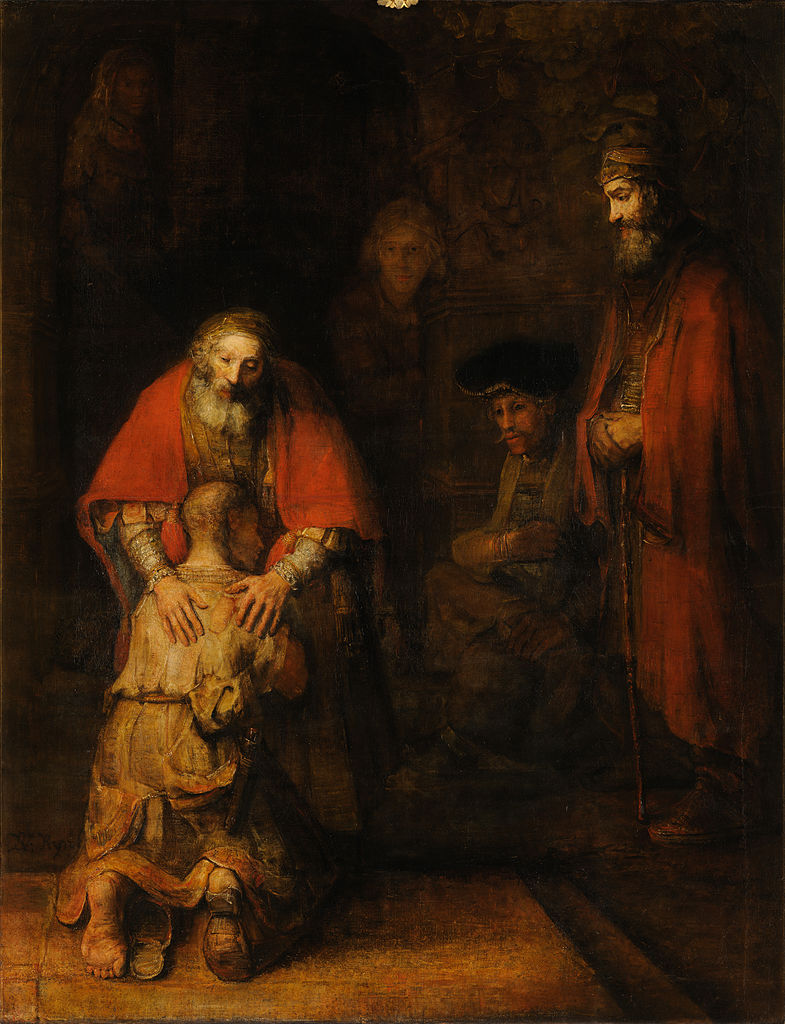
Rembrandt: the father embraces the son.

But indeed, he did catch his breath – because gracious sakes alive, a holy love will take the Savior’s breath away, no matter how much sin drips around the edges.

And drip it did. Drip and smear and suffocate, all over the Savior while he hung there on that gloriously death-drenched cross, holding us in his breathtaking embrace, hugging us from death to life.

Eugene Delacroix (c. 1845)

(I Peter 2)
He personally carried our sins – dripped and smeared all over his holy soul – in his body on the cross so that we can be dead to sin and live for what is right. And having carried them there, and nailing them there, and hanging them there on himself, he said IT IS FINISHED,

And then he breathed his last.

Because we really do take God’s breath away – that day, this day, every day.

About that letter to Christians in Indiana: in which I look deeper

A few days ago, Jesus penned a letter to all the Christians in Indiana and any others elsewhere who might be reading (which I think might have been code for All the Christians America, but that’s just a guess – he kept that a little vague).

I didn’t get the letter until today, which makes me wonder what’s wrong with my mail service. It was addressed to me, after all. I also wonder how many other important missives from Jesus I’ve missed. I thought I had them all, but now who knows?

If Jesus were here, I’d want ask him something – after first confessing all the ways I continue to fail him, each and every day, in spite of passionately loving him and desiring to follow him closely. I’m basically a schmuck. Layers and layers and layers of selfish, petty, blechness filling up my guts, just waiting for a chance to spill out all over the place.

It’s a real problem.

Thankfully, there is also the gracious breath of God nudging aside space to fill up layers and layers and layers of my soul, meaning there is hope each and every day for yet another layer of schmuckiness to get peeled away. At least that’s what I read in an earlier letter. Maybe that’s changed (as this letter seems to imply) and I missed the memo.

This is the thing I would ask Jesus, if I were looking him in the eyes:

Are we really, each and every one of us, as hopelessly and horribly debauched as all that? I know we are each a complete and total mess, especially deep, deep down in the most hidden places, broken beyond human reckoning. But has that beautifully redeemed collective brokenness really grown into nothing more than angry, combative, petty, arrogant, entitled, and unbreachable barriers between you and the world while leaving a legacy of only damage, pain, and isolation, like you said? If so, we might as well all call it quits now because I can only assume the Transforming Spirit of the living God has fled Indiana

If I were looking Jesus in the eyes, and he said such searingly difficult things of me, I wouldn’t say nay. He sees things inside I do not.  He might have even stronger things to say. But I know he wouldn’t give up on me. At least he never has in the past. I also know that he wouldn’t strip my identity and take delight in sweeping me and everyone else into a dust pan of shame.

I know there is much too much yapping, carping, nit-picking, and less-than-neighborly goings-on (not just in Indiana, by all account). I know that a good amount of all the yapping, carping, nit-picking, and less-than-neighborly rhetoric might be so much stinky hot air because many yappers and carpers don’t read the thing they are yapping and carping about – regardless of which angle their yapping and carping may take.

But I also know there are countless disciples and followers of Christ who are not primarily angry, combative, petty, and arrogant full-of-themself screamers whose sole accomplishment is to erect unbreachable barriers between the world and God Almighty.

I was in the presence of 50 tonight – young adults who joyfully and faithfully give up hours each week to share life with middle school and high school students, listening to their questions, attending their events, celebrating their uniqueness, and breaking down barriers.

They are reflecting Jesus to those around them. They are bringing salt and light to a bland and dark world. They are spreading the sweet aroma of Christ wherever they go. They are spilling over with the love of God and changing the world.

But their faithfulness is quiet. Their service is gentle. Their voices are soft. They do not scream and thrash about.

Instead, they follow Jesus, step by step, day by day, faithfully, humbly, joyfully. Even here in Indiana.

They, and countless others, feed the hungry, clothe the poor, comfort the broken, welcome the children, reverently serve and partake of the Eucharist, pass the peace with sincere warmth and concern, humbly refill the coffee pot again, engage in deeply personal conversations with those who are lonely. And so much more.

I know such things could and should happen to a greater degree – but still they are happening. Week after week, day after day, minute by minute, by people who aren’t waving placards or shouting platitudes or taking broad swipes but rather people who are intent on following Jesus as best they know how.

Admittedly, disciples of Christ make missteps along the way, sometimes serious ones. Our rhetoric sometimes fall short of gracious. Our actions sometimes fall short of kind. Our service sometimes falls short of humble.

But Jesus continues working in us, stirring our hearts towards his work, and drawing our souls deeper and further into his. He’s amazingly faithful that way.

Even in Indiana.


Copyright 2015 Crystal Kirgiss
The views and opinions expressed in this blog are those of the author and do not necessarily reflect any organization or institution she is affiliated with.

Expect Dragons (in which I leverage the lessons of certain dead British authors)

Sketch by J.R.R. Tolkien (The Art of The Hobbit)
Sketch by J.R.R. Tolkien from The Art of The Hobbit

**In my ongoing quest to leverage my love for dead British authors (whose writings continue to be long-lasting and meaningful) in the realm of life and ministry (which on occasion runs the risk of being short-lived and shallow), I have compiled:

Seven Principles for a Lasting and Meaningful Ministry, also applicable to Life and other Meaningful Endeavors, based on the writings of C.S. Lewis, J.R.R. Tolkien, Dorothy Sayers, and G.K. Chesterton, authors now long-dead but whose Devout Embrace of Christ lives still in various and sundry essays, tales, poems, letters, and diaries. MMXV.

PRINCIPLE #4: EXPECT DRAGONS

“As you like,” said Chrysophylax, licking his lips again, but pretending to close his eyes. He had a very wicked heart (as dragons all have), but not a very bold one (as is not unusual).
–from “Farmer Giles of Ham,” J.R.R. Tolkien

But perhaps if he had known something about dragons he would have been a little surprised at this dragon’s behaviour. Most of us know what we should expect to find in a dragon’s lair, but, as I said before, Eustace had read only the wrong books. They had a lot to say about exports and imports and governments and drains, but they were weak on dragons.
–from The Voyage of the Dawn Treader, C.S. Lewis

Fairy tales do not give the child his first idea of bogey. What fairy tales give the child is his first clear idea of the possible defeat of bogey. The baby has known the dragon intimately ever since he had an imagination. What the fairy tale provides for him is a St. George to kill the dragon.
–from “The Red Angel” in Tremendous Trifles, G.K Chesterton

Here be dragons to be slain, here be rich rewards to gain . . .
If we perish in the seeking . . . why, how small a thing is death!
–from “Desdichado” in Catholic Tales and Christian Songs, Dorothy Sayers

So, here’s the thing about dragons: they are hands down, entirely, thoroughly, exceptionally, and superlatively bad, wicked, evil, nasty, foul, no-good little stinkers. Period.

Except here. Except now.

Our sophisticatedly nuanced world offers us dragon riders, dragon trainers, and dragon fighter-pilots. Nothing against these tales or their authors (Naomi Novick’s series about draconian aerial warfare during the Napoleonic wars is supremely delightful), but this recent domestication of dragons portends something infinitely more perilous.

On the one hand, we fail (or refuse) to recognize dragons for what they really are, convinced that if we just handle them gently enough, feed them plenty of tasty bits, and cajole them with sweet songs, they will somehow cease to be dragons — as though we have the power and the wisdom to be undragoners.

On the other hand, having lost sight of real dragons, we now see dragons everywhere, squinting our eyes crooked-like and viewing things from inverted angles until – beware! – every kitten, tree, and cloud is branded a dragon — as though we have the capacity and the discernment to be dragonlords.

We surely do hate dragons . . . especially if they are of our own imagining.

We surely do love dragons . . . even if they threaten our very soul.

And by they, I meant it.

Sin. Self-enthronement. Me-centricity. I-fullness. God-emptiness.

It is a dangerous path we tread when we forget that Christ died because of dragons and instead focus our undivided attention on kittens, trees, or clouds, as though they endanger our very existence.

It is a perilous turn we take when we neither recognize nor admit the power of dragons, and instead head off into the forest with a knapsack of jelly sandwiches and a flapping paper shield, as though life were naught but a make-believe quest.

Dragons are. We ignore and forget this at the cost of our ministries and our lives.

But– Christ is. Christ will be. Christ forevermore. We live and minister within that brilliant truth, regardless of the cost.

Expect dragons, dear friends, and then prepare to willingly see them slain.

© Crystal Kirgiss 2015

On Millennials Leaving the Church (in which I consider the problem with talking about the problem)

Four years ago, David Kinnaman’s book You Lost Me: Why Young Christians Are Leaving Church…and Rethinking Faith was published. What followed, and follows still, is a steady stream of opinions about what has become The Single-Most Definitive Problem of Christendom. That is, countless people have offered any number of reasons (3, 5, 7, 11, 13) about why they (the Millennials) are leaving it (the church).**

Here’s the problem with our discussions and rants and musings about this issue: lumping such a large population of people (everyone born between 1980 and 2000) into a single demographic (The Millennials) essentially reduces all of them into a single it. One of the reasons some people claim Millennials are leaving the church is because it neither welcomes nor fosters a sense of meaningful unique identity. Surely if opiners lump-sum Millennials it is no less depersonalizing than if the church lump-sums Young Adults in the Pews (or chairs, or couches, or whatever).

In the same way, lumping such a large number of congregations (of every denomination and size) into a single entity (THE church, or the CHURCH, depending on who’s lumping) essentially reduces all of them into a single it. Some people claim Millennials are leaving the church in part because it too often paints with broad strokes, invoking simplistic generalizations and damning judgments about infinitely distinct things that are much too nuanced for such narrow pigeonholing. Surely if opiners lump-sum The Church it is no less broadstroked and simplistic than if the church lump-sums Sexual Sin and Being Really Mean (or lying, or cheating, or whatever).

There is an abundance of lump-summing all around. There is also an alarmingly confident presumption of guilt that has taken center stage as opposed to, oh I don’t know, humble dialogue. On both sides.

While it might be helpful for whoever it is that makes all the decisions for all the people to know why all the Millennials are leaving all the churches – which is how the opining is often framed – I think it might be more helpful, and far more important, to know why 24-year old Shane is leaving First Community Church because if in fact Shane is leaving that church then Shane already has left that church. It’s a done deal. It is not present progressive. It is present perfect. It is not theoretically general. It is specific.

I would suggest that “Shane has left First Community Church” is far more significant and worrisome than “Millennials are leaving the church.” Shane is a real person. First Community Church is a real congregation. Something real has happened. Mightn’t it be helpful, wise, and progressively Biblical for Shane and those of First Community Church to talk about this?

I fear that we have so lump-summed the larger demographic and the larger institution that we have lost sight of individual souls and particular congregations, which means we have also bypassed any hope of specific resolutions.

It is easy to have an opinion about Why All the People Are Leaving All the Churches. One can comfortably opine and diagnose from a distance. It carries no responsibility, no investment, no humility, and no commitment – on either side.

But when it is Shane and he has left a specific church, the time for opinions and judgments is past, regardless of whether Shane is 13 or 25 or 39 or 54 or 71 and regardless of whether First Community Church is big or small, mainline or non-denominational, pewed or chaired, sanctuaried or auditoriumed, hymned or chorused, organed or guitared.

If your own church preaches a gospel other than Jesus Christ, that is reason to leave.

If your own church boldly exhorts people to gossip, lie and steal, that is reason to leave.

If your own church condemns people for loving their neighbor, that is reason to leave.

If your own church encourages you to serve your own desires before all else, that is reason to leave.

If your own church sometimes struggles to balance love and exhortation, sometimes fails at demonstrating unconditional compassion, sometimes tries too hard to please everyone because it forgets that the gospel is offensive, sometimes offends because it forgets that the gospel is love incarnate, sometimes falls short of being all that we want and expect it to be, sometimes disappoints because it is so very, very far from perfection – then before leaving, might it not be worth first asking, “How can I be part of helping my church better express and demonstrate its true mission and identity?”

The church is not perfect. Neither are Millennials – or the middle-aged, or retirees, or children, or clergy – which isn’t an excuse, but is important to keep in mind. Really, it’s a miracle beyond measure that the church – both collective and specific – manages to limp along at all. That anyone stays and sinks deep roots into a community of quirky, distinct, unpleasant, incorrigible, narrow-minded, irritating, enchanting, engaging, off-putting, and wholly undeserving humans is more miraculous yet.

But that is the gloriously difficult joy into which we are all called.

The collective Church is here to stay. The embodied church of congregants is here to stay.

So I have questions, not about the “problem” of Millennials leaving the church but about the problems with how we talk about the problem.

If (some) Millenials are leaving the church for profoundly insightful and authentically heartfelt reasons, shouldn’t we also ask for what profoundly insightful and authentically heartfelt reasons some other people are staying? Or do we assume that those who stay are merely too stupid to recognize and too unsophisticated to acknowledge the weaknesses and faults inherent in every congregation?

Why do we talk of people leaving the church – a broadly general signifier that can be vaguely and theoretically applied by both the leavers and the stayers? Why don’t we talk of people leaving a congregation (that is, other people) – a specific signifier that requires both the leavers and the stayers to engage in honest self-evaluation and gracious other-centeredness?

Why do we so reduce and restrict our analysis of the situation to “the church always” or “the church never” or “the church did” or “the church didn’t”?

Do we care enough about both the people who leave and the congregations from which they leave to go deeper than “you should” and “you shouldn’t” so that we might build a sacred space of mutual humility, trust, and love?

After four years of frantic angst and strident rhetoric, do we really want meaningful dialogue between Millennials (both those who stay and those who leave) and congregations (both those that are imperfect and those that are even more imperfect), knowing this will necessarily require difficult self-assessment on both sides? Or do we just want to keep wallowing, bemoaning, and wringing our collective hands in pathetically gleeful misery?

After four years of Millennial-centric discourse, has the embodied church failed to carefully notice and intentionally know distinct individuals of other age groups?

I believe the current crisis of the church is real – but the church is always in some state of crisis. It is the nature of being broken yet redeemed humanity living in the tension of the now and not yet.

Unless we decide to move past talking about the situation in generalities and determine to talk with real people in real churches about our mutual commitment to the broken, struggling, fragile, imperfect, precious embodied church, we all run a very real risk of betraying our costly redemption, no matter how much we each blather to the contrary.


**[Here is where I should include lots of links to the best, worst, most popular, most debated, and most egregiously pompous posts about this subject. But there are simply too many of every category. And since most people have probably already read at least one or two or seventeen or forty-three of those posts, I’m foregoing the standard list of Really Important Links You Absolutely Must Read. I sometimes wonder whether if we all read fewer up-to-the-minute posts about Pressing Problems and more old books about Theological Truth we might not all be better off. In that spirit, I include this link to C. S. Lewis’s introduction to De Incarnatione Verbi Dei, thereby fulfilling my blogging obligation.]


Listen! (in which I consider the Shema; or Love, Learn, Live)

Deuteronomy 6:4 (Westminster Leningrad Codex)

Shema yisrael Adonai eloheinu Adonai echad.

Hear, O Israel, the LORD is our God; the LORD is One.

Last night we gathered, the girls and I, first around the table (which is where the best fellowship and most sacred moments happen, even if the table is a kitchen island and the meal is waffles), and then around each other:

sprawled on the couch, the chairs, the floor;
settled under blankets of woven wool, quilted blocks, sweatshirt material;
surrounded by Bibles, journals, pens, markers, paper, all manner of glorious things.

And we read Deuteronomy 6:4-9.

Just six verses.

Just one hundred words.

A lifetime of truth and wisdom and grace and exhortation.

We read it, listed it, drew it, sorted it, organized it, prayed it, considered it, breathed it.

And then summed it up thus:

Hey! Listen!
All of me must
LOVE all of God and
LEARN all of his word and
LIVE all of his truth and love
in all the ways
in all the places
at all the times.

It was a very, very good night.