Exactly one year ago, things changed at Purdue University. Today, I wonder just how lasting that change really was. Do people still remember? Do they still mourn? Does the shocking reality of what happened on January 21, 2014 still run as high, long, wide, and deep as it did in those first days? For a few, no doubt yes. For most, assuredly no. The daily realities of life have settled into the space where the shock once was. That’s to be expected. Else how would life carry on?
But there is one reality that must not be forgotten – one reality that can begin to make sense of last year’s pain – one reality running so much higher and longer and wider and deeper than any other that we dare not forget it. (The following post was first published January 21, 2014.)
Purdue Memorial Mall, 1-21-2014 (Photo: CKirgiss)
It was sunny today at Purdue. Sunny and snowy. Sunny and snowy and freezing. Sunny and snowy and freezing and beautiful. Which is to say, it was a day pretty much like every other wintry day on campus the past two weeks.
Except that it wasn’t.
At 11:00 a.m. when I walked across Memorial Mall, I was struck by the peaceful stillness. By some footprints in the snow. By a brilliant sky. By the hushed atmosphere. Even on this typically busy, bustling day at a Big 10 campus, there was a measurable sense of calm and comfort. Things were much as they should be.
Except that they weren’t.
At noon when I walked back across Memorial Mall, nothing had changed. Not visibly, anyway. There were the footprints. There was the brilliant sky. There was the hushed atmosphere. There was the sense of peaceful stillness amidst the busy, bustling crowd.
And then, ripping through the stillness, slashing through the peace, there was an emergency siren. Screeching. Wailing. Shrieking. On and on and on and on. And the unexpected text message: “Shooting reported on campus. Bldg Electrical Engineering; Avoid area; Shelter in place.”
What place is this? Where am I? Have I stepped into another time and place? Because, you see, these things do not happen here. In other places, perhaps. But not here.
Except when they do.
It has been a devastating day. Someone’s son has died. Someone else’s son has killed. Both families are forever changed. It is one more bitter reminder that we live in a very broken world (all of it), among very broken people (all of us).
That’s right – all of us. We are all broken. Entirely, very, thoroughly, quite broken. That truth manifests itself in different ways, to different degrees, and not just in the midst of tragedy. It is a truth easier to ignore than acknowledge, easier to deny than accept, easier to protest than admit. Nonetheless, we are all – each and every one of us – in need of a Savior who loves, forgives, and transforms broken people.
Which he does.
The sun shone brightly today on a very dark and desperate place. Can you see it there, powerful and radiant?
Both lights – sun by day and candle by night – are glorious, comforting, indescribably beautiful.
But they are nothing – absolutely nothing – when compared to the one light that really matters, the one light that is truth, the one light that is life, the one light that is love, the one light that is hope, the one light that saves.
“I am the light of the world.” The light shines in the darkness, and the darkness has not – and will not ever – overcome it.
Oh, sweet Jesus – we need your love, your compassion, your grace, your humility. Mostly, we need You. Each and every day. Today (and every other day, in truth) is a fresh reminder of this.
[My continued thoughts, written on the third day – January 23, 2014 – are here.]
Exactly 21 years ago today, at 12:34 in the afternoon, Alisa Ruth arrived on the scene two weeks before anyone expected her, the first-born child of my sister and her husband. With her first breath, she officially gave me the title of aunt, which is a wondrous title indeed.
From 600 miles away, I got the joyful phone call from my brother-in-law. “She’s here! She’s lovely! She’s wondrous! She’s a miracle!” I talked to my sister for just a few minutes. Already she was in the rocking chair, nursing her firstborn.
600 miles feels like from here to the moon when it separates you from your sister and your newly arrived niece. I wrote in my journal:
My sister is a mother. Her husband is a father. I am an aunt. A new baby IS! We celebrate!
What is it about new life that is so entirely overwhelming? So utterly breathtaking? So infinitely miraculous? Technically, it’s just another person, on a smaller and less-advanced scale, that for at least a few moments is quite wrinkled, crinkled, slimy, mewling, and flailingly awkward. Anyone who has either given birth or been present at a birth knows this to be true; true but of no consequence because a child lives; breathes; is.
Newborns are my spiritual grounding point. If ever there are doubts about God’s existence or questions about God’s presence or confusion about God’s power or worries about God’s providence, there is this to fall back on: new life; babes; the first breath of being.
For all of our human progress and advancement and development, we cannot create new life; we cannot knit together a new soul; we cannot bestow the breath of being. Ever. This is definitely not of our own making. This is certainly not of nothing’s making. This is of God’s making.
And so in my family that day, there was joy. Rivers and oceans of joy. Mountains and moonscapes of joy. Joy overflowing the dancing shores of our collective selves.
But less than two hours after her first breath, I answered the phone again, and this time instead of uncontained joy, I heard inconsolable grief – sobbing, speechless, overwhelming grief.
Trisomy 21. Down’s Syndrome. Heart condition. These words, and others I don’t remember, spilled out from rivers and oceans of grief, mountains and moonscapes of fear, despair overwhelming the battered shores of first-time parents. Already, nurses were gently lifting Alisa Ruth out from her mother’s arms, towards a NICU that would be her home for the next several weeks.
600 miles feels like from here to eternity when it separates you from your sister and your newly arrived niece who is unexpectedly more beloved and precious than she was just moments ago.
They told me that my sister sobbed; that my brother-in-law went blank. I know that the tears and the emptiness, at their very core, were not primarily about Trisomy 21 and Down’s Syndrome as much as they were about having held and adored their daughter for what must have seemed like mere seconds before she was whisked away, out the room, down a hall, into a Unit.
From 600 miles away, I wrote in my journal:
In a split second, all has changed. Alisa Ruth of K-12, senior prom, marriage, motherhood is gone. But Alisa Ruth herselfis still here – a miracle indeed.
Those first few days were a painful muddle for me – the aunt, 600 miles away. For my sister and her husband…I cannot imagine. So many painful questions. So many difficult decisions. So many things to learn. So much responsibility to shoulder.
Alisa’s heart – the physical one – was not healthy. She needed surgery soon, and would need more as she grew. But other than that, she was a wonder. In a NICU filled with dangerously premature underdeveloped children, she looked misplaced, so big and strong was she. When I held her in my arms the first time – 600 miles are but a small skip when a niece awaits – she took my breath away. Fearfully and wonderfully made she absolutely was.
As so often happens when difficulty explodes into the very center of life, neighbors brought food. Friends ran errands. Relatives wrapped strength and hope and joy around the family-now-of-three. Hope settled over the land of home-and-work-and-hospital, hope that spilled directly from the fount of Christ’s love.
At one week old, Alisa had heart surgery that went very well. The doctor was confident and reassuring.
At two weeks old, she was recovering and gaining strength.
At three weeks old, things took a sharp turn.
At three-and-a-half weeks old, I wrote:
Things are critical. Meningitis. Pneumonia. Collapsed lung. Heart recovery. More. Very little is going right in her body. My sister – whose perspective is shockingly clear – said, “I can handle the Down Syndrome and the heart problems. That’s how she came to us. It’s all this other stuff I can’t handle.”
“That’s how she came to us.” Meaning, “That is my child. That is my flesh. That is my love. That is my Alisa – just as she is.”
Sometime during those very difficult days, someone said to my brother-in-law: “But didn’t you know she had Down Syndrome beforehand?” implying (even just writing these words makes my soul rage) that if they’d known beforehand they could have done something about it beforehand and avoided all this pain and heartache.
Silence, you! Do. Not. Speak. Be silent! BE SILENT! You speak the words of a fool!
Avoiding pain and heartache is not the point. Avoiding pain and heartache is less than living. Avoiding pain and heartache is for people who run from all that matters. Life is pain and heartache. Love is pain and heartache. Joy is pain and heartache. The cross is pain and heartache. How dare anyone suggest that avoiding pain and heartache is worth the price of a life.
Did God plan this? Allow this? Will this? I do not know. Is He here? Watching? Caring? Holding tightly? I do know – yes. Always yes.
At four weeks old, Alisa was still fighting with all the strength and courage she had. Valiantly. Bravely. The nurses said so. My sister told me so. I know it is so. I do not doubt that in every breath she took, the Spirit’s strength poured through her soul.
At four weeks old and a day, after fighting as hard as she could, Alisa’s strength was gone. She breathed her last breath in her parents’ arms, right where she belonged.
I was not there, but I have watched that moment many times over in my mind. I see my sister and her husband more broken than I can imagine, but also more firmly held in the arms of God than I can comprehend.
Just a few years ago, my sister said to me, “Yesterday was the first time I didn’t think about her at least once.” I was stunned. How could I not have known that even after 10, 12, 15, 17 years, her first child still fills her heart?
Just last year, my brother-in-law said, “After 20 years, it still hurts, but it stings less.” I was silenced. How could I not have known that even after 10, 12, 15, 17, 20 years, his first child’s short life was still very real?
Just as importantly, he also said this:
God is good.
A mother’s love is extraordinary.
“No” is an answer.
It’s okay to scream at God. He can take it.
Tell your children “I love you” every chance you get, even if you aren’t feeling it.
Mother’s Day and Father’s Day can be very cruel holidays.
To some people, a crying baby on a plane or in a restaurant can sound like a symphony instead of an annoyance
If a friend is going through something tough, don’t ask what you can do. Just pick something and do it.
Family and friends are important. They’ll be there when you need them. Keep those relationships healthy.
Dwell on the positive. Dwelling on the negative just sets you up for more negative.
I wholeheartedly agree with what Asaph said in Psalm 73:28.*
I can’t choose what circumstances come along in life, but I can choose how I will respond to them.
God is good.
Today is Alisa Ruth’s birthday. She would have been 21. She would have been a wonder. She was a wonder. By God’s infinite love and grace, she is a wonder. I celebrate you, sweet niece, over and over and over again.
Alisa Ruth.
*But as for me, how good it is to be near God!
I have made the Sovereign Lord my shelter,
and I will tell everyone about the wonderful things you do.”
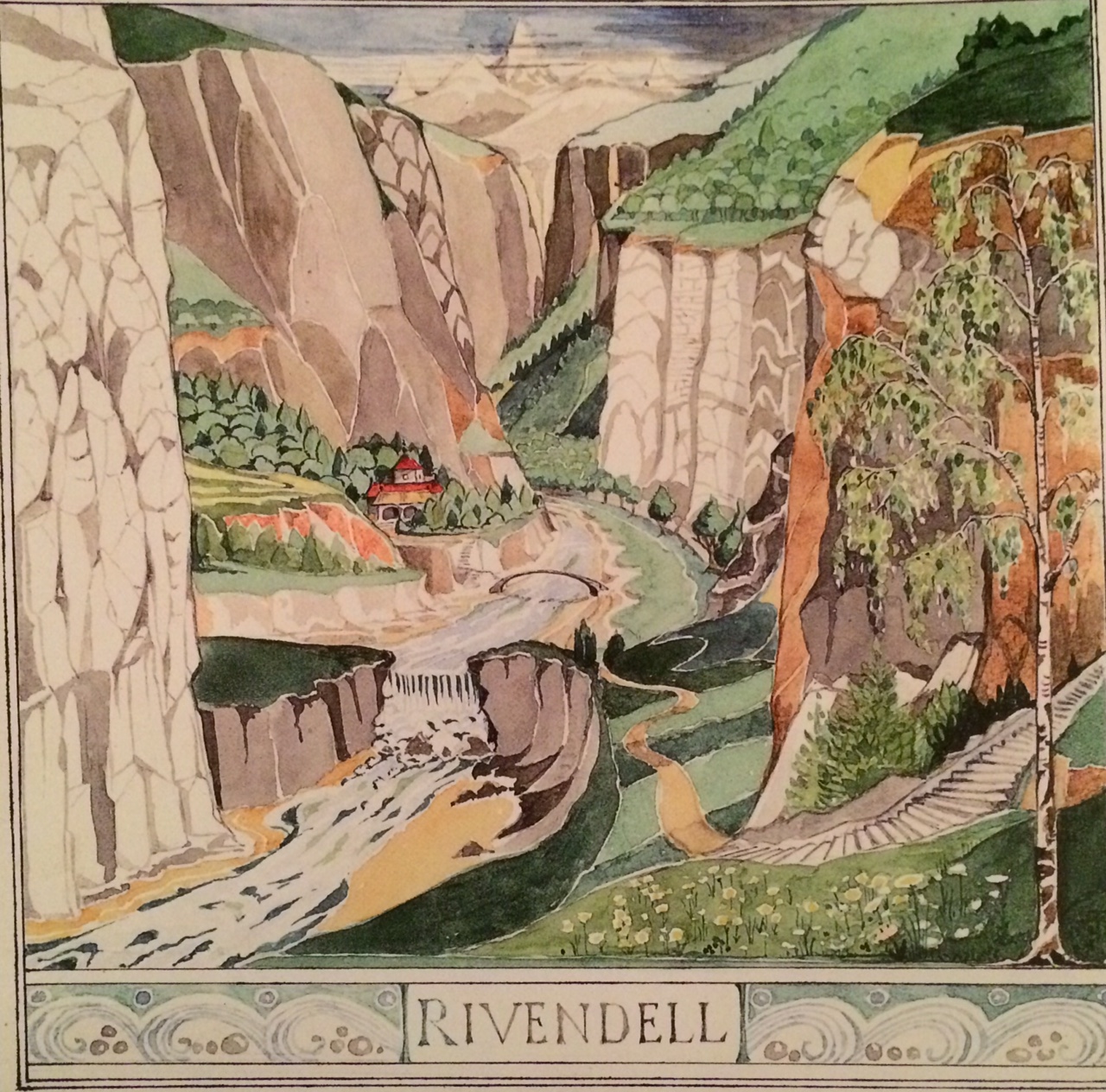
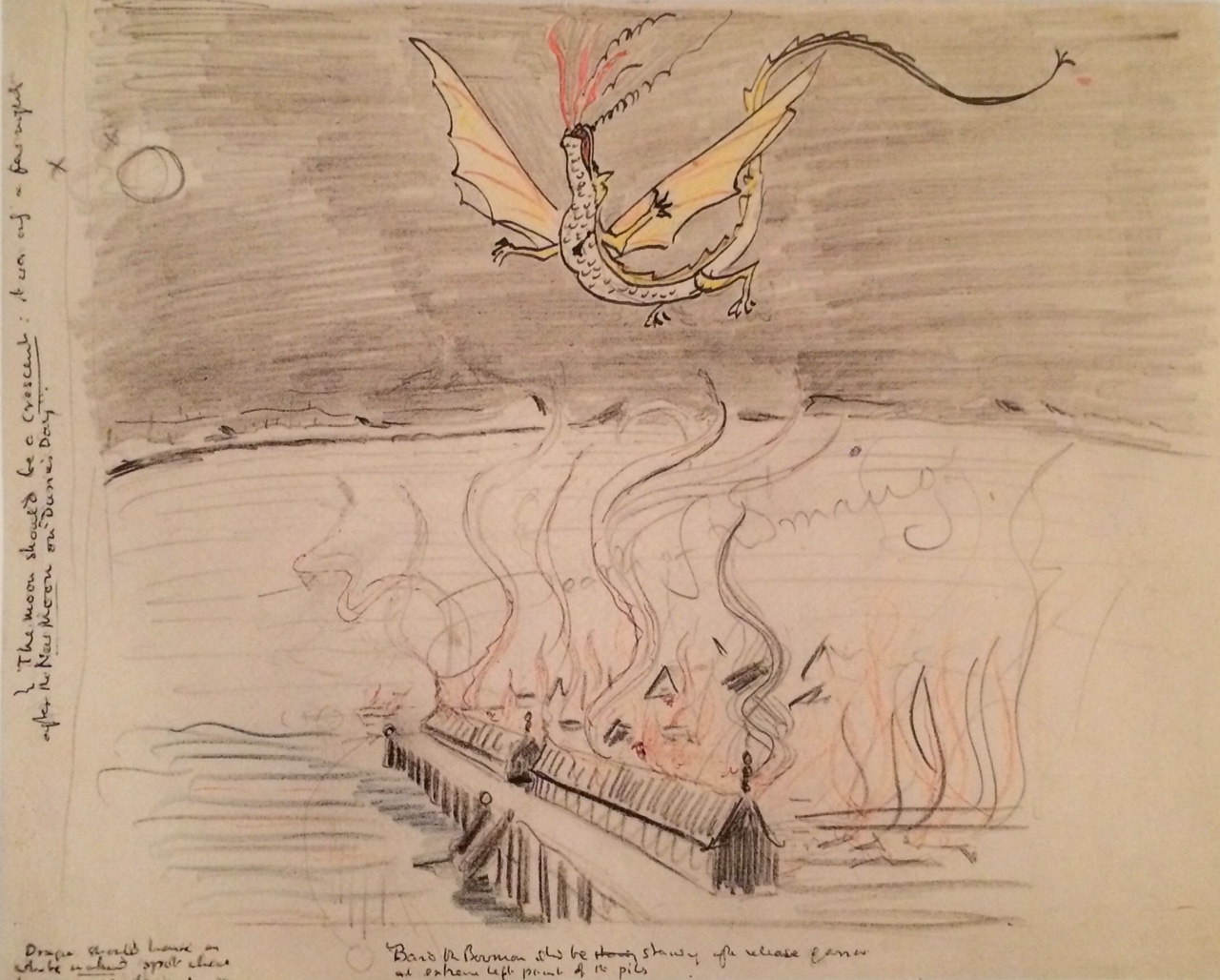
JRRT – “The Hill: Hobbiton-across-the Water”JRRT “Rivendell”JRRT “Bilbo comes to the Huts of the Raft-elves”JRRT “Conversation with Smaug”JRRT “Death of Smaug”
(All images from The Art of The Hobbit by J.R.R. Tolkien, 2012)
Two winters ago I (along with millions of others) planted myself in a movie theater to watch the first installment of Peter Jackson’s The Hobbit trilogy. For several years, I’d included the book on my English syllabus (Purdue University). My students – many of whom had never read the book previously (or even heard of it – how is that possible??) responded to the story in various ways. [Note 1: my rather old-fashioned pedagogy requires students to arrive at class with a comment, question, or discussion starter – based on that day’s reading – written on a 3 x 5 card. In cursive, preferably. Extra points for using a fountain pen.] [Note 2: I’m not big on deconstructing a text to death and then discoursing in a lofty and snooty and philosophical manner about things that are killed by loft and snoot and philosophizing. I’m big on reading – carefully, enthusiastically, intentionally, thoughtfully, and joyfully – and letting a book be what it is, not what I or some dead French philosopher says it should be. But that’s just me.]
Last week, I stumbled across some of those old-fashioned 3×5 cards in an old-fashioned file drawer and enjoyed a few moments of old-fashioned reminiscing.
“I wish Bilbo and gang wouldn’t act so irrationally. Just do as you’re told!”
“I’ve gotten so attached to the dwarves and Bilbo that I may have shed a tear when Bilbo was saying goodbye. Is that normal?? I can’t believe I teared up over dwarves and a hobbit. They’ve changed me.”
“I wish Tolkien could read The Hobbit to me before bed every night.”
“STAY ON THE PATH!!!”
“I got so upset when they wandered off in the woods that I literally threw the book and didn’t pick it up again for several days. Why, Tolkien, why??”
“These dwarves have taken a terrible beating so far. Between giants, spiders, and being locked in barrels, they deserve a break – and TREASURE!”
“As terrible and disgusting as he is, I always just want to give Gollum a hug.”
“Why do the ponies always have to die??”
Who knew that 3×5 cards could be so enjoyable and that college students could be so endearing? But then, this:
“I really wish that Fili and Kili didn’t have to die. And this is going to be such a sweet movie.”
This, from an A+ student, who really loved the book and really can’t be blamed for having such high cinematic hopes.
But the movie wasn’t “sweet” – regardless of how you define the word – and not because it diverged from the written narrative extensively (which it did) but because in making it, Peter Jackson did that which an adult should never ever do: he stole from a child. From all children, actually.
While sitting in that theater two winters ago, I soon gave up on jotting down all the ways the cinematic experience strayed from the textual (and authoritative) narrative and instead got out my phone (yep – I was that person) and started frantically texting all my Tolkien-loving friends who were planning to take their kids to the movie that night, because, you know, children’s book, duh.
My text: Leave the children at home! Really! Truly! Just do it!
I fumed as I typed because, well, this was not a children’s movie. (And yet people brought their children anyway. What is wrong with people?) And if children couldn’t (or shouldn’t) go to see The Hobbit, then what was the point? (Besides the money, that is.)
Not surprisingly, I skipped installments two and three because, as my students rightly observed, The Hobbit is a story that should be read to children – or by children – at night. And also adults. Of course. Indeed. And though readers of all ages should rightly shudder at the thought of goblins (pony-eating horrors that they are) and Smaug (gentle and tame dragons are a freak of postmodernism) and Wargs (blerrgggh), we should still be able to sleep peacefully because the book is ultimately joyful and entirely eucatastrophic* in a way that honors all readers, and especially the children.
The movie – not so much.
“I hope the movie gives off the same happiness that the book does,” wrote one of my students on his 3×5 card just a month before the release date.
Um, no. It does not. Not in part one. I suspect not in part two. And definitely not in part three where two-plus hours of a large-screen brutally vivid battle does not do justice to Tolkien’s genius of appropriately describing for children, on just a few pages,** the Battle of Five Armies – “and it was very terrible.” (Chapter XVII) Based on reviews I’ve read, neither does it do justice to Tolkien’s genius of narrative construction, which is just so very sad.
I’m a firm believe that the book – any book – is always better than the movie, just because (which isn’t to say that movies aren’t ever good or wonderful or brilliant or delightful.)
But when the movie exists in its present form only by way of being rudely, violently, and quite childishly wrested away from its intended audience – an audience that gives the story its very essence – then things have gone too far. They have perhaps gone there, but then failed to come back again.
Please, please, please – stop it, stealers. Really. Truly. Just write your own stories.
If you dare.
If you can.
*Read Tolkien’s essay “On Fairy Stories.” Now. Really. Truly. Just do it.
**I recently read this comment in an online forum: Did Fili and Kili die in the book, too? They are by far the greatest characters in the movie, yet I don’t have the heart to read the book since it is to[sic] long.
Grrrr.
You could read the entire book, cover-to-cover, in less time than it takes to watch the entire movie conglomerate, credit-to-credit. Really. Truly. Just read it, already.
I suspect that God’s view of such things as injustice, hatred, war, murder, dishonesty, lying, greed, pride, bitterness, anger, gossip, selfishness, abuse, stealing, and vengeance are not of a single kind or degree.
I believe that his reactions to the vast range of shortcomings and sins of humanity cover an equally vast range of disgust, wrath, disappointment, grief, sorrow, regret, and mourning.
Certainly this week there has been plenty for Him to mourn, plenty for Him to decry, plenty for Him to denounce, and plenty for Him to reject. On all sides.
I know for certain that each and every one of us, if we dig deep enough, has done things, said things, and thought things that do not reflect the image of God in even the smallest degree or measure.
And yet, against all odds and in spite of all our manifold undeservedness, He loves humanity and ushers in redemption for all who would claim it. And though His views and reactions to our individual and communal sins may be broad, the cost to forgive them is the same: a Single Life, sacrificed willingly and completely, bearing the weight of an entire world’s less-than-image-of-God-ness.
It seems as though there are a thousand reasons to not be grateful today, a thousand reasons to question humanity’s soul, a thousand reasons to selfishly ask where God is in the midst of sorrow and pain, and a thousand reasons to begrudge others, whether for their fortunes or their foolishness.
But those thousands upon thousands upon thousands of reasons crumble away into less than dust when held up against this single reason to give thanks: we are beloved by God Almighty, offered new life – real life, embraced with the powerfully just and gentle arms of Abba, Father.
And oh, sweet Jesus, how much we need Your love and life and grace.
For this one thing – this single, immeasurable, infinite, boundless, incomprehensible (and entirely undeserved) gift, we give thanks. Thanks upon thanks upon thanks.
Side by side is where I found these two November leaves late last night, prone on the pavement, fully dead, yet clinging to something – anything – resembling life, the one by reflecting brilliant colors (as brilliant as night light allows) and the other by bedding down the new-fallen snow, giving it a place to last, to live, to remain for just a few minutes more.
They are the flip side of life and death, one holding out for its own last few breaths, the other holding up another’s first few breaths.
They are poignantly beautiful. They are powerfully sublime. Yes – those two tiny dead leaves made me feel small (a smallness that is divinely reassuring) in the way only nature can. They read my heart and they whispered the words written there: “You are loved, whether exposed to the bitter cold air, whether feebly attempting to cling to one last breath, whether bravely trying to help another hold on just a little longer, whether lying all alone on an endless pavement, whether clinging to another for comfort and companionship and hope, whether looking ahead with hope or looking around with caution, whether courageous or afraid. You are truly loved, by the God who created all that is.”
Sometimes nature does that – reads our souls and reflects the words back to us, reminding us of what is true.
And sometimes nature – being born of the hand of God – gets it right, which is a lovely, moving, and sacred event. But other times nature – being viewed through the eyes of a weak and broken being – gets it wrong. Not intentionally, of course. But wrong, nonetheless.
Being read by nature often makes my spirit leap with something resembling joy.
Being read by the Creator of nature makes my spirit soar – with joy, remorse, adoration, hope, contrition, love.
Trust in the LORD (are you trusting in someone else? in something else?)
with all your heart (how much of your heart is Mine – deeply and truly Mine?).
Don’t depend on your own understanding (the way that you so often do).
Seek his will (not yours, not someone else’s – just Mine)
in all you do (all things, all the time…all…it’s a powerfully big word, ‘all’ is)
and he will show you (are you looking? are you listening? are you watching?)
which path to take (because gracious, child, I know how many paths beckon.)
Being read by truth aches. Soothes. Exposes. Reveals. Comforts. Corrects. Breaks me apart into tiny, jagged pieces. Stitches me back together with loving grace and joy.
Read the true words of God and be filled with them.
Be read by the true words of God and be enlivened by them.
For those who live there and know the people, the greatest tragedy of last Friday’s school shooting in Marysville, Washington is that there was a shooting at all; that people died; that parents are aching for their children; that teens are weeping for their friends; that a community is reeling with questions; that a place once thought safe and secure has been ripped open, exposed, and rattled to its inner core.
For everyone else, the greatest tragedy of last Friday’s school shooting in Marysville, Washington is that it has already become last week’s news; that we have moved on to the next shocking and shattering event; that the names and details have started becoming vague; that we have become so accustomed to hearing about such things that they are identified by place rather than by people – Columbine, Virginia Tech, Marysville.
As onlookers, our inherent tendency is to gawk, then move on. It is how we cope. It is how we survive. It is how we avoid having to make sense of a world that is very, very broken – not just over there, where a tragedy took place, but also right here, in our own hearts and souls. For we have all hated. We have all been angry. We have all been frustrated. We have all felt helpless. We have all felt hopeless. We have all hidden the way things really are, down there in the depths of our selves.
In other words, we are all capable of doing unspeakable things. It is the human condition. It is the truth of who we are, deep down inside, where dark things that should be thoroughly routed and ripped out are instead left to rot and fester or even take root, luring us to tend and care for them with all due diligence.
Someone from Marysville – someone who is understandably grasping for hope and grace and light from a place of desperation and despair – said of the healing process, “We just have to reach for that human spirit right now.” Which sounds lovely and hopeful and true.
But isn’t.
Unless the human spirit (selfish and proud and greedy and false) is infused with the Spirit of God (loving and humble and giving and true) there is nothing in it worth reaching for. The reality of the human spirit in its natural state is undeniable. The world screams its reality every day, providing irrefutable evidence for sin and evil.
And yet we also see glimpses of goodness – moments of undeniable grace and love pouring out from hearts in the worst of circumstances, unexpectedly reflecting the light of Christ in the shattering darkness. Those glimpses of grace do not emanate only from people who follow Jesus. And people who follow Jesus do not always reflect the light of Christ. The reality of the world and our hearts is not so easily pigeonholed into neat categories of behavior and belief.
Still, I know this to be true. The only true and lasting hope in life will never be found by reaching for the human spirit. It will only be found in seeking and surrendering to the one true God who – miracle of miracles! – deeply loves and freely redeems a world of undeserving people.
We are all the least deserving of such grace. And yet we are all showered with it, daily, infinitely, thoroughly.
I don’t know how to rightly remember the tragedy of Marysville. I don’t know how to carry all the pain and suffering and horror of this world. I don’t know how to honor the victims. I don’t know how to encourage the survivors. These things are far beyond my wisdom and comprehension.
I only know this: hope and healing are found only in Christ – perhaps not quickly (especially in the deaths of children), and maybe not fully (in the now, that is, but absolutely in the not yet). But assuredly, they are found there. And only there.
Marysville has tasted the bitterest of sorrows. We should all ache for the communal loss of life. We should also all look deep inside ourselves, not to find answers, but to face truth.
Come, Lord Jesus – for we need you more than we know.
[From an address Sayers gave in February, 1942 (“The Creative Mind” in Unpopular Opinions: Twenty-One Essays, Dorothy L. Sayers. Gollancz Ltd., 1946. p. 57). These words are as true now as then, but even more pressing because of how immediately and how widely words are today cast out into the world.]
“It is as dangerous for people unaccustomed to handling words and unacquainted with their technique to tinker about with these heavily-charged nuclei of emotional power as it would be for me to burst into a laboratory and play about with a powerful electro-magnet or other machine highly charged with electrical force. By my clumsy and ignorant handling, I should probably, at the very least, contrive to damage either the machine or myself; at the worst I might blow up the whole place. Similarly the irresponsible use of highly-electric words is very strongly to be deprecated.
“At the present time we have a population that is literate, in the sense that everybody is able to read and write; but, owing to the emphasis placed on scientific and technical training at the expense of the humanities, very few of our people have been taught to understand and handle language as an instrument of power. This means that, in this country alone, forty million innocents or thereabouts are wandering inquisitively about the laboratory, enthusiastically pulling handles and pushing buttons, thereby releasing uncontrollable currents of electric speech, with results that astonish themselves and the world. Nothing is more intoxicating than a sense of power: the demagogue who can sway crowds, the journalist who can push up the sales of his paper to the two-million mark, the playwright who can plunge an audience into an orgy of facile emotion, the parliamentary candidate who is carried to the top of the poll on a flood of meaningless rhetoric, the ranting preacher, the advertising salesman of material or spiritual commodities, are all playing perilously and irresponsibly with the power of words, and are equally dangerous whether they are cynically unscrupulous or (as frequently happens) have fallen under the spell of their own eloquence and become the victims of their own propaganda.”
Lord, help us all – especially those of us whose vocations are language-centric – be mightily careful of the work we do, never forgetting the power and import (and sacredness, for did you not speak the universe into existence?) of the tools we wield.
I wrote these words 13 years ago but could have written them yesterday – not just about the events of that day (because the events of that day are repeated over and over and over again throughout history, in a thousand places and in a thousand ways) but about all of life when it is lived outside of God’s immeasurable, forgiving, majestic, jealous love. (And please do silence your outcry regarding God’s jealousy, for it is not humanly petty. It is gloriously divine. It is for us – all of each one of us – and nothing could be more breathtakingly astounding.)
Some say that 9/11 forever changed our world. God says that today (and every day) He will forever change me. I choose the second.
______
Regarding September 11…
I have a thousand questions I want answered.
I have a thousand fears I want quelled.
I have a thousand thoughts I want sorted out.
I have a thousand concerns I want soothed.
I have a thousand things I want changed.
I have a thousand people I want saved.
I have a thousand places I want seen.
I have a thousand songs I want sung.
I have a thousand steps I want walked.
I have a thousand prayers I want uttered.
I have a thousand bridges I want crossed.
I have a thousand roads I want traveled.
I have a thousand books I want read.
I have a thousand poems I want whispered.
I have a thousand birds I want freed.
I have a thousand trees I want honored.
I have a thousand skies I want admired.
I have a thousand oceans I want remembered.
I have a thousand eyes I want dried.
I have a thousand ears I want opened.
I have a thousand voices I want heard.
I have a thousand wrongs I want forgiven.
I have a thousand mountains I want climbed.
I have a thousand stars I want named.
I have a thousand lives I want lived.
I have a thousand fields I want sown.
I have a thousand rivers I want blessed.
I have a thousand children I want born.
I have a thousand sorrows I want healed.
I have a thousand days I want begun.
I have a thousand years I want danced.
I have a thousand clouds I want explored.
But I have only one God, who is true from the highest heights to the lowest depths, from the farthest east to the farthest west, and from the beginning of always to the end of never.
The god for whom people were willing to die last Tuesday is no god at all.
The true God does not say, “Die for me.” He says, “I’ve died for you – though you did not deserve it.”
The true God does not say, “Hate others.” He says, “Love others – as much as you love yourself.”
The true God does not say, “Crucify the enemy.” He says, “Crucify your heart – so I can create in you a new one.”
Would that the entire world could live in the contented peace of such simple truth as this.
For three days now – while in Iraq people huddle on a mountaintop in fear; while in West Africa people shudder at the widespread atrocities of disease; while in Gaza people hold their breath for fear a tenuous truce will shatter; while in St. Louis confusion, anger, and unrest reign; while in Venezuala doctors and patients fear gunmen as much as illness; while in New York two young girls are suddenly missing from a roadside; while in Ukraine the weight of power tips precariously on its axis; while in every corner of the world there is measurable suffering and sadness, wickedness and worry – the death of Robin Williams has loomed large.
The death of any single human being should indeed loom large. Death – like so many other things in life – reminds us how very broken and ill this world actually is.
But I do wonder why this particular death has loomed so large for so long, three days being a virtual lifetime in the technological universe. Certainly others have died under similar circumstances, have waged similar battles, and have enjoyed similar degrees of friendship and fame.
(Which is not to say that this particular death is any less real or poignant or significant because it has a certain degree of similarity to any other. Indeed the world becomes a more broken place than it already is when we overlook even a single death. But alas, when deaths are “similar” in whatever degree – 6 millions deaths in that genocidal war, 3000 deaths in that coup, 400 deaths from that disease, 6 deaths in that crime spree – we tend to overlook the individual for the masses, to our own dehumanizing detriment.)
In a world filled with tenuous truces, devastating disease, atrocious hatred, unspeakable crime, and unstoppable war, we especially mourn the loss of someone who was able to make us laugh. Really, truly laugh. Belly-roar laugh. Gut-bust laugh. Understandably, we love someone who can make us happy (with generous portions of brilliant antics) and in a world that makes us sick (with heaping platters of putrid sorrow).
Yes: we are all sad to lose a man who brought so much laughter to the world. And while many have aired their opinions about mental illness and depression and addiction and suicide, we would all do well to remember that not a single one of us really knows how Robin Williams may have suffered deep in his mind or what Robin Williams may have believed deep in his soul. None of us. Not even those who live with and fight similar battles every day. Judgmental lecturing in response to judgmental lecturing is equally empty of grace.
We are a people who love to know things – everything – which might be a grim reminder of how the world went wrong in the first place. So for three days, while the world has collectively posited and theorized and sermonized and declared what it knows about this particular situation and its larger context and its underlying facts, I too have wondered what I actually know – and not justknow as fact but rather know to be true.
It is simply this:
Robin Williams was indeed a source of life-giving laughter for many, me included, But real life depends on deep-seated joy, whose source is infinite, everlasting, and freely given to all.
Robin Williams was indeed a performer of incomparable talent that wowed many, me included. But more importantly, he was created in the image of God(as we all are) and the true value of his personhood (and all personhood) resides in that single breathtaking fact.
Robin Williams was indeed a man of many sorrows and suffering, as he himself repeatedly said. But he (and we all) are loved beyond words by the incarnated God whose sorrow and suffering went deeper and wider and higher than we can possibly imagine.
Robin Williams was indeed a soul who believed things (as we all do), things that were known only to him. It is none of our jobs to decide, determine, and pronounce what anyone else believes. But we ourselves must intently seek out and pursue truth so that we can confidently know what we believe and why.
In fact, I know very little about life and even less about death – Robin Williams’ or any other.
But I do know this: there is a God – a loving, powerful, almighty God – who created human life and imparts each one with meaning, and who offers Real Life both now and forever to those who would have it. And oh my gracious sakes alive – such an offer to such as I is so far beyond what I deserve that it cannot help but take glorious precedence in a world full of heartbreaking news.
(Photo: CKirgiss)Contented calm is not my natural status quo. I fret. I worry. I fuss. I fume. I meddle. I creep my fingers into the very middle of things and discreetly (or not) try to move the players and control the outcomes. That kind of life, as some of you may know, is an exhausting killer of joy, love, peace, relationships, trust, grace, and hope. Life itself becomes both a dead and deadly thing.
I do not want to live a dead and deadly life, or be the exhausted killer of all good things. So contented calm is one of my deepest desires, and has been for many years. Pursuing it is a long and painful process requiring penitent prayer, sacrificial surrender, and a willingness to embrace humility as one of the highest virtues of life in Christ. Repentance, sacrifice, surrender, and humility are as entirely unnatural for me as contented calm.
In other words: this process has high potential for total failure and minimal possibility for significant life-change. Except for the factthat I follow a powerful, forgiving, and transforming Savior. Otherwise, contented calm would be the least likely of fairy-tale endings for my life (and “they all – every single one of them – lived contentedly calm” is a much better ending than “they all – meaning the prince and princess – lived happily ever after).
I want to be a Psalm 131 child (so much more than I want to be a Proverbs 31 woman, I confess). I want the Psalmist’s words to be a true description of me:
LORD, my heart is not proud (I do not presume that its motives are pure – I’ve dug down deep and seen the rot);
My eyes are not haughty (I know that I am not better or higher than other people – though I’ve often believed and behaved otherwise).
[Note to self: a proud heart and haughty eyes are not just a “thing” to be worked on; cf. Proverbs 21:4.]
I don’t concern myself with matters too great or too awesome for me to grasp (in other words, I don’t play God because, Lord knows, every time I switch into control mode and try to orchestrate things to my own liking, it turns out badly. FOR EVERYONE. EVERYTIME.)
INSTEAD (an unexpectedly profound lexical marker of transformation)
I have calmed and quieted myself (not by my own power, to be sure, but by my own willingness to be shaped and molded and humbled by the Almighty God and Loving Father),
like a weaned child who no longer cries for its mother’s milk (nothing against nursing-on-demand, something of which I’m a big fan – but a weaned child has moved beyond the need for immediate gratification and comfort).
Yes, like a weaned child is my soul within me.
[Note to self: we never outgrow being a weaned child, even when we have weaned children of our own. Weird.]
O Israel (and you too, Crystal)
put your hope in the LORD (not in money, success, fame, appearance, or really smart dead British authors)
now (this very day, this very moment)
and always (you know…ALL THE TIME).
Amen. And amen. Oh dear God – please let this be true of me.
***What are the traits of a content and discontent child – of any age – that can help you understand the deep truth of what the Psalmist is saying? For example: content children are trusting, know how to share, and enjoy discovering new things. Discontent children quickly become angry, are demanding, and often withdraw. I’d love to hear your thoughts on these lists – add your own words or phrases in the comments.








 Breathe