Palm Sunday (Holy Week Day 1)

Today – Palm Sunday – begins what we today call Holy Week or Passion Week. It marks the days leading up to Jesus’ death and resurrection, allowing space and time to listen, focus, and remember what happened on these days almost 2000 years ago.

Just before this day, Jesus had been in Jericho. He’d met and spent time with Zacchaeus – a Jewish tax collector who worked for the Roman occupying government, doing a job which his family, neighbors, and fellow Jews despised and looked down on. And yet Jesus spent time with Zacchaeus and befriended him, giving a glimpse of how very upside-down the kingdom of God truly is. 

Shortly after that, Jesus met a blind man on the road, and in usual fashion, he stopped, listened, and healed him, giving physical sight to a specific man, giving a glimpse of what was to come — clear spiritual sight for any and all who ask.

From Jericho, Jesus headed to Jerusalem, the capital city, where faithful and devout religious people traveled regularly for feasts and other temple celebrations.

Like so many others, Jesus was going to Jerusalem for the coming Passover. But he was mostly going there for another reason: to not just celebrate the Passover but to be the Passover lamb and to die the Passover lamb’s death.

If you’ve ever been in church on Palm Sunday, you’ve likely experienced the joy and energy of young children walking the aisles, a chaotic mass of little bodies, smiling at parents, poking younger siblings, waving their palm branches wildly (like the children they are) or methodically (like the adults they may grow into), shouting at the top of their tiny young lungs, “Hosanna! Hosanna! Blessed is he who comes in the name of the Lord.”

They’re re-enacting what the people did when Jesus himself rode into Jerusalem. Riding on a donkey. Think about that for a moment: Jesus – the Creator of all, the King of all, the Savior of all, the long-awaited Messiah, God himself — riding into Jerusalem on a donkey. The Jewish people had long been living under the oppression of different occupying rulers, currently the Romans, and for hundreds of years, they’d been waiting for God to send them a conquering Messiah, someone who would overthrow their oppressors and set things right with a strong military reign. 

But Jesus came to set things right in a different way, at a deeper level: in our very souls.

And for that monumental task, he arrived on a donkey.

We might think of a donkey as nothing more than a work animal. In the ancient world, thought, donkeys were associated with kings, specifically with peaceful kings. A warrior king arrived on a horse, a peaceful king on a donkey. Already Jesus was making a statement about how his Kingdom worked. 

Long before Jesus was born, the prophet Zechariah had spoken about this very thing when he said, “Rejoice, O people of Zion! Shout in trumph, O people of Jerusalem! Look, your king is coming to you. He is righteous and victorious, yet he is humble, riding on a donkey — riding on a donkey’s colt.” (Zech 9:9) Over the years, people focused and clung to the first part of those words about victory and justice. The humility part, the donkey part, somehow got lost in the days and years and generations of waiting.

Today when we hear Hosanna, most people either have no idea what it means, or they think it means, “Praise him!” or “Honor him!” or “Worship him.” But Hosanna simply means either “God saves” — a statement of fact, or “God, save us” — a plea for rescue.

Jesus does in fact save. At that moment, people were hoping and expecting him to save them and their city in a very specific way. But the way he eventually saved was actually more amazing than anything they imagined, for he came to save everything — all of broken humanity, all of cursed creation.

Jesus saves. Hosanna. When he rode a donkey into Jerusalem that day, he rode into a crowd of branches and praise. But mostly what he rode to was betrayal, rejection, and death.

For you. For me. For the whole world. For all of creation.

About that letter to Christians in Indiana: in which I look deeper

A few days ago, Jesus penned a letter to all the Christians in Indiana and any others elsewhere who might be reading (which I think might have been code for All the Christians America, but that’s just a guess – he kept that a little vague).

I didn’t get the letter until today, which makes me wonder what’s wrong with my mail service. It was addressed to me, after all. I also wonder how many other important missives from Jesus I’ve missed. I thought I had them all, but now who knows?

If Jesus were here, I’d want ask him something – after first confessing all the ways I continue to fail him, each and every day, in spite of passionately loving him and desiring to follow him closely. I’m basically a schmuck. Layers and layers and layers of selfish, petty, blechness filling up my guts, just waiting for a chance to spill out all over the place.

It’s a real problem.

Thankfully, there is also the gracious breath of God nudging aside space to fill up layers and layers and layers of my soul, meaning there is hope each and every day for yet another layer of schmuckiness to get peeled away. At least that’s what I read in an earlier letter. Maybe that’s changed (as this letter seems to imply) and I missed the memo.

This is the thing I would ask Jesus, if I were looking him in the eyes:

Are we really, each and every one of us, as hopelessly and horribly debauched as all that? I know we are each a complete and total mess, especially deep, deep down in the most hidden places, broken beyond human reckoning. But has that beautifully redeemed collective brokenness really grown into nothing more than angry, combative, petty, arrogant, entitled, and unbreachable barriers between you and the world while leaving a legacy of only damage, pain, and isolation, like you said? If so, we might as well all call it quits now because I can only assume the Transforming Spirit of the living God has fled Indiana

If I were looking Jesus in the eyes, and he said such searingly difficult things of me, I wouldn’t say nay. He sees things inside I do not.  He might have even stronger things to say. But I know he wouldn’t give up on me. At least he never has in the past. I also know that he wouldn’t strip my identity and take delight in sweeping me and everyone else into a dust pan of shame.

I know there is much too much yapping, carping, nit-picking, and less-than-neighborly goings-on (not just in Indiana, by all account). I know that a good amount of all the yapping, carping, nit-picking, and less-than-neighborly rhetoric might be so much stinky hot air because many yappers and carpers don’t read the thing they are yapping and carping about – regardless of which angle their yapping and carping may take.

But I also know there are countless disciples and followers of Christ who are not primarily angry, combative, petty, and arrogant full-of-themself screamers whose sole accomplishment is to erect unbreachable barriers between the world and God Almighty.

I was in the presence of 50 tonight – young adults who joyfully and faithfully give up hours each week to share life with middle school and high school students, listening to their questions, attending their events, celebrating their uniqueness, and breaking down barriers.

They are reflecting Jesus to those around them. They are bringing salt and light to a bland and dark world. They are spreading the sweet aroma of Christ wherever they go. They are spilling over with the love of God and changing the world.

But their faithfulness is quiet. Their service is gentle. Their voices are soft. They do not scream and thrash about.

Instead, they follow Jesus, step by step, day by day, faithfully, humbly, joyfully. Even here in Indiana.

They, and countless others, feed the hungry, clothe the poor, comfort the broken, welcome the children, reverently serve and partake of the Eucharist, pass the peace with sincere warmth and concern, humbly refill the coffee pot again, engage in deeply personal conversations with those who are lonely. And so much more.

I know such things could and should happen to a greater degree – but still they are happening. Week after week, day after day, minute by minute, by people who aren’t waving placards or shouting platitudes or taking broad swipes but rather people who are intent on following Jesus as best they know how.

Admittedly, disciples of Christ make missteps along the way, sometimes serious ones. Our rhetoric sometimes fall short of gracious. Our actions sometimes fall short of kind. Our service sometimes falls short of humble.

But Jesus continues working in us, stirring our hearts towards his work, and drawing our souls deeper and further into his. He’s amazingly faithful that way.

Even in Indiana.


Copyright 2015 Crystal Kirgiss
The views and opinions expressed in this blog are those of the author and do not necessarily reflect any organization or institution she is affiliated with.

9/11 (in which I consider life, loss, pain, God, love, forgiveness, and hope)

I wrote these words 13 years ago but could have written them yesterday – not just about the events of that day (because the events of that day are repeated over and over and over again throughout history, in a thousand places and in a thousand ways) but about all of life when it is lived outside of God’s immeasurable, forgiving, majestic, jealous love. (And please do silence your outcry regarding God’s jealousy, for it is not humanly petty. It is gloriously divine. It is for us – all of each one of us – and nothing could be more breathtakingly astounding.)

Some say that 9/11 forever changed our world. God says that today (and every day) He will forever change me. I choose the second.

______

Regarding September 11…
I have a thousand questions I want answered.
I have a thousand fears I want quelled.
I have a thousand thoughts I want sorted out.
I have a thousand concerns I want soothed.
I have a thousand things I want changed.
I have a thousand people I want saved.
I have a thousand places I want seen.
I have a thousand songs I want sung.
I have a thousand steps I want walked.
I have a thousand prayers I want uttered.
I have a thousand bridges I want crossed.
I have a thousand roads I want traveled.
I have a thousand books I want read.
I have a thousand poems I want whispered.
I have a thousand birds I want freed.
I have a thousand trees I want honored.
I have a thousand skies I want admired.
I have a thousand oceans I want remembered.
I have a thousand eyes I want dried.
I have a thousand ears I want opened.
I have a thousand voices I want heard.
I have a thousand wrongs I want forgiven.
I have a thousand mountains I want climbed.
I have a thousand stars I want named.
I have a thousand lives I want lived.
I have a thousand fields I want sown.
I have a thousand rivers I want blessed.
I have a thousand children I want born.
I have a thousand sorrows I want healed.
I have a thousand days I want begun.
I have a thousand years I want danced.
I have a thousand clouds I want explored.

But I have only one God, who is true from the highest heights to the lowest depths, from the farthest east to the farthest west, and from the beginning of always to the end of never.

The god for whom people were willing to die last Tuesday is no god at all.

The true God does not say, “Die for me.” He says, “I’ve died for you – though you did not deserve it.”

The true God does not say, “Hate others.” He says, “Love others – as much as you love yourself.”

The true God does not say, “Crucify the enemy.” He says, “Crucify your heart – so I can create in you a new one.”

Would that the entire world could live in the contented peace of such simple truth as this.

copyright 2013 Crystal Kirgiss

Pits Aisle – a bustling sacred space

In the kitchen of a 17th-century monastery where he was assigned to work, Brother Lawrence discovered how to experience solace and contentment and joy, day after day after day.

But only after many days of unrest and discontent and unhappiness. After all, dirty dishes are not the stuff of prestige and power.

But over time, he grew into a richly deep faith – while surrounded by pots and pans and dishes – wherein he did his “common business” wholly and only for the love of God.

If only we could all live like that. If only we could all be contentedly joyful, whether in a 17th-century monastery kitchen or a 21st-century camp kitchen where the task of washing up after 500 people happens three times a day, each day, every day, day after day after day.

That’s a lot of knives, forks, and spoons. That’s a lot of serving platters. That’s a lot of pots and pans. That’s a lot of bacon grease.

Even so, there are a lot of smiles coming out of Pits Aisle (which, with all its back-and-forth traffic is more like an alley or lane), all day, every day, day after day after day, where the dishwashing crew (aka the Pits Crew) works in a narrow space under heavy heat and high expectations.

Pits AlleyPits AlleyPits Alley

These teenagers gave up a month of their summer, with no pay, so that they could wash dishes. And pots. And pans. And more. For a thousand or so people who will never know their names or sing their praises.

And why? Because the job has to get done. Because Jesus lets us be his hands and feet. Because the common business of life is the soil of faithful living and humble service.

More simply:

  • Because they want to. (True story.)
  • Because they can. (Awesome privilege.)
  • Because they follow a loving Lord. (Wild journey.)

What other reason do they need? What other reason do we?

Psalm XXVI (for a Monday Morning)

Photo: CKirgiss
Photo: CKirgiss

Sometime or other, I picked up a small Book of Psalms for tens of tens of pennies. Maybe at a library sale. Maybe at a thrift store. Maybe at an estate sale. (Since then I’ve learned that it’s important – for my own sake – to document each and every book purchase on the inside front cover. “Bought in May 2006 for $1.00 at a tiny, crowded, musty fusty bookshop in southern Michigan when I was passing through.” That kind of thing.)

I picked up this particular Book of Psalms because

  1. it is leatherbound
  2. it has quirky (some might say elegant) gold-gilt type on the cover
  3. it is of a size and shape and weight that feels just right in my hands
  4. it has an intact binding
  5. it has a personalized fly-leaf noting that Aunt Lil gave it to her nephew Arthur on December 17, 1916
  6. it has a quirky (some might say historical) book stamp on the title page noting that it was once the property of Arlington Street Church, Boston
  7. it boasts 1882 as a publication date (and 1882 books are, as a general rule, good for the soul)
  8. it numbers the individual songs Romanically (which apparently is not a word, but whatever).

That last one is important. There is something mighty and majestic about “Psalm XXVI” as a title that “Psalm 26” lacks. Perhaps that’s why we say “Twenty-Second Winter Olympics,” but we write “XXII Winter Olympics.”

No matter. Whether XXVI or 26, this morning’s Psalm – as is so often the case – is best considered as a series of questions and challenges before starting yet another week of full, rich, real life.

Have I acted with integrity and trusted the Lord without wavering?
Have I invited the Lord to truly test the motives of my heart?
Am I always aware of His unfailing love?
Have I lived according to His truth?
Do I resist going along with hypocrites?
Do I refuse to join in with the wicked?
Do I enter the glorious presence of God, singing with thanksgiving and telling of His wonders?
Have I fully embraced God’s redemption and mercy so that I can (undeservedly) stand on solid ground?
Do I publicly and joyfully praise the Lord?

Of course not. At least not to the extent that I could or should, and certainly not to the extent that He deserves.

But (oh glory!) “of course not” is not a static state of being. Rather, it is the reality from which we launch ourselves anew each and every morning straight into the loving arms of our Creator and Savior, there to be embraced just as we are. For it is only in those arms – the source of all love, forgiveness, strength, and grace – that we have any hope to live a life that can answer “yes” to the questions of Psalm XXVI. After all, it is not just “A Psalm of David” but rather “A Psalm of Us All.”


Daffodil dismay

As October winds down to its last day, the weather has kicked into a frenzy that is leaving everyone a bit upended.

Sandy has already begun wreaking havoc on the East Coast. So much for humanity being in charge of the world. Every now and then, we are faced with the reality of What Lies Beyond, and our only response is to batten down all the hatches. And also shut down Wall Street.

In my own little corner of the world, the past six months have wavered between drought and drenching rains, seasonal dog-days and early chills, and now seasonal frosts and surprising heat. Last week it was 70 degrees. And also 34.

Photo: CKirgiss
October hydrangeas

The hydrangeas in my front yard are playing by the seasonal rules (those rules of nature that we humans know are beyond us but that we still like to nod at and murmur over, as though we somehow devised them ourselves). They are dried out, appropriately bronzed, and extra crunchy to the touch. They’ve settled into a dignified state of horticultural rigor mortis, no longer in peril of bending and bowing, blown this way and that, tossed and twisted by the air that blows around them. Instead, like the aged who droop with elegance and grace, they are at risk of being snapped off in a flash, torn from the stalk that roots them to the ground.

All is as it should be there in my front yard. I have successfully ushered my hydrangeas through another season of life. Just look at them. Really, I am quite something.

My back yard is another story. Amidst all the naked trees, withered leaves, and shriveled perennials (who are compliantly following all of the seasonal rules), there is this:

Photo: CKirgiss
October daffodils

Green among the brown. Growth among the decay. Life among the death.

If the context were anything other than the late-October nature cycle, this scene would be cause for rejoicing, would it not? For these little daffodils of mine are a delightfully poignant metaphor of the spiritual life. Rejoice! Give thanks! All is new! Amen.

I love spiritual metaphors as much as the next person. Sometimes more.

But these are my daffodils, thank you, not my soul. I look to them for miracles and messages – in season. I want them to do their regular old daffodil-thing so that I can, in small measure, fancy myself to be a green-thumber who works wonders in her little plot of dirt. I need this from my daffodils because, truth be known, my thumb is as ungreen as it could possibly be. Embarrassingly so, being of good farm stock. On both sides.

These rogue daffodils are doing it all wrong. They are making a mess of things. They are threatening my springtime feelings of humble smugness and self-congratulations. Springtime! Blooms! Look what I grew! Amen.

Stupid daffodils.

Beautiful life.

Beyond my control and comprehension.


Eleven years later…

I wrote these words 11 years ago, but could have written them yesterday – not just about the events of that day, but about all of life when it is lived outside of God’s immeasurable, forgiving, majestic, jealous love. (Please silence your outcry for that last element. God’s jealousy is not humanly petty. It is gloriously divine. It is for us…all of us, and nothing could be more breathtakingly astounding) .

______

Regarding September 11…
I have a thousand questions I want answered.
I have a thousand fears I want quelled.
I have a thousand thoughts I want sorted out.
I have a thousand concerns I want soothed.
I have a thousand things I want changed.
I have a thousand people I want saved.
I have a thousand places I want seen.
I have a thousand songs I want sung.
I have a thousand steps I want walked.
I have a thousand prayers I want uttered.
I have a thousand bridges I want crossed.
I have a thousand roads I want traveled.
I have a thousand books I want read.
I have a thousand poems I want whispered.
I have a thousand birds I want freed.
I have a thousand trees I want honored.
I have a thousand skies I want admired.
I have a thousand oceans I want remembered.
I have a thousand eyes I want dried.
I have a thousand ears I want opened.
I have a thousand voices I want heard.
I have a thousand wrongs I want forgiven.
I have a thousand mountains I want climbed.
I have a thousand stars I want named.
I have a thousand lives I want lived.
I have a thousand fields I want sown.
I have a thousand rivers I want blessed.
I have a thousand children I want born.
I have a thousand sorrows I want healed.
I have a thousand days I want begun.
I have a thousand years I want danced.
I have a thousand clouds I want explored.

But I have only one God, who is true from the highest depths to the lowest valleys, from the farthest east to the farthest west, and from the beginning of always to the end of never.

The god for whom people were willing to die last Tuesday is no god at all.

The true God does not say, “Die for me.” He says, “I’ve died for you.”

The true God does not say, “Hate others.” He says, “Love others…as much as you love yourself.”

The true God does not say, “Crucify the enemy.” He says, “Crucify your heart so I can create in you a new one.”

Would that the entire world could live in the contented peace of such simple truth as this.

copyright 2001 Crystal Kirgiss

Psalm 23 re:mix

I know nothing of sheep (Psalm 23) or vineyards (John 15), but much about music lessons. I believe the heart of God is revealed just as beautifully in the best attributes of a piano teacher (and so many other roles) as in those of a shepherd or farmer.

The LORD is my piano teacher, I have nothing to fear.

He starts me on the easiest songs so I can make true and simple music even as a beginner.

He teaches me my scales (I hate them, I do!) so my fingers know when to cross and tuck, over and under, and I will be ready for the difficult music that lies ahead.

When I stumble and cry because the music is hard (but I practiced! so much and so long!) he comforts me, then breaks it into smaller pieces that I can work on little by little, one by one, over and over and over again. He never ever tells me I am hopeless, untalented, and a waste of his time (like some other teachers do). But neither does he stop challenging me, stretching me, and molding me into a real musician. (Truly, it would be much less work for him if he didn’t care so much about my progress, if he just let me twiddle around in Book I, playing what I already know, never moving beyond 4/4 time signatures in the Key of C.)

When I stumble and err because I did not practice (but I was busy! so very, very busy!) he patiently waits while I mumble my excuses, then helps me get back to work so I can someday make a joyful noise. He never, ever slaps or slams the piano lid on my fingers (like some other teachers do). But neither does he look the other way, pretend all is well, and say “well, well, you are truly wondrous” just so I will feel happy. (Indeed, it would be much less work for him if he didn’t care so much about his students, if he just enrolled them methodically, lectured them dispassionately, listened to them unaffectedly, deposited their monthly tuition checks promptly, and called it even.)

When I play well – and it does happen now and then, miraculously, only because of all he’s taught me – he doesn’t offer cheap, worthless prizes (oh joy…another plastic bust of Liszt) but instead gives me new, more beautiful, more exciting, and more difficult songs to learn.

He is not content that I simply be a piano player. Instead, he molds me into a musician who loves music from deep inside my heart, makes music from deep inside my soul, and hears music from deep inside my being.

Sing! Shout! Make a joyful noise! The LORD does wondrous things for even such as I!

Thirsty dirt

The earth is thirsty. Cracked across her skin. Parched to her roots.

And we are all crying out for rain. Oh please, God, rain. We need it so badly. (And the crying out becomes complaining and cursing and fists shaking in rage and disbelief.)

But when we do have rain – when things are green and sated and as they should be (indeed . . . so that over time water really does turn into wine) we simply roll along, taking in the miracles that lie before and behind and above and around us.

On May 6, the earth was sufficiently watered (in Indiana, at least) – and in her subtle, surprising way, she was slowly slipping out from under a heavy, dull brown blanket, worn for many months, into a light, fresh green shift (n.a loosely fitting dress that hangs straight from the shoulder; a chemise) that shimmered when it caught the light.

I saw this from a motorcycle, which is sometimes the perfect place for noticing the mundane things that lie to the left and right – for seeing the unexpected way the earth rises and falls, lilts and skips – for seeing the flashing, blinking field rows that fly past – for seeing the unnoticed world that surrounds us – for seeing, well, all kinds of things that one doesn’t normally see.

I wrote this at the time:

Spring Fields

A gently whispered green
tints the earth
and teases the eye
here then gone
seen then not –

a silent ode to human hands
that ever and again
work the land
with patient care –
a soaring anthem to Divine Mystery
where ever and again
broken seeds become bread
and broken bread becomes grace
to any who would take and eat.

CK 05.06.12

I mused, detangled, listened, and reshaped until the rhythm, flow, and words were finished, complete, and just so.

I wrote. I posted. I breathed deeply and (admittedly) felt a certain sense of self-satisfaction at having found something to say and then a way to say it. In a very small way, I had created, and as Dorothy Sayers would point out, that is perhaps one of the most important ways in which humanity images the Creator.

Good for me.

I wrote. I created. I imaged the Creator. And yes, I experienced awe, amazement, and gratitude for the creation God placed in our hands.

What didn’t I do? I didn’t – not even once – stop and specifically thank God for the rain that made the mysterious “whispered green” possible. For the rain that miraculously turns dead seeds into living plants – living plants into fruit and grain – fruit and grain into food and sustenance.

Experiencing gratitude (which I did) is not quite the same thing as giving thanks (which I did not). The one is passive. The other is active. The one receives. The other gives. The one is experienced. The other is enacted.

I do not for one second espouse to some (crack) theology that equates my lack of giving thanks with the current lack of rain. The lack of rain is what it is – a lack of rain. It’s happened before. It will happen again. As I understand Genesis, the earth reaped her own set of unsought consequences from humanity’s fall.

But I do espouse to a faith that can challenge, transform, and grow a person no matter how long they have known God or followed Jesus.

So:I want to live a life defined by thanks rather than complaints – contentment rather than curses – peace rather than unrest. Perhaps a very manifest dry spell in the weather can help reroute a very obscure dry spell of the soul.

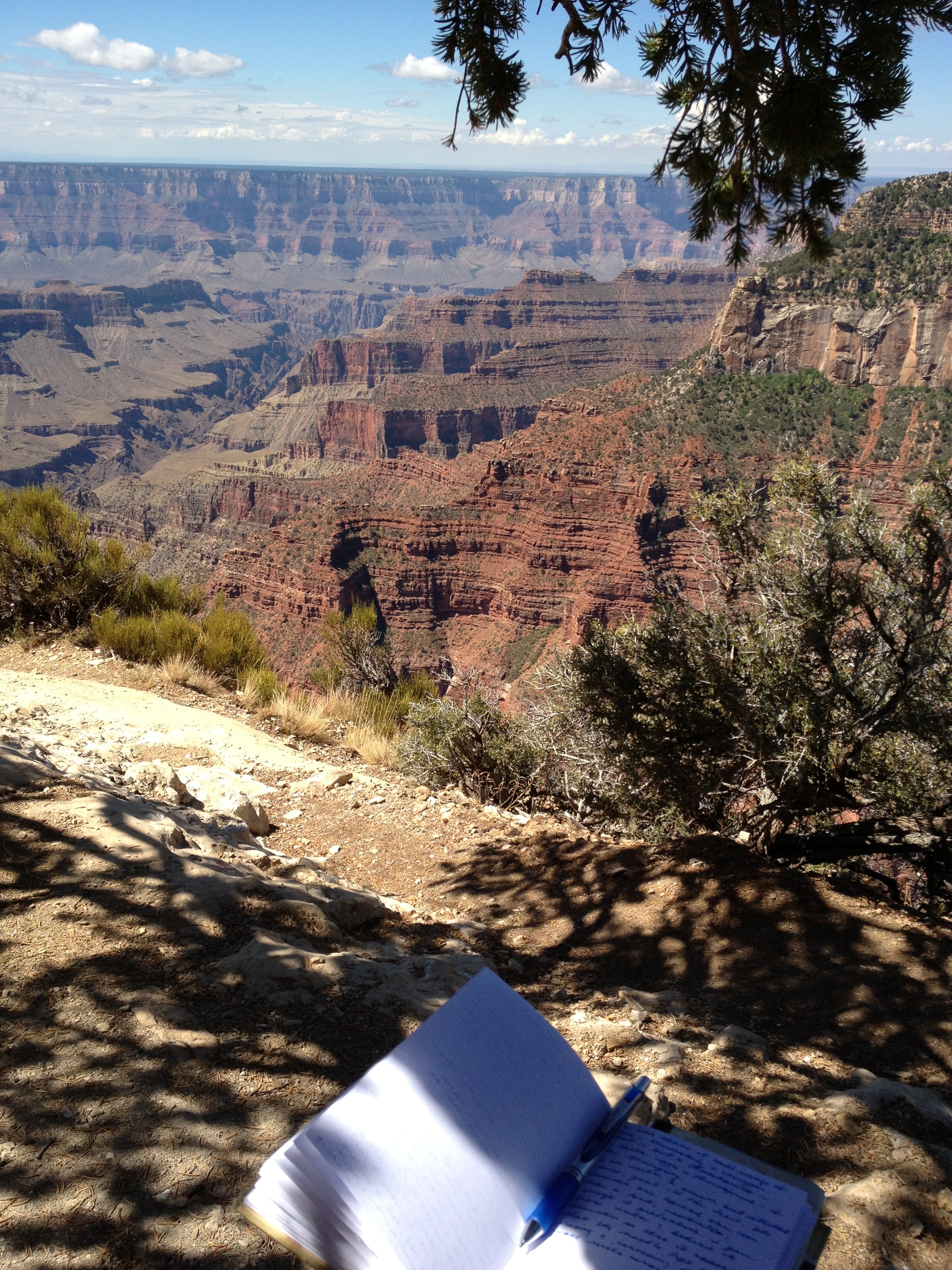
Reflections from the North Rim

20120716-184447.jpg

I am sitting at the edge of the Grand Canyon’s North Rim, ever so slightly off the marked path. Off to the right, two people are perched at the very tip of a major outcropping, posing (I suppose) for a Christmas e-letter photo. I worry that if either of them so much as sneezes or blinks or breathes, they will go tumbling over the edge; there go all my hopes of sweet dreams for the next several weeks.

Just behind me, a young family is making the trek out to Angel Point with their 2- and 4-year old sons in tow. And I do mean in tow. Except at just a few outermost spots, there are no safety rails or guards here. The only thing between you and the bottom of the canyon is a few inches of pathway and several thousand vertical feet. I briefly looked into the eyes of that mother as she wrangled with her adventurous 2-year old. She wants to go home. She wants to take a nap. She wants to strap her children into cushioned chairs and plant them in front of an electronic device. I don’t fault her for this. She is probably a wonderful mother who spends time doing creative and educational things with her children; who lets them run and jump and play and climb trees; who reads to them each night from the pages of classic literature. But this is the North Rim and there is no space for a wildly alive 2-year old to do anything except get dragged and pulled and contained and restrained by a wildly protective parent. There go all her hopes of sweet dreams for the next several weeks.

I am here without children and so am free to be still and quiet at the edge of the Canyon for as long as I want. So here I am, settled under the cool shade of God’s wings woven into the very being of a tree whose branches spread over me like a fringed embrace even while their needle-tips seem to kiss and caress the canyon wall miles away. I am overlooking a landscape whose majesty contains and reflects the very thumbprint of God Himself, but whose expanse can’t even begin to contain and reflect more than a mere thumbprint of God’s own majesty.

My North Rim stillness and quietness has shown me this:

It is impossible to fully take in (let alone fully describe) the immensity and grandeur spread out before me. Even with photographs. Perhaps especially with photographs. Trying to transfer and contain such colorful and variant and immeasurable depth, width, height, and length onto a two-dimensional surface – no matter how large – is futile. (Perhaps this explains in part previous generations’ universal dread of Other People’s Vacation Slide Shows, those drily-narrated and flattened-out Kodak Ektachrome versions of three-dimensional miracles that were powerfully spoken into existence.) (Which, in turn, might explain the genius of social media photo albums, those drily-captioned and flattened-out Instagrammed versions of life that are entirely optional for viewing.)

And also this:

I am small. Very small. A speck, in fact. I know this in my soul – for I am but one of trillions – even as I can see it with my eyes – for my outstretched hand (just inches away) is but a dot on the canyon wall backdrop (miles and miles away). I am but dust, the unmeasurable (because of my smallness) surrounded by the immeasurable (because of its magnitude).

When I consider the sight before and beside and below and around me (which is but a grain of sand among the Lord’s creation), I am left breathless. I am undone. Entirely.

Because of this:

God knows I am here. Knows my name. Knows me. And even still considers my unmeasurableness worth a full measure of His love and grace.

And this:

Inside this small speck of my unmeasurable self resides all the fullness, not of the immeasurable creation before and beside and below and around me, but of Christ Himself…the very creator of the immeasurable creation that is before and beside and below and around me. (Or at least as much of His fullness as I make room for by emptying myself of self, a daunting task indeed.)

What manner of mystery and miracle is this? That the Creator of the Cosmos – the only true God – not only reduced His own self to a fully human speck (so that we could be saved), but even further, compressed his own spirit to dwell within fully fallen, flawed, broken, and small specks of dust (so that we could know real life)…?!