C. S. Lewis “An Easter Hymn”

From a June 10, 1958 letter to Francis Turner (at which time Turner was President of Magdalene College, Cambridge), in which Lewis wrote: “A challenge is a challenge, so here comes my (Easter) hymn. It aims at little more than to be mouth-filling. If the numbers are unpleasing, the sentiments, since they are scriptural, must surely be just.”

Lords coëval with creation,
Seraph, Cherub, Throne and Power,
Princedom, Virtue, Domination,
Hail the long-awaited hour!
Bruised in head, with broken pinion,
Trembling for his old dominion,
See the ancient dragon cower!
For the Prince of Heaven has risen,
Victor, from his shattered prison.

Loudly roaring from the regions
Where no sunbeam e’er was shed,
Rise and dance, ye ransomed legions
Of the cold and countless dead!
Gates of adamant are broken,
Words of conquering power are spoken
Through the God who died and bled:
Hell lies vacant, spoiled and cheated
By the Lord of life defeated

Bear, behemoth, bustard, camel,
Warthog, wombat, kangaroo,
Insect, reptile, fish and mammal,
Tree, flower, grass, and lichen too,
Rise and romp and ramp, awakening,
For the age-old curse is breaking.
All things shall be made anew;
Nature’s rich rejuvenation
Follows on Man’s liberation.

Eve’s and Adam’s son and daughter,
Sinful, weary, twisted, mired,
Pale with terror, thinned with slaughter,
Robbed of all your hearts desired,
Look! Rejoice! One born of woman,
Flesh and blood and bones all human,
One who wept and could be tired,
Risen from the vilest death, has given
All who will the hope of Heaven.//

Lewisians will hear echoes of Narnia (and Malacandra and Perelandra) in this poem — especially in stanza 3 when all manner of animal and nature romp with joy at the onset of New Creation, and in stanza 4 when Sons of Adam and Daughters of Eve are called to look and rejoice because one who wept and could be tired has risen and given the hope of Heaven to all who will receive it.

Lewis wrote other things about Easter, but this little poem, tucked away in a non-Eastertime letter, is not well known. Read it today and with all other Sons of Adam and Daughters of Eve who feel weary, twisted, mired, pale with terror, thinned with slaughter, and robbed of all your hearts desired, Look! and Rejoice! For Christ is risen. He is risen indeed.

Palm Sunday (Holy Week Day 1)

Today – Palm Sunday – begins what we today call Holy Week or Passion Week. It marks the days leading up to Jesus’ death and resurrection, allowing space and time to listen, focus, and remember what happened on these days almost 2000 years ago.

Just before this day, Jesus had been in Jericho. He’d met and spent time with Zacchaeus – a Jewish tax collector who worked for the Roman occupying government, doing a job which his family, neighbors, and fellow Jews despised and looked down on. And yet Jesus spent time with Zacchaeus and befriended him, giving a glimpse of how very upside-down the kingdom of God truly is. 

Shortly after that, Jesus met a blind man on the road, and in usual fashion, he stopped, listened, and healed him, giving physical sight to a specific man, giving a glimpse of what was to come — clear spiritual sight for any and all who ask.

From Jericho, Jesus headed to Jerusalem, the capital city, where faithful and devout religious people traveled regularly for feasts and other temple celebrations.

Like so many others, Jesus was going to Jerusalem for the coming Passover. But he was mostly going there for another reason: to not just celebrate the Passover but to be the Passover lamb and to die the Passover lamb’s death.

If you’ve ever been in church on Palm Sunday, you’ve likely experienced the joy and energy of young children walking the aisles, a chaotic mass of little bodies, smiling at parents, poking younger siblings, waving their palm branches wildly (like the children they are) or methodically (like the adults they may grow into), shouting at the top of their tiny young lungs, “Hosanna! Hosanna! Blessed is he who comes in the name of the Lord.”

They’re re-enacting what the people did when Jesus himself rode into Jerusalem. Riding on a donkey. Think about that for a moment: Jesus – the Creator of all, the King of all, the Savior of all, the long-awaited Messiah, God himself — riding into Jerusalem on a donkey. The Jewish people had long been living under the oppression of different occupying rulers, currently the Romans, and for hundreds of years, they’d been waiting for God to send them a conquering Messiah, someone who would overthrow their oppressors and set things right with a strong military reign. 

But Jesus came to set things right in a different way, at a deeper level: in our very souls.

And for that monumental task, he arrived on a donkey.

We might think of a donkey as nothing more than a work animal. In the ancient world, thought, donkeys were associated with kings, specifically with peaceful kings. A warrior king arrived on a horse, a peaceful king on a donkey. Already Jesus was making a statement about how his Kingdom worked. 

Long before Jesus was born, the prophet Zechariah had spoken about this very thing when he said, “Rejoice, O people of Zion! Shout in trumph, O people of Jerusalem! Look, your king is coming to you. He is righteous and victorious, yet he is humble, riding on a donkey — riding on a donkey’s colt.” (Zech 9:9) Over the years, people focused and clung to the first part of those words about victory and justice. The humility part, the donkey part, somehow got lost in the days and years and generations of waiting.

Today when we hear Hosanna, most people either have no idea what it means, or they think it means, “Praise him!” or “Honor him!” or “Worship him.” But Hosanna simply means either “God saves” — a statement of fact, or “God, save us” — a plea for rescue.

Jesus does in fact save. At that moment, people were hoping and expecting him to save them and their city in a very specific way. But the way he eventually saved was actually more amazing than anything they imagined, for he came to save everything — all of broken humanity, all of cursed creation.

Jesus saves. Hosanna. When he rode a donkey into Jerusalem that day, he rode into a crowd of branches and praise. But mostly what he rode to was betrayal, rejection, and death.

For you. For me. For the whole world. For all of creation.

Home-away-from-home sweet home (Michindoh Post 7)

[This post is seventh of a series in which I reflect on spending a month at camp for Wyldlife (middle schoolers) and YoungLives (teen moms). You can follow by subscribing to this blog below. All posts are categorized as ‘Michindoh 2013’.]
 

Going to camp for a month is no small thing. Besides all the packing for the destination stay, there’s all the preparation for the departure site. Read: who will take care of things at home while we are gone? And by “things” I mean the lawn and the dog, neither of which is self-sufficient or hibernatorial. In 20+ years of fairly consistent camp assignments, neither the lawn nor the various dogs have ever been left unattended. I consider this fact to fall somewhere on the miraculous end of the camp prep scale.

One of the blessings of camp life is leaving the things of home back home where they belong.

One of the challenges of camp life is feeling at home when not really at home.

There are several possible ways to accomplish this, some of which are beyond foolish (we’ll just skip over those, shall we?), and others that are tried and true.

1. Avoid the sleeping-on-a-lumpy-mountain-top syndrome, or conversely the sleeping-on-a-lumpy-but-flat-inner-tube debacle by bringing your own pillow. Or two or three.

2. Avoid the what-exactly-is-scrunched-around-my-neck-and-face nightly worries by bringing your own blanket. Or two or three.

3. Bring craft materials. Lots of it. Because there will probably be some six-year-old girls at camp who will require a special diet of sidewalk chalk, glitter, markers, glue, and various doodads. In large daily doses.

4. Bring books. Lots of them. Because there will probably be some . . . oh, let’s just be honest. Because you can’t leave home without them. And by “them” I mean ten. Or maybe twenty. Or more.

5. Find the nearest thrift store and buy a $1.99 string of gigantic illuminated Christmas stars to drape across the front of your camp abode. (Also: probably buy some more books.) Nothing screams sophisticated and classy like a $1.99 string of gigantic illuminated Christmas stars. That blink.

Christmas Stars in June (Photo: CKirgiss)

The stars are really the icing on the creating-a-home-away-from-home-sweet-home cake.

More importantly, they are a reminder that we serve the one true God who, at the beginning of all things, spoke the stars into existence, stars that are counted and named.

They are a reminder that we hope kids meet the Creator who laid the foundations of the world while the morning stars sang together and the angels shouted for joy.

They are a reminder that we follow the only fully human/fully divine Messiah whose birth was announced to shepherds and kings alike by a brilliant star.

They are a reminder that we are very small – much smaller than a single real star of the universe – but are still beloved by the Almighty God.

When I  gaze at the night sky – the moon and stars that You lovingly made and placed and named – I can only cry out: “What are we, Lord, that You would consider us worthy of even one short moment of Your love and attention? Who am I, Lord, that You would become a helpless babe in order to rescue and rebirth me?”

My home-away-from-home sweet home blinking stars are tacky beyond words.

But they are also quirky and delightful and joyful beyond words.

They make me smile, even as they help me remember Who we love and why we are here.


Wash Day (Michindoh Post 3)

[This post is third of a series in which I reflect on spending a month at camp for Wyldlife (middle schoolers) and YoungLives (teen moms). You can follow by subscribing to this blog below. All posts are categorized as ‘Michindoh 2013’.]
 

It’s Monday. In the non-camp world, that means a whole host of things (as whined about here, reflected on here, celebrated here). In the 5-day-week-Wyldlife-camp world it doesn’t mean all that much. Unless it happens to fall on Day 3 in which case it means workcrew wash day.

At Michindoh, we have a trim and lean work staff  of 23- just 15 Servers in the dining hall, 4 Special Project Peeps in the outdoors, indoors, and everywhere else, 3 in Retail, and 1 Sound Tech.

We have no laundry crew. But we sure do have laundry. Even after just 3 days of camp life.

So today Christina and I hoisted a stack of laundry bags into the car trunk, drove around to the other side of the lake whence is found the laundry facility, and started in on what should have been an easy task for two seasoned laundry veterans.

Laundry Day (Photo: CKirgiss)

And it would have been easy except for this: lots of the clothes weren’t labelled with the owner’s initials (camp laundry rule #1) so we had to, you know, keep track of which bag the clothes came out of. And one of the dryers was down for repairs so we had to, well, wait for the other three power-operated-with-five-optional-settings dryers to keep pace with the four similarly power-operated-with-infinite-settings washing machines. Plus the room was terribly hot and humid so we had to, um, sit outside in the fresh air beside the pine grove while we visited and read and journaled during the wash- and rinse- and spin-cycles.

You can just imagine what a terrifically challenging task the whole thing was for, er, two seasoned laundry veterans.

The day wasn’t really about broken dryers or stuffy laundry rooms or un-initialed clothes (maybe it was a little bit about that). It was about washing clothes clean. Of course, it wasn’t really even about washing clothes clean since Christina and I didn’t actually have to wash anything – we just had to dump stuff into one machine, transfer it to another machine, fold it, and put it back into the appropriate mesh laundry bag.

Cleaning clothes takes almost no work at all, even if the clothes are really dirty and especially if the clothes are barely dirty.

But whether barely or really dirty, the clothes do both need cleaning. They both go into the same machine. They both go through the same cycles. They both get agitated back and forth and back and forth and back and forth and also around and around and around.

It costs the same to wash the clothes that are really dirty as it does to wash the clothes that are barely dirty. The machine doesn’t charge more for the really dirty clothes – nor does it charge less for the barely dirty clothes.

Really dirty and barely dirty are in fact both dirty, both not clean, both in need of washing.

In that hot, humid, one-dryer-down laundry room, standing among the piles of initialed and un-initialed clothes alike, I thought about this:

Unlike washing clothes on Day 3 of Wyldlife camp, washing human hearts is a labor-intensive and difficult task that only one Person is seasoned-veteran-(and-fully-Divine)-enough to successfully complete.

And human hearts, whether really dirty or barely dirty, surely do need washing.

And the cost to wash human hearts, whether really dirty or barely dirty, is just the same – no more for the really dirty and no less for the barely dirty.

And the cost is astonishing to consider because the cost is nothing less than absolutely everything.

Indeed, Jesus paid it all, for all, on the cross so that both the really dirty and the barely dirty – a distinction that ultimately has no significance – can be washed clean and made new.

And after being washed clean and made new, the formerly (really) dirty or (barely) dirty human heart is newly named . . . not with initials on a tag, but with an identity of the soul:
child of God . . . daughter . . . son . . . heir . . . beloved.

So there’s that: human laundry. It’s good for what ails us all. And sometimes – oh gracious and glory be – it happens at camp. For human hearts. Inside of middle school students. Who are beloved by the Father. Who washes us all. Just because He loves. Just because He can.

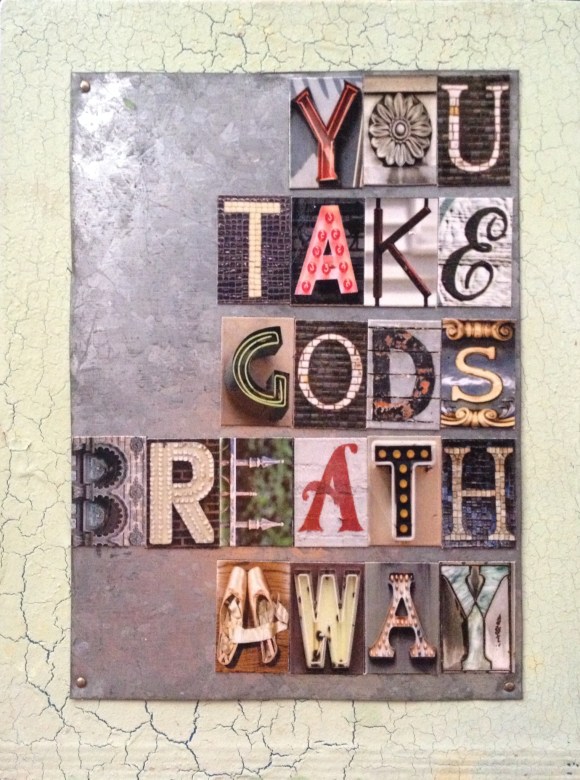
You (and I, and we all) take God’s breath away

Photo: CKirgiss"I will take out your stony, stubborn heart and give you a tender, responsive heart."
Photo: CKirgiss
“I will take out your stony, stubborn heart and give you a tender, responsive heart.”

It’s a very big day. For shoppers, at least.

Black Friday. Sales. Deals. Drastic cuts. A shopping day to make one’s heart race.

All is well. (Indeed.)

Meanwhile, there is this:

Good Friday. The crucifixion. The substitution. The redemption. The superlative act of gracious, undeserved, breathtaking love.

These words I have spoken to thousands of people regarding the Creator’s love: You take God’s breath away.

You. Take. God’s. Breath. Away.

The Creator of the universe – who set the stars in place, who suspended the planets in the spheres, who ordered the species, who painted the landscape with unimaginable life – that God, that Creator, that infinite source of power, majesty, and grace – – – well, He finds us each (and oh, how can this possibly be?) breathtaking.

Indeed He does.

Utterly. Thoroughly. Completely.

What manner of love is this that He should love such as I?

And yet He does.

So then it should come as no surprise (but oh, it does – comes as a surprise that I cannot fathom or comprehend or grasp in my tiny hands) that on this day, more than 2000 years ago, He would demonstrate this endless, boundless, ceaseless love on the cross.

But He did.

Willing death.

Voluntary suffering.

Immeasurable sacrifice.

For those He finds breathtaking.

For me. For you. For us all.

We take God’s breath away. Once and for all at the cross. Each and every day in his love.

“At noon, darkness fell across the whole land until three o’clock. Then at three o’clock Jesus called out with a loud voice:
           Eloi, Eloi, lema sabachtham?
Then Jesus uttered another loud cry and breathed his last. And the curtain in the sanctuary of the Temple was torn in two, from top to bottom.” (from Mark’s gospel)

You take God’s breath away. That is how He loves – on that day, on this day, and on every other day that will ever be.

All is well. Indeed.

YTGBA
Photo: CKirgiss
“He breathed his last…”

[All content copyright Crystal Kirgiss.]

Mary’s Sonnet

Mother and Child
Mother and Child

Mary’s Sonnet

Gently and beautifully, she tips her brow
Down t’wards the babe while at her breast he sleeps.
She moves beyond the joy to wonder how
Love strikes so deeply ’tis pain, and she weeps.
Her eyes drink in the beauty of his hands,
His feet, his face – so small, perfect, her own.
In her heart, she cannot conceive the sands
Of years changing babe to man, birth to grown.
The heavn’s dance as angels shout the birth
Of pure love. The stars and seas cry joy.
And even the God smiles and sings for earth.
All time and space celebrates her small boy.
Eternity is pressed in this one night
As she lies bathed in Emmanuel’s light.

____________________________

Dance with the angels!
Shout with the stars!
Messiah has come,
and with Him
faith
hope
love.

a theology of babes

Photo Credit: Melissa Hassey (melissahassey.com)

Babies are my grounding point. When I need a visible and tangible reminder of God’s majesty, deity, splendor, creativity, love – even very existence – I find it there: living, breathing, crying, wiggling, squirming, sucking, sleeping, breathtaking babies.

Those fingers. Those toes. Those eyelashes, like spun silken strands in miniature.

That hair. That nose. That skin, like softened velvet robes in space.

Who can comprehend the miracle? Who can fathom the process? Who can understand the astonishing surprise of human life appearing in such a thoroughly helpless yet perfect bundle of being?

And most of all: who can grasp the unimaginable truth that Almighty God, Creator of the universe, would willingly choose such a form for His greatest work of all – the rescue of mankind from itself?

Christ, the living babe. The helpless, living, breathing, crying, wiggling, squirming, sucking, sleeping, breathtaking babe.

The incarnated Word.

God in flesh.

Majesty on earth.

Love embodied.

It boggles the mind (if one really thinks about it). It astounds the senses (if one really absorbs it). It overwhelms the soul (if one really believes it).

Oh my word, what could be more startling? (There is nothing like it.)

Oh my Word, who could be more salvific? (There is no one like You.)

Amen.

[Here is quite certainly the most delightful Christmas pageant ever. I’d be mightily surprised if this video of children-as-sheep, children-as-wisemen, children-as-stars, and children-as-holy-family didn’t make you smile broadly and cry joyfully.]

A fruitful endeavor

Photo: C. Kirgiss

This year, what with the drought and all, my raspberry bushes were a bust. Nary a single blossom or berry did we get.

Sometime in mid-summer, just when things normally begin to get exciting in the berry patch, the bushes simply fell over into a collective droopy heap of dry, shriveled, sad, exhausted, and bare canes. Where berries should have been was nothing more than small, darkened, hardened, undeveloped blossoms.

We don’t harvest enough berries to brag about – just an added dash of bright red in fruit salads or atop ice-cream treats. But that’s enough to make us feel productive, farm-ish, and connected to the earth in some small way. That’s enough to marvel at the sweet burst of flavor. That’s enough to revel in the mystery of dirt-plus-rain-plus-sun-equals-bounty. That’s enough to be reminded of God’s goodness.

That’s enough to make this year’s non-harvest a source of disappointment.

It was – and still is – quite heartbreaking. I need to get out there and prune back the dead canes so next year’s berry crop stands a chance. But it’s depressing to look upon that pile of despair, to think about what could have been, to realize that the miracle and mystery of nature doesn’t always have a joyful ending.

I don’t particularly like the image.

It hits rather close to home.

It echoes the truth about my humanity.

It reflects what too often happens in my own life.

Droopy heaps of dry, shriveled intentions…of exhausted, bare emotions…of hardened, undeveloped thoughts…of dead, fruitless endeavors…these are the natural result – the only possible result – of a soul’s drought.

Bearing spiritual fruit is a miracle so far beyond dirt-plus-rain-plus-sun-equals-bounty that it’s nearly impossible to comprehend. How can broken creatures such as we produce beautiful things such as love, joy, peace, patience, kindness, goodness, faithfulness, gentleness, and self-control?

We cannot, of course. On our own, left to our own devices, life is nothing more than a perpetual, deadly drought.

Thank God we are not consigned to live on our own, to scorch and shrivel and droop and rot in a pile of dry death.

Thank God we are invited to plant ourselves along the riverbank, to drink deeply of the water of life, to fill our souls with the truth of Christ, and to experience the breathtaking miracle of a fruit-filled life.

Thank God we are not subject to nature’s shifting weather patterns but instead are showered with the endless grace of Jesus.

Thank God we are loved and redeemed and transformed and cultivated in spite of ourselves.

Thank God indeed.

No Service

I am spending two days here to, you know, get away from it all.

To enjoy the peace and quiet.

Away from the crowds and busyness and traffic and chaos.

Away from the noise and stress and rush and press.

Away from the piles and stacks and tasks and lists.

Away from all that is of this world.

All of which sounds prosaic and introspective and intentional and even spiritual…a little time for me and Jesus, me and family, me and I, to do some serious reflecting and resting. It doesn’t require much beyond a good book (check), a decent bed (check), and indoor plumbing (check).

So this should be great in every way. It really should.

Except for this: two words in the top righthand corner of my phone screen –

No Service

Nothing. Zip. Zero. Not even half a bar of “can you hear me know now?”

I’m stymied. This has never happened to me before. I’ve always been connected, even if by nothing more than the tiniest glowing arc….just a dot, really, at the base of that rainbow-ish / radiowave-ish / parachute-ish symbol that is the supreme essence of 21st-century existence in a wirelessly connected world.

Huh.

No Service.

How, exactly, am I supposed to fully enjoy and appreciate the peace and quiet of this place – away from the chaos and noise and stress of the world – if I can’t, with the click of a button and the swipe of a screen, pull up a minute-by-minute reminder and replay of said chaos and noise and stress?

How indeed.


Thirsty dirt

The earth is thirsty. Cracked across her skin. Parched to her roots.

And we are all crying out for rain. Oh please, God, rain. We need it so badly. (And the crying out becomes complaining and cursing and fists shaking in rage and disbelief.)

But when we do have rain – when things are green and sated and as they should be (indeed . . . so that over time water really does turn into wine) we simply roll along, taking in the miracles that lie before and behind and above and around us.

On May 6, the earth was sufficiently watered (in Indiana, at least) – and in her subtle, surprising way, she was slowly slipping out from under a heavy, dull brown blanket, worn for many months, into a light, fresh green shift (n.a loosely fitting dress that hangs straight from the shoulder; a chemise) that shimmered when it caught the light.

I saw this from a motorcycle, which is sometimes the perfect place for noticing the mundane things that lie to the left and right – for seeing the unexpected way the earth rises and falls, lilts and skips – for seeing the flashing, blinking field rows that fly past – for seeing the unnoticed world that surrounds us – for seeing, well, all kinds of things that one doesn’t normally see.

I wrote this at the time:

Spring Fields

A gently whispered green
tints the earth
and teases the eye
here then gone
seen then not –

a silent ode to human hands
that ever and again
work the land
with patient care –
a soaring anthem to Divine Mystery
where ever and again
broken seeds become bread
and broken bread becomes grace
to any who would take and eat.

CK 05.06.12

I mused, detangled, listened, and reshaped until the rhythm, flow, and words were finished, complete, and just so.

I wrote. I posted. I breathed deeply and (admittedly) felt a certain sense of self-satisfaction at having found something to say and then a way to say it. In a very small way, I had created, and as Dorothy Sayers would point out, that is perhaps one of the most important ways in which humanity images the Creator.

Good for me.

I wrote. I created. I imaged the Creator. And yes, I experienced awe, amazement, and gratitude for the creation God placed in our hands.

What didn’t I do? I didn’t – not even once – stop and specifically thank God for the rain that made the mysterious “whispered green” possible. For the rain that miraculously turns dead seeds into living plants – living plants into fruit and grain – fruit and grain into food and sustenance.

Experiencing gratitude (which I did) is not quite the same thing as giving thanks (which I did not). The one is passive. The other is active. The one receives. The other gives. The one is experienced. The other is enacted.

I do not for one second espouse to some (crack) theology that equates my lack of giving thanks with the current lack of rain. The lack of rain is what it is – a lack of rain. It’s happened before. It will happen again. As I understand Genesis, the earth reaped her own set of unsought consequences from humanity’s fall.

But I do espouse to a faith that can challenge, transform, and grow a person no matter how long they have known God or followed Jesus.

So:I want to live a life defined by thanks rather than complaints – contentment rather than curses – peace rather than unrest. Perhaps a very manifest dry spell in the weather can help reroute a very obscure dry spell of the soul.