[This post is ninth of a series in which I reflect on spending a month at camp for Wyldlife (middle schoolers) and YoungLives (teen moms). You can follow by subscribing to this blog below. All posts are categorized as ‘Michindoh 2013’.]
The busses just pulled out. 350 campers and leaders are on their way home.
We are left here to rejoice in the way we saw God at work – and to cope with the empty space left in our hearts by those who just departed.
It’s hard to say goodbye.
Sure, tonight we might get to relax, and tomorrow we don’t need to rise for an early breakfast. But we will miss the faces we were just getting to know and the smiles we were just growing used to and the souls we were just starting to love.
Those 350 middle-schoolers left behind a deep well of joy and hope and grace and love.
They also left behind this:
Lost, not found (Photo: CKirgiss)
. . . shirts and shorts and shoes and all manner of stuff that a middle-schooler may not miss, (but the mother who bought it might).
It’s this way at the end of every camp week. Kids are so busy running and playing and laughing and dancing and hanging out and having fun that lost items of this-or-that often go entirely unnoticed. Unmissed. Unseen. Unsought. Unclaimed.
The items in this pile that are expensive, clean, stylish, and attractive might someday be claimed.
The items in this pile that are ripped, worn, smelly, and dirty will not.
Thank goodness the same is not true of God’s view towards humanity.
He is never too busy holding the stars in place or breathing life into the universe to not notice a lost soul.
And He does not consider any lost soul – regardless of whose it is, where it has been, what it has done – to be a merely this-or-that item, not worth the effort of seeking and finding.
Jesus came not to condemn the world but to redeem it. Jesus came to offer hope to those who know they are broken. Jesus came to show us how to live.
Jesus came to seek and to save the lost. He does not distinguish between those who appear to be clean, stylish, and attractive and those who are obviously ripped, worn, and filthy.
He seeks them all. Unceasingly. Lovingly. Faithfully. Gently.
And when He finds even just one – well, then the cosmos is momentarily shattered by the joy within His heart and the celebration throughout the heavens.
[This post is eighth of a series in which I reflect on spending a month at camp for Wyldlife (middle schoolers) and YoungLives (teen moms). You can follow by subscribing to this blog below. All posts are categorized as ‘Michindoh 2013’.]
Dateline: Michindoh – Week 2, Day 4.
It’s a typical Day 4 at Wyldlife camp. Except that it’s also Sunday, June 16th.
On this Father’s Day the Work Crew and Summer Staff, who have left their fathers behind for a month, are enthusiastically celebrating the holiday by . . . doing what they do every other day – rising early to start a day of work that will not end until sometime after 11:00 tonight. Were I to list all the details and responsibilities of their individual jobs, you would want to curl up in a ball under your bed covers and take a very long nap – a luxury they do not have.
The work staff welcomes with expectant joy the long days of work, as well as the cramped sleeping quarters, the close communal living, the absence of technology, the lack of significant alone time, the separation from friends and family, and so many other things that would be viewed with disdain in the normal hustle and bustle of daily life back home.
They welcome, and on occasion patiently weather, these things so that a thousand middle-schoolers and a hundred teen moms will be introduced to the Abba Father who knit them together in their mothers’ wombs, whose loving thoughts towards them are too numerous and too profound to comprehend, and who waits patiently yet longingly for the chance to embrace them, put a ring on their finger, new sandals on their feet, and a brilliantly clean robe on their shoulders in preparation for a celebration feast to end all feasts.
They welcome, and on occasion grow weary of, these things so thata thousand middle-schoolers and a hundred teen moms will know beyond doubt that Abba Father, who created all that exists and whose majestic power extends farther than the east is from the west, waits longingly for the moment He can call each and every one of them Daughter or Son.
They welcome, and on occasion have time to glory in, these things becausethey have a heavenly Father whose love and grace extends to (and infinitely beyond) the thousand middle-schoolers and hundred teen moms they will selflessly (even when battling self-importance) and tirelessly (even when exhausted beyond measure) serve this month.
Depending on one’s earthly biological circumstances, Father’s Day might be a time to mourn or a time to celebrate, a time of painful memories or a time of contentment.
Beyond our immediate biological circumstances, there are no such widely divergent oppositions.
There is just God. Father. Abba. Into the hearts of His children, He sends the Spirit of his Son, prompting us to call out, “Abba, Father.”
We are no longer a slave to the world’s lies or our insecure fears or our own messy pride.
Rather we are God’s own children. His Daughters and Sons. His very own.
What a glorious thing to celebrate today and every other day.
(And to all the fathers we’ve left behind us for a month – we love and miss you truly.)
[This post is seventh of a series in which I reflect on spending a month at camp for Wyldlife (middle schoolers) and YoungLives (teen moms). You can follow by subscribing to this blog below. All posts are categorized as ‘Michindoh 2013’.]
Going to camp for a month is no small thing. Besides all the packing for the destination stay, there’s all the preparation for the departure site. Read: who will take care of things at home while we are gone? And by “things” I mean the lawn and the dog, neither of which is self-sufficient or hibernatorial. In 20+ years of fairly consistent camp assignments, neither the lawn nor the various dogs have ever been left unattended. I consider this fact to fall somewhere on the miraculous end of the camp prep scale.
One of the blessings of camp life is leaving the things of home back home where they belong.
One of the challenges of camp life is feeling at home when not really at home.
There are several possible ways to accomplish this, some of which are beyond foolish (we’ll just skip over those, shall we?), and others that are tried and true.
1. Avoid the sleeping-on-a-lumpy-mountain-top syndrome, or conversely the sleeping-on-a-lumpy-but-flat-inner-tube debacle by bringing your own pillow. Or two or three.
2. Avoid the what-exactly-is-scrunched-around-my-neck-and-face nightly worries by bringing your own blanket. Or two or three.
3. Bring craft materials. Lots of it. Because there will probably be some six-year-old girls at camp who will require a special diet of sidewalk chalk, glitter, markers, glue, and various doodads. In large daily doses.
4. Bring books. Lots of them. Because there will probably be some . . . oh, let’s just be honest. Because you can’t leave home without them. And by “them” I mean ten. Or maybe twenty. Or more.
5. Find the nearest thrift store and buy a $1.99 string of gigantic illuminated Christmas stars to drape across the front of your camp abode. (Also: probably buy some more books.) Nothing screams sophisticated and classy like a $1.99 string of gigantic illuminated Christmas stars. That blink.
Christmas Stars in June (Photo: CKirgiss)
The stars are really the icing on the creating-a-home-away-from-home-sweet-home cake.
More importantly, they are a reminder that we serve the one true God who, at the beginning of all things, spoke the stars into existence, stars that are counted and named.
They are a reminder that we hope kids meet the Creator who laid the foundations of the world while the morning stars sang together and the angels shouted for joy.
They are a reminder that we follow the only fully human/fully divine Messiah whose birth was announced to shepherds and kings alike by a brilliant star.
They are a reminder that we are very small – much smaller than a single real star of the universe – but are still beloved by the Almighty God.
When I gaze at the night sky – the moon and stars that You lovingly made and placed and named – I can only cry out: “What are we, Lord, that You would consider us worthy of even one short moment of Your love and attention? Who am I, Lord, that You would become a helpless babe in order to rescue and rebirth me?”
My home-away-from-home sweet home blinking stars are tacky beyond words.
But they are also quirky and delightful and joyful beyond words.
They make me smile, even as they help me remember Who we love and why we are here.
[This post is sixth of a series in which I reflect on spending a month at camp for Wyldlife (middle schoolers) and YoungLives (teen moms). You can follow by subscribing to this blog below. All posts are categorized as ‘Michindoh 2013’.]
The famous Round Table of Arthurian legend has got nothing on the infamous Round Table of Camp.
In short, we eat at Round Tables. Every meal. Every day. Banquet tables would hold more people. And they could be set up in neat rows.
But we prefer Round Tables. Of 8 people. Set up in free-flowing pods.
Pre-meal Round Tables are nothing to write home about. They would never grace the pages of a slick home and garden mag.
Adding bread and water livens things up a bit and is entirely lovely since the conversations and interactions that take place at the Round Tables are blessed and consecrated by the Bread of Life and the Living Water.
Pre-meal round table, plus bread (Photo: CKirgiss)
Feeding everyone at all of the Round Tables is not quite as miraculous as feeding the 5000 – but it surely is as beautiful.
Serving the Round Tables (Photo: CKirgiss)
The Round Tables are a perfect place to eat with friends, to look at one another face to face, to be part of a circle that is mightier by far than any group of Arthur’s noble knights.
Being at the Round Table (Photo: CKirgiss)
In a world where Round Tables – or any other shaped tables – are becoming more and more rare, the chance to gather around one several times each day is a blessed gift indeed.
If there is any disadvantage to Round Tables, it is only this: half of the people must turn in their chairs…
Round Table entertainment (Photo: CKirgiss)
…in order to see such momentous upfront events as…
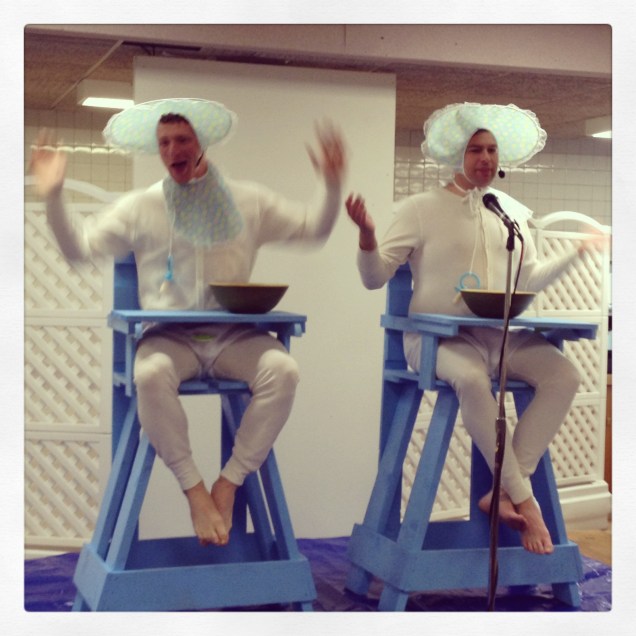
Baby and Baby’s Playtime (Photo: CKirgiss)
…Baby and Baby blowing Coco-Puffs. Out of their noses. Into buckets. For points.
You might not be surprised to hear that Baby won (with 12) while Baby lost (with 8).
But at the Round Tables, there are no losers. Ever. Each and every middle-schooler circled around each and every meal is loved. Listened to. Cared for. Encouraged. Believed in. Prayed for. Delighted in. And so much more.
The shape of the table matters indeed.
But more importantly:
The hearts of the people eating around the table matter beyond measure.
[This post is fourth of a series in which I reflect on spending a month at camp for Wyldlife (middle schoolers) and YoungLives (teen moms). You can follow by subscribing to this blog below. All posts are categorized as ‘Michindoh 2013’.]
Being a grown-up at camp for middle-schoolers is a rather magical thing. (Also entirely exhausting, but we’ll save that for another day.)
Of the various grown-up populations at middle-school camp, two in particular require an extra measure of inherent childlike joy and wonder – along with a willingness to expose oneself to all manner of ridicule and mess – in addition to limitless wisdom, maturity, and grace.
Exhibit A: The Leaders. These two particular leaders are husband and wife who willingly sleep in separate bunked quarters for a week (one with a group of squirrelly, aromatic, hair-gelled boys, the other with a group of giggly, chatty, accessorized girls – and yes, I admit those are loaded generalizations that are certainly not equally true of every individual member within said aromatic [read: smelly-ish] and chatty [read: what you will] groups).
The Joy of Marriage at Middle School Camp (Photo: CKirgiss)
These leaders – like every other leader here this week – will never get rich doing what they do. They will never get famous doing what they do. They will never advance along the path of commercial success and achievement doing what they do.
Rather, they will be plastered with mud, smeared with shaving cream, dusted with flour, dangled from ropes courses, flung from inner tubes, buried in sand, kept up late, woken up early – and they will Love (if not like) every single moment of it because in the process they will have earned the singular privilege of sharing their lives and hearts with a group of squirrelly and giggly folk that are rarely considered worthy of such time and commitment.
These leaders – like every other leader here this week – are my heroes. I am in awe of who they are and what they do.
Exhibit B: The Program Peeps. These two particular program directors are educated, experienced, gifted men who could each pursue any number of socially approved and culturally sanctioned paths to success. (They are also over 6′ tall, a fact that will enhance your interpretation of the photo below.)
“Baby and Baby” – Michindoh 2013 (Photo: CKirgiss)
These program people – like every other program team this summer – will never get rich doing what they do. They will never get famous doing what they do. They will never advance along the path of commercial success and achievement doing what they do.
Rather, they will dress, dance, sing, and speak like fools (beloved fools, to be sure), sacrifice their vocal chords (along with their dignity), expend every ounce of creativity with which their Creator endowed them, get up early, stay up late, eat on the run, stand in the sun, organize the chaos – and they will Love (if not like) every single moment of it because in the process they will have helped create a space in which the similarly exhausted and expended leaders (see exhibit A above) can share their lives and hearts with a group of squirrelly and giggly folk that are rarely considered worthy of such time and commitment.
For every grown-up in the wide world who doesn’t get kids and doesn’t get life and doesn’t get Jesus there is a God-fearing kid-loving grown-up in the even wider Kingdom who does.
[This post is third of a series in which I reflect on spending a month at camp for Wyldlife (middle schoolers) and YoungLives (teen moms). You can follow by subscribing to this blog below. All posts are categorized as ‘Michindoh 2013’.]
It’s Monday. In the non-camp world, that means a whole host of things (as whined about here, reflected on here, celebrated here). In the 5-day-week-Wyldlife-camp world it doesn’t mean all that much. Unless it happens to fall on Day 3 in which case it means workcrew wash day.
At Michindoh, we have a trim and lean work staff of 23- just 15 Servers in the dining hall, 4 Special Project Peeps in the outdoors, indoors, and everywhere else, 3 in Retail, and 1 Sound Tech.
We have no laundry crew. But we sure do have laundry. Even after just 3 days of camp life.
So today Christina and I hoisted a stack of laundry bags into the car trunk, drove around to the other side of the lake whence is found the laundry facility, and started in on what should have been an easy task for two seasoned laundry veterans.
Laundry Day (Photo: CKirgiss)
And it would have been easy except for this: lots of the clothes weren’t labelled with the owner’s initials (camp laundry rule #1) so we had to, you know, keep track of which bag the clothes came out of. And one of the dryers was down for repairs so we had to, well, wait for the other three power-operated-with-five-optional-settings dryers to keep pace with the four similarly power-operated-with-infinite-settings washing machines. Plus the room was terribly hot and humid so we had to, um, sit outside in the fresh air beside the pine grove while we visited and read and journaled during the wash- and rinse- and spin-cycles.
You can just imagine what a terrifically challenging task the whole thing was for, er, two seasoned laundry veterans.
The day wasn’t really about broken dryers or stuffy laundry rooms or un-initialed clothes (maybe it was a little bit about that). It was about washing clothes clean. Of course, it wasn’t really even about washing clothes clean since Christina and I didn’t actually have to wash anything – we just had to dump stuff into one machine, transfer it to another machine, fold it, and put it back into the appropriate mesh laundry bag.
Cleaning clothes takes almost no work at all, even if the clothes are really dirty and especially if the clothes are barely dirty.
But whether barely or really dirty, the clothes do both need cleaning. They both go into the same machine. They both go through the same cycles. They both get agitated back and forth and back and forth and back and forth and also around and around and around.
It costs the same to wash the clothes that are really dirty as it does to wash the clothes that are barely dirty. The machine doesn’t charge more for the really dirty clothes – nor does it charge less for the barely dirty clothes.
Really dirty and barely dirty are in fact both dirty, both not clean, both in need of washing.
In that hot, humid, one-dryer-down laundry room, standing among the piles of initialed and un-initialed clothes alike, I thought about this:
Unlike washing clothes on Day 3 of Wyldlife camp, washing human hearts is a labor-intensive and difficult task that only one Person is seasoned-veteran-(and-fully-Divine)-enough to successfully complete.
And human hearts, whether really dirty or barely dirty, surely do need washing.
And the cost to wash human hearts, whether really dirty or barely dirty, is just the same – no more for the really dirty and no less for the barely dirty.
And the cost is astonishing to consider because the cost is nothing less than absolutely everything.
Indeed, Jesus paid it all, for all, on the cross so that both the really dirty and the barely dirty – a distinction that ultimately has no significance – can be washed clean and made new.
And after being washed clean and made new, the formerly (really) dirty or (barely) dirty human heart is newly named . . . not with initials on a tag, but with an identity of the soul:
child of God . . . daughter . . . son . . . heir . . . beloved.
So there’s that: human laundry. It’s good for what ails us all. And sometimes – oh gracious and glory be – it happens at camp. For human hearts. Inside of middle school students. Who are beloved by the Father. Who washes us all. Just because He loves. Just because He can.



 Breathe