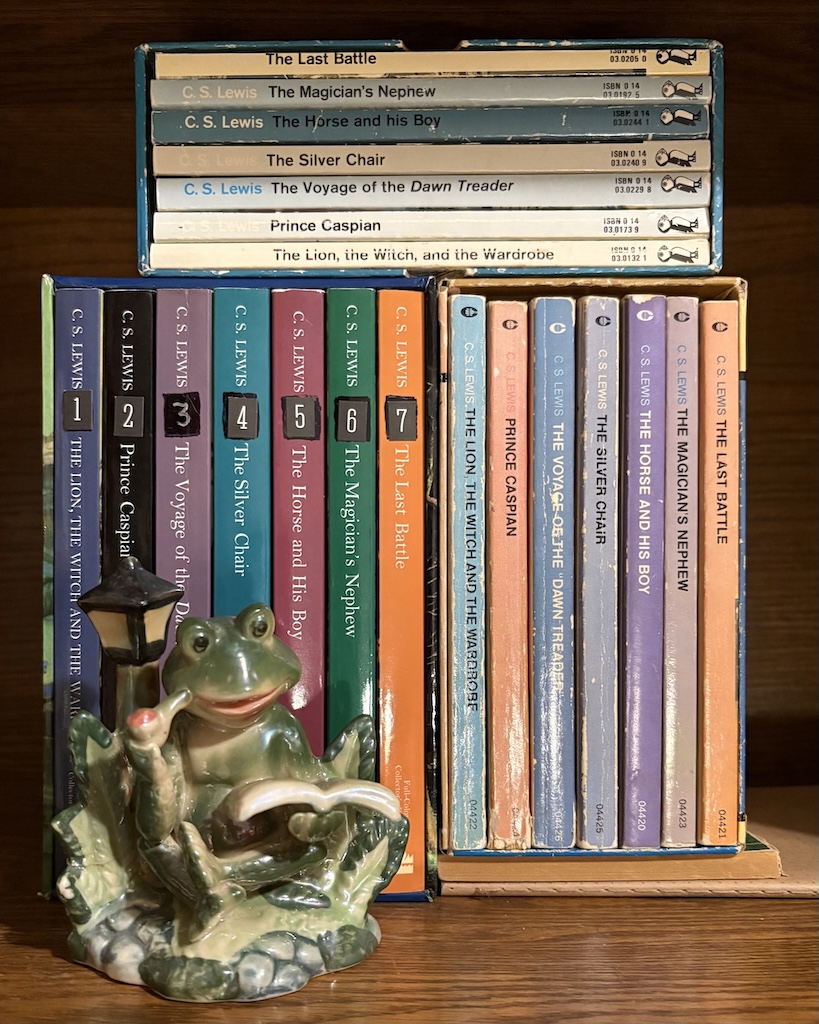
There is much broohaha about the new Netflix Narnia movie. I have thoughts. But there are plenty of thoughts roiling around in the churning waters. A few more will not clarify anything for anyone and will most likely just make the roiling more churny or the churning more roily or everything more Charny (see what I did there?).
Instead, I’ll take this moment to digress and outline just a few of the reasons why I believe (know, if I may be so bold) that publication order is the one and only correct order for a person’s initial reading of the Chronicles. Most likely nothing that I’ve written here is new — many other wise and dedicated Narnians have laid out their own arguments for publication order being proper order. We are all drawing from the same source material (the seven books themselves) and secondary material (primarily Lewis’s letters). Also, no AI was used in the compilation of tidbits for this post. Written by a human for humans, a little detail I’m stubbornly committed to.
Let us begin with internal book evidence, something Lewis held in high esteem.
FIRST — Why THE MAGICIAN’S NEPHEW should absolutely not be read first (numbers in parentheses identify chapter and paragraph):
- (1/1) “[This] is a very important story because it shows how all the comings and goings between our own world and the land of Narnia first began.” If one doesn’t know what Narnia is, has never visited it on the printed page and in their imagination, and hasn’t fallen in love with it, this sentence is moot and provides absolutely no meaningful reason to read MN. After reading books 1–5, readers will see this opening sentence and experience a sense of joy and surprise, things Lewis loved to experience himself and provide for his readers. “Ahhh! I cannot wait to read how my beloved Narnia came to be!”
- (3/56) “Digory was the sort of person who wants to know everything, and when he grew up he became the famous Professor Kirke who comes into other books.” This is a major spoiler for those reading MN first, and meaningless information unless one already knows who Professor Kirke is and has a reason to care about his backstory. At this point, readers will start to put things together, and young readers will be excited to see origin story dots beginning to take shape in front of their very eyes. (There are many dots in MN including Digory’s observation that Jadis is “hardly human” which we know to be true from LWW; that evil will come to Narnia because of Digory’s carelessness but that Aslan will “see to it that the worst falls upon myself;” that Jadis’s face was “deadly white, white as salt” after she’d eaten one of the forbidden silver apples, an early glimpse at her frightening familiar visage in LWW; that the beloved lamppost of LWW came from a piece of London iron dragged into Narnia by Jadis … and let’s pause to acknowledge how lovely and redemptive it is that her wickedness eventually provided a light and landmark by which later earthly human heroes and heroines would enter a land they were destined to help restore and reign over.)
- (10/3) “Hail, Aslan. We hear and obey.” So say the newly created Narnians to a Lion who has never been introduced or named. Two chapters earlier (8) there was first just a Voice, then a Singer, and finally a Lion, “huge, shaggy, and bright.” For well-read Narnia lovers, this is the biggest dot of all. THERE HE IS!! For people who are reading MN as book one, this a big nothingburger moment, lacking joy and wonder. When the newly chosen talking animals call the Lion by name, new readers might be confused. Aslan? Who is that? How do these animals know his name? What did I miss? Readers must be introduced to Aslan in a thoughtful way for his glorious presence to carry its full weight. See point #2 in the next list of reasons for the antidote to this underwhelming introduction to Aslan.
- (15) SPOILER ALERTS. The last chapter of MN is — if read first — one big spoiler after another. We learn about Professor Kirke’s big house in the country, Lantern Waste, the magic wardrobe, and biggest, most spoily of all, that “hundreds of years later, another child from our world got into Narnia” through said magic wardrobe. This level of killjoyishness is as un-Lewisian as anything, for Lewis craved moments of unexpected joy and did all he could to provide them to his readers in the Chronicles. Read first, MN lacks delightful surprise and becomes merely, well, a joy-sucking backstory.
SECOND — why The Lion, the Witch and the Wardrobe should absolutely be read first:
- (Throughout) Spoilers galore if reading LWW second. The house in the country. The old professor. The wardrobe. The lamppost. All the wonder and mystery is flattened, erased, smooshed to nothingness. (See point 4 above.)
- (7/34–35) “‘They say Aslan is on the move — perhaps has already landed,'” said Mr. Beaver to the children. And then the narrator says this: “And now a very curious thing happened. None of the children knew who Aslan was any more than you do; but the moment the Beaver had spoken these words everyone felt quite different.” (Ital. added.) Really, this speaks for itself. From this point forward, Aslan is slowly revealed, introduced, and encountered. Nothing more is said of him until the after-dinner conversation in the next chapter (next point).
- (8/13+) “Tell us about Aslan!” say the four Pevensie children to the Beavers. “Who is Aslan?” Here is where readers are meant to first hear and learn who Aslan really is. They felt something in chapter 7. Here they learn things. He’s the King. The Lord of the whole wood. The son of the great Emperor-Beyond-the-Sea. He’s not a man. He’s a lion about whom is prophesied: “Wrong will be right, when Aslan comes in sight / At the sound of his roar, sorrows will be no more / When he bares his teeth, winter meets it death / And when he shakes his mane, we shall have spring again.” He’s not safe, but he is good, and most importantly, he is on the move. In effect, Mr. and Mrs. Beaver catechize the children into the truth of the one true Lord of Narnia (who is, in our world, the Lion of Judah.)
- (17/final) “And that is the very end of the adventures of the wardrobe. But if the Professor was right it was only the beginning of the adventures of Narnia.” Speaks for itself, doesn’t it? This story kicks off the entire cycle of Narnian adventures. It is the starting point, the portal into another world.
THIRD — why Prince Caspian: The Return to Narnia should absolutely be read second, after reading LWW first.
- Because the original complete title clearly denotes it as a sequel (and because Lewis intended it to be the sequel as shown in point two of reason list five).
- Because the entire first scene revisits and replays scenes fromLWW (Cair Paravel, the apple orchard, the gifts, etc.).
- Because the book as whole revisits and replays the overarching narrative of LWW, e.g. Aslan hasn’t been seen in some time, the Narnians are in desperate need of rescue (this time from a wicked man who claims to be king rather than a wicked witch who claims to be Queen), many Narnians have remained faithful through a long difficult season, there is a final showdown between good and evil, Lucy and Susan ride on Aslan’s back, the children leave through a doorway rather than enter through a doorway, and more.
FOURTH — why The Horse and His Boy should not be read immediately after LWW even though newfangled numbering says it should:
- Because HHB does not happen after LWW but instead happens during LWW. HHB cannot be read chronologically. Forcing it into a series position that doesn’t exist is just silly, a sign of stubborn determination to override an author’s overarching plan.
- Because one of the unexpected joys of HHB occurs mid-story when readers discover they’ve been whisked back to The Golden Age of Narnia when the Pevensies reigned as adults, an epoch that is only briefly hinted at but completely missing from LWW.
- Because in the penultimate paragraph of chapter three of book four, The Silver Chair, Eustace and Jill are enjoying a royal banquet in the Narnian palace when this happens: “And when all the serious eating and drinking was over, a blind poet came forward and struck up a grand old tale of Prince Cor and Aravis and the horse Bree, which is called The Horse and His Boy and tells of an adventure that happened in Narnia and Calormen and the land between, in the Golden Age when Peter was High King in Cair Paravel. (I haven’t time to tell it now, though it is well worth hearing.)” And then (for original readers) one year later, lo and behold!, the “adventure well worth hearing” is suddenly available for them to enjoy firsthand. That parenthetical authorial comment is Lewis winking at his readers, teasing them, knowing full well that they will, in fact, get to hear for themselves the adventure known as The Horse and His Boy very soon. Note that HHB was clearly planned and titled and probably finished before SC went to press (see point 2 below).
FIFTH — one additional item worth mentioning and some thoughts about The Letter:
- The Chronicles were numbered in publication order as long as Lewis was alive. If he’d wanted that changed, he could have done so. This is so obvious as to not need stating … but apparently it needs stating. (NB: there is a narrative that goes something like this: “Before he died, Lewis told me the correct order should be chronological.” I call foul. Anyone can claim anything about someone’s end-of-life wishes when that somebody was the only person present.)
- The Letter often brandished as a silencing “Ha! So there!” defense of chronological reading was written in 1957 to Laurence Krieg, a young boy who’d read the full Narnian series already (important detail) and now wondered if reading in chronological order was proper. Lewis said yes BUT ALSO SAID THIS: “The series was not planned beforehand as [your mother] thinks. When I wrote the Lion I did not know I was going to write any more. Then I wrote P. Caspian as a sequel [IMPORTANT DETAIL] and still didn’t think there would be any more, and when I had done the Voyage I felt quite sure it would be the last. But I found I was wrong. So perhaps it does not matter very much in which order anyone reads them. I’m not even sure that all the others were written in the same order in which they were published. I never keep notes of that sort of thing and never remember dates.” (1) (Note that this letter is a primary reason why Gerwig chose to adapt MN first.)Let’s dissect, shall we? In this letter, Lewis starts with “yes, chronological” in response to someone who’d already read all seven books, then moves to “it does not matter very much,” and in between says things that are definitively, absolutely, one hundred percent inaccurate, which means that perhaps none of the definitive or semi-definitive statements about reading order stand up under scrutiny.Back in 1952, Lewis had written to a group of schoolboys who’d written to him about Prince Caspian, which they’d recently read and enjoyed. In his response, Lewis said this (among other things): “The new book is called The Voyage of the Dawn Treader.” Lucy and Edmund find Caspian (now King of course) on board ship sailing to the Eastern end of the Narnian world. There will be lots about Reepicheep. And there will be a Sea Serpent and a Dragon and lots of strange islands. I do hope you will all like it. I intend to have seven of these stories altogether – that is, four more after the next one. They will be called The Chronicles of Narnia. The
fifthsixth book will go right back to the beginning and explain how there came to be that Magic Wardrobe in the Professor’s house – for of course you will have guessed that the old Professor must have known something about things like that himself or else he would never have believed what the children told him.” (Ital. added.)A few things: In this 1952 letter Lewis implies that after reading LWW children might wonder/guess why the Professor was so understanding. He does not imply that they should know, which they would if they’d already read MN. He also corrects his own ordering statement with a strikeout to clarify that the origin story will be the sixth book. And he clearly shows that the full series was planned in advance, contrary to what he wrote Laurence on April 21, 1957, exactly one month after his Christian marriage to Joy Davidman (March 21, 1957) while she was in a hospital bed after being diagnose with terminal bone cancer. Mayhap Lewis was a bit distracted while responding to young Laurence.
Once a person has read all the Chronicles in proper order — the order which carefully introduces the land of Narnia and the reigning Aslan with surprise, joy, wonder, and delight — reading order no longer matters. One might pick up VDT on a day one craves an episodic quest. Or HHB when one craves a coming-of-age story. Or LWW when one craves a traditional fairy tale. Or MN when one craves an origin story. Or PC when one craves an avenging sequel. Or SC when one craves a mysterious Arthurian quest (plus a Marshwiggle). Or LB when one wants an apocalyptic drama that will made one seethe, weep, and rejoice all at the same time.
It does not matter what order one re-reads the Chronicles, for one will have already fallen in love with Narnia, and most importantly with Aslan, who is the Lion of Judah (as Lewis wrote to Carol Jenkins on Jan. 22, 1952) (2), and who has another name in our world (as he himself told Lucy in VDT), and who gets bigger each year we get older (as he said to Lucy in PC).
(1) The Collected Letters of C. S. Lewis Vol. 3, HarperCollins, 2007, p. 847–48.
(2) Not to intentionally throw another wrench into things, but in the same letter, Lewis told young Carol, who’d asked how he’d named the Lion, “I found the name in the notes to Lane’s Arabian Nights: it is the Turkish for lion. I pronounce it Ass-lan myself.” I suspect most readers pronounce it AZ-lihn. Switching to the Turkish pronunciation takes some doing. But Lewis did very kindly add “myself” in his answer, which might mean, “However you pronounce it is fine.”

