Self-sanctification (in which I consider the folly of pre-folded life laundry)

[More musings from the world of summer camp.]

Laundry day. (Again.We are washing things clean. We are making all things new. All these things…
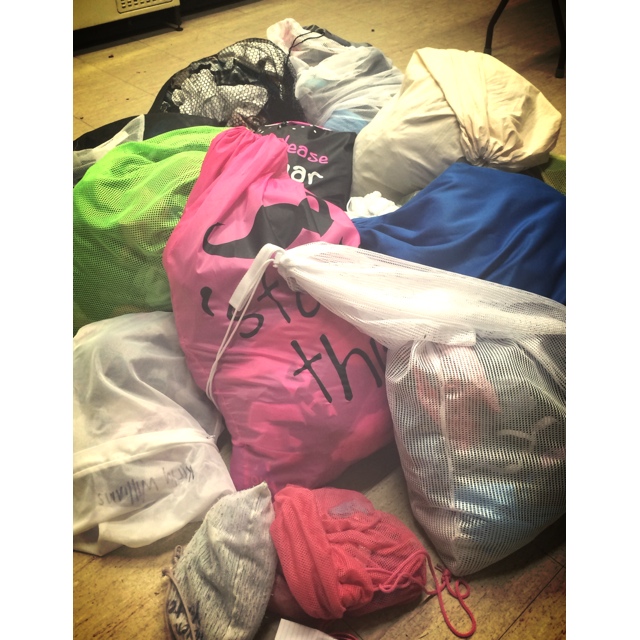
Laundry bags (Photo: CKirgiss)

…things appropriately stuffed into bags – whites mixed with brights mixed with darks, socks mixed with jeans mixed with tees, sweat mixed with muck mixed with food. Laundry is a beautiful jumbled mess of dirt just waiting to be washed and worn again, no matter how dingy and stained it may be (dinginess and stains being the entire point of laundry in the first place).

There is only one requirement here: turn the clothes right side out, please. It cuts the folding time in half. For the most part, this small request is honored.

And then, behold, someone goes one step further and there is this:

Pre-folded laundry (Photo: CKirgiss)

Pre-folded grime. Neatly piled and packaged dirt. Laundry that looks to be already washed and ready to wear.

The fact that a teenager takes the time to neatly fold and politely package his laundry is endearingly delightful.

But I fear that far too often this is just what I do with myself. I gather the grimy stained pieces of my life that accumulate throughout any given day, turn them right side out, fold them, stack them, and package them neatly before handing them over – either grudgingly (“Really, they’re not that dirty. I could live in them for at least another day or week or month”) or flippantly (“Laundry. Whatever.”) or shamefacedly (“Oh. Hmm. Well, yes, okay. But, um, no need to look closely before washing them, and please keep in mind that most of those stains are beyond my control”) or angrily (“If you’d just limit the dirt around me – which you could do if you wanted…”).

Too often I care more about appearing washed than being washed. (But even if dirt can be hidden, its stench cannot.)

Too often I care more about hiding stains than exposing stains. (Stains flipped inside out, though, are still stains.)

Too often I care more about being in a neatly folded pile than being fully alive. (Neat piles of clothes, however, are pointless unless eventually worn.)

Were that large mountain of right-side-out laundry my life, it would be better left inside out when handing it over for sanctification since  sanctification is a from-the-inside-out process, starting in the heart, soul, and mind. Besides, God does not need to cut down on his folding time.

Were that neatly folded small pile of laundry my life, it would be better left as a muddled mess since muddled messes are more likely to desire and appreciate being cleansed and changed. Besides, God is not impressed by my attempts at self-improvement.

That I can – and must – humbly fall as I am at the feet of Jesus each and every day is not easy in a world that encourages self-made (and remade, and remade again) identities. But I can make no such thing, let alone remake it. What joy it is, then, to know the Maker of all things and the reMaker of all who would be remade.

And so my prayer for today is simply this: “Here I am, Lord – inside out and unfolded. Have your way with me.”


Ohhhhh, we’re halfway there… (in which I consider how to serve well to the very end)

[Musings from the middle school camping front.]

Humility in action
Humility in action

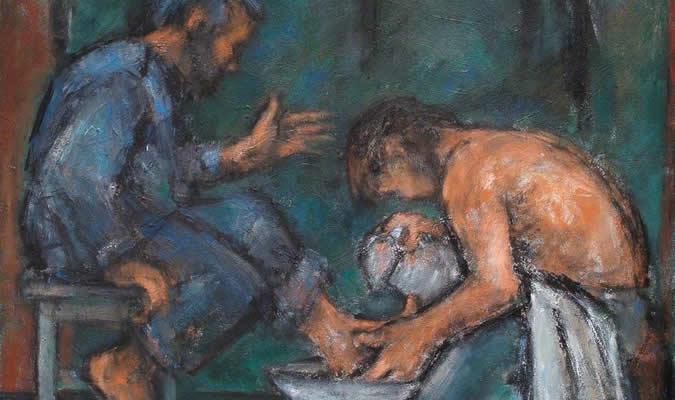
The story of Jesus washing his disciples’ feet has lately made itself at home in my soul where it continues to sink itself down deeply and stir things up unexpectedly. (You can read previous foot-washing thoughts here where I suggest that the story isn’t about actual foot washing at all.)

On the direct ministry front, we are today halfway through our camp assignment. That is, there is at least as much work still to do as has already been done. Perhaps more. I love camp. We all love camp. And middle-schoolers – oh how we do love them. There is no lack of love here for either the setting or the subjects.

Still, there is a hint of weariness. Camp life is exhausting. In every way.

So it would seem logical to rally our collective selves by calling out for more energy! more joy! more enthusiasm! more love!

And while all of those things are good, I think there is one thing only that will carry us from this midpoint to the finish line: humility. Active humility. The kind of humility that Jesus displayed when he washed his disciples’ feet.

That he was the one to do the washing – to stoop, to pour, to rinse, to dry – should change how we live. In every way.

As a human being, he was clearly the only one there who had a right to expect and demand that someone else be the foot washer. He was the leader. The rabbi. The teacher. And there is also this: “The Father had given him authority over everything” (John 13:3).

As God incarnate, he was obviously the only one there who had a right to expect and demand that someone else be the foot washer. He had come from God. He would return to God. He was with God. He was God.

What else does a fully man/fully God guy need to do to get his feet washed?

And let’s not forget that on a previous occasion, he had turned foot-washing water into superb wine. That a water-into-wine man should also be a water-onto-feet God speaks volumes about the one true Lord Almighty.

Jesus’ humility is overwhelming. And it is one of the final lessons he leaves with his disciples: no one is too good to be the foot-washer. When Jesus washed those dusty, dirty, calloused, worn, smelly, stinky feet, he was demonstrating the epitome of humble obedience and obedient humility.

The disciples may not have disobeyed outright when they – not a single one of them – did not offer to wash the others’ feetBut not disobeying is not necessarily the same thing as obeying.

And the disciples may not have displayed excessive pride by pointing to each other and saying, “You do it.” “No, you do it.” “NO, you do it!” But not displaying pride is not necessarily the same thing as being humble. (As proof of that, Luke tells us that the disciples argued among themselves about who would be the greatest among them…after Jesus had already washed their feet.)

Washing someone else’s feet (metaphorically) is not the stuff of headlines. It is not the stuff of blogs or ‘grams or tweets. It’s not even the stuff of the Synoptic Gospels. Only John – many, many years after the fact – recognized the significance of what had taken place and recorded it so that we might learn.

Here, at the midpoint of camp – and really every other day of life – there is only one thing that will position us to live well: the humility of Christ. And not just the humility that willingly washes the feet (metaphorically) of campers (or parishioners or employees or subordinates or whatever) but rather the humility that willingly washes the feet of our fellow workers.

For here is a difficult truth: It is easy to serve campers. It is much harder to serve those who serve alongside us.

If we cannot foot-wash with and among and towards our fellow workers with a genuinely humble heart, we will not be able to foot-wash with and among and towards anyone else. Ever.

And if we do not know our true identity (infinitely loved and undeservedly redeemed child of God), if we have not grasped our clear purpose (to be salt, light, and the sweet fragrance of Christ), and if we do not have an eternal perspective (I will work not just for the here-and-now but for all that lies beyond my final breath on earth), we will never be able to get up from the table, wrap a towel around our waist, pour water into a basin, and begin to wash all the feet that need washing.

This is the Jesus we follow. This is the example he set. This is the task we have. Lord, grant us the grace we so desperately need in order to live as we should.

Jesus knew that the Father had given him authority over everything and that he had come from God and would return to God. So he got up from the table… (John 13:3, NLT)


“The story of my life…” (in which I consider what it means to live a better story)

[Last night, campers roared the lyrics of One Direction’s “The Story of My Life,” which was stupendous to hear and mighty to behold – but my musings about the collective roar led me far beyond the walls of camp, so for today, I digress.]

Stories are the thing right now. (For bookish, literary folk, stories have always been the thing; so in at least this one way, the bookish, literary folk are ahead of their time – even though many of us love stories that are in fact before our time.)

In today’s narrative culture, “Tell me about yourself,” is entirely passé. Anyone who knows anything (and who is even the least bit Christo-hipster) knows that “Tell me your story” is the singular way to start a legitimate conversation.

And telling one’s story is, in truth, a meaning-full act. Our stories do matter – just maybe not in the way we think or have been told.

Teenagers (all of us) are bombarded with stories, each one more exciting and colorful and dramatic than the one before. And while it can be exhilarating to be bombarded with exciting and colorful and dramatic stories, it can also be depressing and dangerous. What if my story pales in comparison? What if my story doesn’t measure up? What if my story is entirely unexciting, uncolorful, and undramatic?

The world (and sometimes those in the Church) would say: well then, go out and write a better story for yourself – as if an ear for narrative and an eye for revision are the answers to what ails us.

Having a better story sounds lofty. Noble. Spiritual, even.

But I think that having – (or rather living, which is not quite the same thing as having) – a real story is the thing that actually matters, and real stories – however unexciting, uncolorful, and undramatic they may seem on the surface – are the only stories worth living.

The problem with ‘writing a better story for ourselves’ is that we are all of us pitiful life-story authors. We fumble around with plots and conflicts and settings and characters, hoping to somehow weave them into a tale for the ages. But we are not life-story authors, not a single one of us. Rather, we are one character (a character who does not get to determine the actions and attitudes of other characters, which is a bitter disappointment, indeed) in a much larger Real Story (a story into which we are graciously invited as a full-fledged and beloved player but not the major protagonist, which is a beyond-bitter disappointment, decidedly).

Though personal stories matter, and though desiring to live a better story is perhaps a fine goal, it is exceedingly trite for people of faith to reduce God to being merely the Author of My Story, or more grandly The Author of Life. Rather, God is the only Authority of life. All of life. Every single life. Life now and forever.

Further, inviting God (humbly, no doubt) to be the author of my life leaves open the door (very, very wide open) for me to then be the eager editor of my life who will zealously reorganize, revise, and rewrite the story more to my own liking. If we are pitiful life-story authors, we are even more surely blundering life-story editors.

I will live a better story – a better life – only if I recognize God’s authority, fully embracing it with both heart and mind (Christ abiding in me), and both heart and mind being fully embedded in it (I abiding in Christ).

On paper, it may not sound like much. But we are not paper stories. We are living stories. And a living story composed and centered around the Authority of Christ is, indeed, a story for the ages.


Day One, round two (in which I consider roots, anchors, fruit, and faith)

[Part of a series in which I muse about life at camp.]

It is a new week at camp. In one hour, 370 new campers and leaders will arrive for the collective explosion known as Day One. And we – who have been here for a while – must live and serve with both a second-Day-One-of-camp maturity (because hopefully we have learned some things) and also with a first-Day-One-of-camp excitement (because 370 people deserve no less).

That balance is not easy to strike, whether at camp or home. It requires a willing embrace of a disciplined life, which leads to deep roots of faith, which leads to fruitful living.

We love fruitful living.

We don’t so much love disciplined living.

We are a culture that adores first-Day-One highs. We are a people that celebrates first-Day-One emotions. We are a church that chases after first-Day-One moments.

Day One is a beautiful thing. But if Day One does not lead to deeper wisdom, wider love, and stronger faith, then Day One has been lived in vain.

The miracle of following Jesus is that the pursuit of deeper wisdom, wider love, and stronger faith does not require an abandonment of Day One joys, celebrations, and thanks. Just the opposite. Digging deeper and deeper allows us to follow farther and farther. Being anchored more firmly frees us to follow more expansively. Giving up my life of self allows me to gain true life in Christ.

These are crazy, wondrous, incomprehensible, and yet wholly believable truths.

So we race towards this second-Day-One extravaganza with a first-Day-One joy. And we do this because (oh, glory!) that is what Jesus has graciously invited us to do.

“And now, just as you accepted Christ Jesus as your Lord, you must continue to follow him. Let your roots grow down into him, and let your lives be built on him. Then your faith will grow strong in the truth you were taught, and you will overflow with thankfulness!” (Colossians 2:6-7)

Laundry day (in which I consider what it means to be washed clean)

[Part of a series in which I mused about life at camp.]

It is laundry day at camp, a day during which the dirty clothes of the entire work staff will be washed clean. There are four sets of washers and dryers on the property. Three of the four work. The dryers take approximately 1.5 hours to fully dry a medium-sized load. There are eight hours until dinner. It’s going to be a race against time. And dirt.

Laundry day (Photo: CKirgiss)

There is a lot of laundry smashed into the bags of this hill. (I lift my eyes to hill – where does my help come from? My help comes from the detergent.) The mesh bags hold the dirt in – even hide it to some extent.

But the dirt is indeed in there, even if it is not easily seen. That’s the nature of clothing. Wear it and and it will need to be washed. Period.

I will wash these clothes today. And then I will wash them again next week, and the week after that, and the week after that … much like God washes me over and over and over again.

Yes, we were cleansed once and forever, 2000 years ago at the cross of Calvary. But the old self is indeed still resident in the soul, even if it is not easily seen. That’s the nature of life. Live it and it will need to be washed. Period.

What miracle is this that the God who graciously and undeservedly cleansed me to my very core (cleansed me fully, at the cost of his own wholly pure life) should faithfully and patiently continue the cleansing, day in and day out, until the day I breathe my last and finally stand in his presence?

It is a miracle beyond comprehension. It is a miracle playing out before my very eyes. This laundry. My sanctification. Indeed.

“You were cleansed; you were made holy; you were made right with God by calling on the name of the Lord Jesus Christ and by the Spirit of our God.” (I Corinthians 6:11)


“…(though, of course, the servants knew)…” (in which I consider water, wine, and wonderful floors)

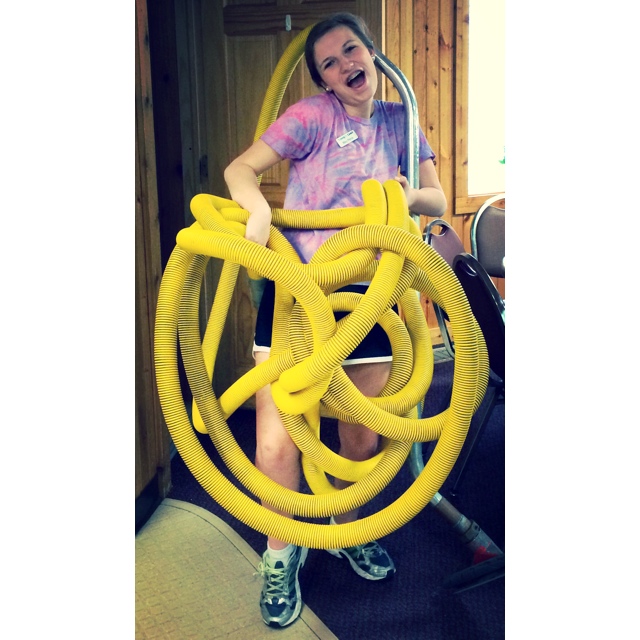
"...though, of course, the servants knew..." (Photo: CKirgiss)
“…though, of course, the servants knew…” (Photo: CKirgiss)

[Part of a series in which I muse about life at camp.]

There she is – one of countless high-school students who are voluntarily serving at camp this summer – waging battle with an uncooperative and unmanageable sea creature. The giant vacuum. The massive yellow tubular monstrosity that does indeed have a mind of its own.

It’s enough to get anyone down.

But the dining room floor, you see, must be vacuumed after each meal. Each and every meal. Because, well, sometimes food drops on the floor, and if the food isn’t cleaned up after each and every meal, then the floor won’t be wonderful at the next meal.

And wonderful floors are important when you are trying to show middle school campers how much you really truly love them…even if they never notice the wonderful floors and even if they never know how the wonderful floors stay wonderful.

Some people might save the wonderful floors for the last big meal of camp. But at this camp (and so many others), the wonderful floors happen right from the get go. And never stop happening. No matter how tired or bored or discouraged the tamers of the sea monster may become.

“When the campers saw the wonderful floor, not knowing where it had come from (though, of course, the teenagers on work crew knew), they said to their leader, ‘My school food is okay, and the cafeteria is alright – but something about this place is different. Awesome. Wonderful. Every day is the best day ever.”  This miraculous sign at camp in the midwest was not the first time Jesus’ love had been displayed by teenagers. And those same teenagers believed in him even more deeply.” (John 2:9-10, paraphrased)

Let us taste His goodness. Let us drink His love. And let us do it in a banquet hall with wonderful floors.

The light shines in the darkness (in which I consider the importance of tiki torches and water balloons at middle school camp)

It is 11 pm on the first day of camp as I write this.

The beautifully explosive middle school descent (also known as Day One of Camp) was a smashing success. They are here – all of them, in all their glory. And because they are here – all of them, in all their glory – it seemed wondrously wise to celebrate. Late at night. In the dark. Long after dinner, games, gathering, and discussion.

Because what could be better than a late night celebration (aka obstacle course) in the dark? Look here and see what I mean:

Night games (Photo: CKirgiss)

Can you see it, the wildly energetic celebration of life (extended across one parking lot, two football fields, one patch of woods, a forest path, and a beachfront) right there in the very dark of very darkness? Those blue lights on the left are flashlights, guiding small groups of the larger raucous crowd across a hilly field. Those two lights on the right are tiki torches, also known as The Official Starting Line. There are lots and lots of people there, mingling in the darkness, so ready to take off running. Look.

Night games in detail (Photo: CKirgiss)

There. Do you see them? Masses of middle schoolers, lined up politely and patiently (relatively speaking).

Truth: the world is full of people living in the very dark of very darkness. They run from one light to another, hoping to arrive safely, hoping to find friends along the way, hoping to find something worth living for. Mostly they are hoping to find a place where the light  is more than just a tiny spot of world-centric bobbing and weaving.

They are looking for the only light that satisfies, the only light that pierces the darkest of dark, the only light that is steady and constant and true, the only light that embraces wholly, the only light that breathes love.

They are looking for Jesus, even if they don’t know it yet. And we are desperately hoping to reflect his light in the very dark of very darkness – rather than reflecting ourselves, which is an ever-present danger in a world that celebrates self.

And though the very dark of very darkness can sometimes overwhelm and suffocate, it does not have the last word because
the Light shines in the darkness,
and the darkness can never extinguish it.

We are for Jesus. We are for light. And against all reason and rationale, Jesus is for us.

Sing! Shout!  Let the celebration begin!


Here there be octaball (in which I consider beautifully shattered silence)

[Part of a series in which I muse about life at camp.]

Here there be octaball (photo: CKirgiss)

In 3 hours (180 minutes / 10,800 seconds) masses of middle-schoolers will descend upon this place. And what a magnificent descent it will be. Loud. Energetic. Excited. Boisterous. Caffeinated. Frenetic, some might say.

Glorious, we would say. Because with those masses of middle-schoolers will come life as only middle-schoolers can live it.

And in this place here, those masses of identity-formational stage of life middle-schoolers will (by the grace of God) encounter life as only Jesus can give it.

It is quiet right now. Beautifully, soothingly, breathtakingly quiet – not because all is at rest, but rather because all are at work. A Sabbath kind of work. A worshipping kind of work. A restoring kind of work. The kind of work that is absolutely necessary in order folife on earth to meet life in Christ.

It is quiet here – even in the octaball court. (Which is both miraculous and creepy.) But soon – (wonderfully, excitingly soon) the still silence will be beautifully shattered in a way that only happens at camp.

Be still, my soul – in peace, in thanks, in adoration – and in preparation for the earth-shattering explosion that even now is barreling down the highway in this direction. We await in expectant joy!

The Best Week of Your Life (in which I consider the miracle of summer camp)

Michindoh Day 0 (photo: CKirgiss)

The miracle that is summer camp defies description on so many levels, even before summer camp has begun.

In 24 hours, 300+ middle-schoolers will descend on a little plot of sacred space in the mitten known as Michigan. So in fact the miracle we await will be twofold as miraculous summer camp collides with miraculous middle-school and creates a breathtaking explosion of awesomeness.

The excitement and anticipation and energy and total stupendousness of what’s to come is almost too overwhelming.

But not quite – because there is work to do. The miracle that is summer camp, you see, does not happen on its own. Not even close.

So today – 36 hours before campers arrive and the collision begins, and 8 hours before the full staff arrives – a small group of people started to work. Hard. Even though the work doesn’t officially start yet. Because that’s how things happen at camp. People step in. People step up. People step out, marching to the sacramental beat of an incarnated Savior who fully embodied and faithfully modeled humble service and grace and joy and love.

Welcome to camp, Day 0. We look ahead. We anticipate We catch our breath in sweet expectation.

And we work. Because without work – sweet, sacred, blessed work – the miracle that is summer camp cannot happen.

Let us rejoice and be glad!

That foot-washing thing, reconsidered

During this Holy Week, I’ve thought quite a lot about Jesus washing his disciples’ feet. I’ve worked my way through some tricky Greek words, wrestled with the exasperating response of Peter (who can always be counted on for that kind of thing), and contemplated the gravity of the coming days.

But mostly, I’ve just thought about Jesus – the son of God, the Almighty incarnate- kneeling down in willing service to wash 24 dusty, dirty, calloused, cracked, leathery, worn, and smelly feet.

It was an insignificant and lowly job, that foot-washing thing, worthy of nobody beyond the lowest servant. It’s a task that doesn’t get noticed, an action that doesn’t get lauded, which is perhaps why the three earliest gospel writers don’t even record it: because it wasn’t something people paid attention to; because its significance was completely lost on those who were right there to see it and experience it.

That’s the thing about foot-washing. When done in the right spirit, for the right reasons, people aren’t likely to take notice. That’s because most foot-washing jobs are entirely inglorious. Entirely. They are not the stuff of headline news or award ceremonies or viral retweets.

They are the dusty, dirty, calloused, cracked, leathery, worn, and smelly jobs. The jobs that absolutely no one wants to do. Ever. Not even a tiny little bit.

Except Jesus – who consistently throws a wrench in the way humanity would choose to live were it left to its own devices.

Like many others in a ministry community, I have washed another person’s feet – one set, anyway, after a month of really hard work during which some of us didn’t perhaps love each other quite as well as we should have all the time, so, you know, we washed feet to make things right and to publicly express unity and grace, forgiveness and humility, which, though beautiful in its own way, isn’t really the point of that foot-washing thing.

What Jesus did when he washed those 24 feet – two of whom belonged to a traitorous friend – certainly embodied unity and grace, forgiveness and humility. But more importantly, it displayed an attitude that says:

  • I will do the task that no one else will do.
  • I will do the task that most others consider to be beneath them.
  • I will do the task that promises no rewards or accolades or notice.
  • I will do the task that goes unnoticed and unappreciated.
  • I will do the task that others overlook.
  • I will do the task that everyone else takes for granted.
  • I will do the task that leads to nothing bigger and better and grander.
  • I will do the task that is unpleasant and messy and sometimes even disgusting.
  • And I will do it quietly, discreetly, and humbly, to the best of my ability, with a gracious spirit.

As moving and beautiful and sincere as our actual foot-washing ceremonies may be – whether in the context of summer camp, large ministry communities, or intimate small groups – washing feet isn’t Jesus’ real challenge for us. Rather, it is to have a foot-washing attitude. In every situation. All the time.

We are all incapable of this on our own. Entirely. A foot-washing attitude cannot grow except in a soul overflowing with the Spirit’s love and grace and strength. A foot-washing attitude cannot thrive except in a life that is totally surrendered to the Lord’s sovereignty. Even more elemental, a foot-washing attitude cannot even be except in those who know their true identity in Christ, know their purpose, and have an eternal perspective – just as Jesus did.

Jesus knew that the Father had given him authority over everything, and that he had come from God, and would return to God. SO – he got up from the table, took off his robe, wrapped a towel around his waist, poured water into a basin, and began to wash the disciples’ feet.

During this Holy Week, when the cross proclaims his immeasurable love and the empty tomb proclaims his infinite power, that foot-washing thing that Jesus did proclaims his wholly servant-minded and humble attitude. We would do well to remember it and do likewise.