The Fifth Night of Christmas (counting fingers, toes, and joy)

family hands

Over and over and over she counts them –

  • 1-2-3-4-5 fingers
  • 1-2-3-4-5 fingers
  • 1-2-3-4-5 toes
  • 1-2-3-4-5 toes

– kissing each one gently, joyfully, with her mother lips.

Each one accounted for. Each one warm with life. Each one astonishing, a miniature digit, marvelously made, wonderfully formed.

1-2-3-4-5 and 1-2-3-4-5 and 1-2-3-4-5 and 1-2-3-4-5.

Twenty breathtaking glimpses of glory. Twenty unique prints of divinity. Twenty brilliant points of life.

Could anything be more earthy, more human, more formed-of-dust than baby fingers and toes? Could anything be more delicate, more humble, more knit-together-in-a-mother’s-womb than baby fingers and toes? Could anything be more amazing, more astounding, more woven-together-in-the-dark-of-the-womb than baby fingers and toes?

Baby fingers and toes – whether on the incarnate God or each infant created in his image – reveal the true heart of the Almighty Father, a heart that counts and knows every finger, every toe, every hair, every cell, every child.

The Fourth Night of Christmas (new beginnings)

sleeping baby
Creative Commons CC0 (Pixabay)

One day. Two days. Three days. Four…

On what day does a new life take hold, wrap its fingers tightly round your heart, dig its roots deep into your soul, and sink its very spirit into your love?

None can measure a miracle of new life – whether it be a newborn breathing babe or a reborn broken self.

When we see – really see – the brokenness we each carry; and when we hear – really hear – that brokenness needn’t be the end of our story; and when we know – really know – that healed wholeness is offered in the form of forgiveness; and when we believe – really believe – that we are truly made new …

well, how many days does it take for that newness to feel real?

or, how many days might to take for that newness to be forgotten?

We do so easily forget things of deep import, things that rearrange our selves and remake our days. That’s because rearranged selves and remade days always require work and often result in pain.

By the once-for-all shed blood of Christ (the shed blood of the humble babe who was but four days old once-upon-a-time), we are made fully new in a moment.

By the ongoing surrendering of self (the self of the me who battles pride always-upon-a-time), we are made ever new moment by moment.

It is a long and weary process. It is a great and glorious pageant.

It is the trek and trod of all who follow The Way of the babe.

On the fourth night of Christmas, may you be overwhelmed not just by the Savior’s new life but also by the new life that is found only through the Savior.


The Third Night of Christmas (finding a new rhythm)

baby fingers

When the birth is over, the angel song is silent, and the guests have departed – what next?

How do we find a new rhythm of existence when everything is new, upended, unsettled? (Surely new babies – and a thousand other things – unsettle everything about life.)

On the third night – when things were still brand new (but also seemed to have always been that way) – what did Mary and Joseph do with their new reality, the bundle of new life that depended on them utterly and wholly?

On that third night – when they were still in a strange place far from home (but what place, exactly? how long did they stay in the stable? the cave? did a place open for them at an inn? did relatives make space for the young family?) – what did Mary and Joseph do now that two had become three?

On that third night – when God in flesh breathed earth’s air, drank mother’s milk, slept in father’s arms – what did creation feel in her roots and veins as her Maker joined the dance of human life upon her surface?

Christmas night three: a new rhythm begins in the young family, in the ancient creation, in the newborn babe.

(And the angel song – though silent on earth – continues reverberating across the heavens above.)

The Second Night of Christmas (learning to sleep and eat, see and know)

baby feet pexel.jpg

At one-day old, did Jesus sleep soundly, nestled in strips of cloth while lying at his mother’s side? Or did he fuss, whimper, wail, and cry … like so many newborn human babies do?

At one-day old, did Jesus nurse easily, cradled at his mother’s breast while drinking deeply of her precious milk? Or did he struggle to attach, suckle, and swallow … like so many newborn human babies do?

At one-day old, did Jesus see clearly, held in the strong arms of his earthly father while gazing with wide-eyed wonder at those around him? Or did he blink with confusion, blear, and blur … like so many newborn human babies do?

At one-day old, did Jesus know who he was, that someday the earth would celebrate his birth as the miracle of history? Or did he know nothing beyond hunger, warmth, exhaustion, and comfort … like so many newborn human babies do?

At one-day past, is the awe of Emmanuel as stunning and breathtaking as it was on Christmas day? Or have you forgotten, moved on, and faded … like so many sidetracked and busy humans do?

Emmanuel, still. God with us, still. Christ the Savior is born, still.

Be still. Savor, remember, and rejoice, still. Still and always.

The First Night of Christmas (a fool’s game and foolish signs)

‘Tis the first night of Christmas. The heavens proclaim:

Emmanuel.

God with us.

Deity made flesh.

Lord sent to earth.

Christ the Savior is born.

This story of Jesus’ birth (and all it portends) is foolish in all worldly ways. Collective humanity is far more wont to desire:

Myself.

Us as God.

Flesh made divine.

Earth bereft of Lordship.

Death of salvation doctrine.

This list of worldly desires (and all it portends) is a fools’ game, leading to nothing but empty souls full of self.

Surely the arrival of humanity’s Savior indicates this, at the very least: humanity is in desperate need of saving. 

Surely the Savior of humanity deserves this at his arrival, at the very least: a crown, a robe, a throne. These are signs worthy of God made flesh, Christ the Savior, Lord of all, Creator of heaven and earth.

As so often happens in the Real Story, things do not progress as one might expect, for the actual signs of Christ’s arrival are shockingly unspectacular and superlatively unpowerful.

And you will recognize him by this sign: You will find a baby wrapped snugly in strips of cloth, lying in a manger.

No crown. No robe. No throne. Not a single thing that speaks of royalty or divinity in even the smallest degree.

Sign One: “You will find.” The finding itself is a sign, for without a specific roadmap or address, how is one to find the Savior of the world, especially a Savior who on the first night of his life was hidden among the vast masses of lowly ordinary folk?

Simply by looking. “Let us go and see this thing which the Lord has told us about.”

It really is that simple.

Sign Two: “A baby, wrapped snugly in strips of cloth, lying in a manger.”

A baby. A baby.

This is the sign of Christ’s arrival? This is the proclaimed Savior and Lord of all? This is God among us?

“Sign” (sēmeion – σημειον) means this:

a mark, a token, by which a person or a thing is distinguished from others and is known; transcending the common course of nature.

The grown Jesus was often asked for miraculous signs that would prove his identity, that would distinguish him from others, that would transcend the common course of nature. As a general rule, he refused such requests. He knew that signs, spectacular as they may be, can be misused and finicky things.

Still, the grown Jesus, at the most inopportune and unexpected times, displayed sign after sign after sign – most often to the benefit of the vast lowly masses among whom he was born rather than for the morbid curiosity of those who would deny and disown him.

But the newborn Jesus did not display any signs that would qualify as signs, per se. There was no crown. There was no robe. There was no throne. There was no blinking neon sign splattering the peaceful night with its urgent message: MESSIAH ON TAP! OPEN!

The signs, rather than distinguishing Jesus from others, identified him with others. He arrived as a helpless babe, just as we all do.

The signs, rather than proclaiming Jesus as one who transcends the common course of nature, identified him as one who descends to the common course of nature. Humanity. Suffering. Rejection. Death.

If you expect God to give you a sign that Christ IS, perhaps you must do as the shepherds did:

Go and look for this thing that has happened, this Person who has arrived.

Look in the least likely of places, where worldly power is absent and heavenly humility reigns.

The shepherds hurried to the village and found it … the baby, lying in the manger. After seeing him, they told everyone what had happened and what the angel had said about the baby. Then they went back to work, praising and glorifying God.


“Behold, I am of no account” – Job’s shocking solace

galaxy

Job is often read as a book about suffering, patience, providence, righteousness, and faithfulness.

Certainly Job discusses all of those things.

But it is not primarily about those things.

It is primarily a book about someone coming face-to-face with this stunning and silencing truth:

Behold, I am of no account. (ESV)

I am nothing. (NLT)

We just finished reading Job in my Bible as Literature class. We plowed through its dialogues and discourses, its philosophical wonderings, and its theological thunder.

Job, like all of scripture, is richer, deeper, wider, and wiser than anyone can possibly understand in a single lifetime. Its narrative structure and poetic beauty are hallmarks of ancient literary genius.

In his introduction to Job, G. K. Chesterton – with typical brilliance, wit, and British pithiness – notes that God’s ultimate discourse (chapters 38-41) upends our expectations in four ways:

  1. Rather than offering answers to all the questions posed of him, God offers questions of his own – richer, deeper, wider, and wiser questions than any yet presented. “In dealing with the arrogant asserter of doubt, it is not the right method to tell him to stop doubting. It is rather the right method to tell him to go on doubting, to doubt a little more, to doubt every day newer and wider things in the universe, until at last, by some strange enlightenment, he may begin to doubt himself.”
  2. Though God offers deeper, darker, and more desolate riddling questions than Job has yet encountered, Job is strangely comforted by the Lord’s words. “[Job] has been told nothing, but he feels the terrible and tingling atmosphere of something which is too good to be told. The refusal of God to explain His design is itself a burning hint of His design. The riddles of God are more satisfying than the solutions of man.”
  3. As God unrolls a panorama of his mighty creation, he seems to “insist on the positive and palpable unreason of things” and to declare that the world’s inexplicableness is one of its finest truths. “Instead of proving to Job that it is an explicable world, [God] insists that it is a much stranger world than Job ever thought it was.”
  4. In a stunning use of imagery, and sacred language – and “without once relaxing the rigid impenetrability” of divine power – God drops here and there “the metaphors, sudden and splendid suggestions that the secret of God is a bright and not a sad one…like light seen for an instant through the cracks of a closed door.”

Indeed, oh yes indeed he does.

  • God robes his earth in brilliant colors.
  • He guides the Bear and her cubs across the heavens.
  • He tilts the waterskins of heaven to satisfy the parched ground.
  • He creates the cosmos to the celebratory accompaniment of singing stars and shouting angels.

The secrets of God are indeed bright. The inexplicability of God and his creation is indeed a comfort. The impenetrability of divine power is indeed a reassurance.

To be small, to be of no account, and to be nothing – this is in fact that most spacious truth within which to exist.

It is to be deeply content with my identity as a child of God (as opposed to believing I am a god myself).

It is to be thoroughly assured of my role in the universe as merely one of trillions (but one who is nevertheless fully and undeservedly loved).

It is to be wholly at rest in the arms of one I cannot condense, comprehend, deconstruct, or delimit (but one who I can surely know – personally and intimately).

Only when I believe of myself, “I am of no account. I am nothing,” will I be positioned to finally be all that God has made me to be.

Only when I accept the paradox of being fully loved while being nothing and being fully redeemed while being of no account will I finally understand the price and purity of God’s love for me.

Only when I embrace my very finite smallness will I be able to rejoice assuredly in the frightening magnitude of my Lord.

“Behold, I am of no account.” Yes and amen. Thus can I live and love with a full and free heart.

[Quotes taken from “Introduction to the Book of Job, by G. K. Chesterton (originally published 1916), available at chesterton.org]


Indiscriminate Evil – Indiscriminate Love

[22 May 2017 – a day in which too many young people died in Manchester, England (and so many other places)]

Once again, collective humankind is appalled that someone would strap a bomb to himself, enter a crowd of people, and rejoice at the ensuing destruction and death – including his own.

How is this possible? How can this be? What has happened to humanity – (all of it, for each of us in our own way has been the source of varying degrees of destruction and death) – that we have devolved so far from the joy, love, hope, and peace for which we were intended?

Of course, what makes us especially indignant and baffled this time around is that the victims are young. We feel that this particular evil is especially bad because it was so unfairly targeted, so wrongly directed, and so devilishly aimed.

But isn’t this the very nature of evil, that it is an indiscriminate infliction of anger, hatred, and pain? Would it have been less evil had the targets been infants? young adults? middle-aged adults? aged adults?

Evil cares nothing about the essence of people or things. It does not recognize inherent worth. It does not measure value in ways that make sense.

And so our world continues to be – as it has always been – a place where evil inflicts its barbaric and mindless destruction — indiscriminately.

But this, too:  our world continues to be – as it has always been – a place where God LOVES even more indiscriminately than evil hates; where God RESTORES even more indiscriminately than evil destroys; where God FORGIVES even more indiscriminately than evil offends; where God HEALS even more indiscriminately than evil injures.

God’s indiscriminate forgiveness and redemption, fully and freely available to all, is wider, higher, deeper, longer, stronger, and infinitely more powerful than every turn of evil.

Every time.

Our world is a shattered mess because of humanity. There is lasting hope because of Jesus Christ our Lord.

That’s the story we must live into, even as we take a stand against evil, boldly proclaim the truth of the cross, and fully embrace the hope of glory.

Death wounds for a lifetime. The love of Christ reigns for eternity.

May God’s peace and comfort be with those who mourn, yesterday, today, and tomorrow. Amen.


He is not here…

why weepest thou
“Why weepest thou?” J. Kirk Richards (jkirkrichards.com)

What must it have been like on that early morning, millennia past,
to have walked faintly to the place where lay his beloved body —
once alive but now
stiff
silent
still
cold
in order to anoint the Anointed One
to prepare the one whose way had been prepared
to weep over the one who had wept over all creation —
only to find the stone rolled away.

What must it have been like on that early morning, millennia past,
to have stood fearfully in the place where lay only burial cloths —
once filled but now
discarded
scattered
useless
empty
to find angels ablaze
to gaze at lightning faces
to feel thunder from heaven —
only to hear “He is not here.”

What must it have been like on that early morning, millennia past,
to have run fiercely from the place where lay their doubts —
once afraid but now
emboldened
empowered
renewed
amazed
to shout the news
to proclaim the joy
to embody the living Word —
only to be doubted by the world.

What must it have been like on that early morning, millennia past,
to have spoken faithfully of that place where Christ was not —
He is alive!
He is not here!
He has conquered sin!
He has defeated death! 

to be a follower
to be a mother
to be a friend —
and to know that nothing in all creation would ever be the same again.

Why are you looking among the dead for someone who is alive?
Why are you looking among the world for something only Christ can give?
Why are you looking among yourself for what only Christ can be?

He is risen. He is risen indeed.


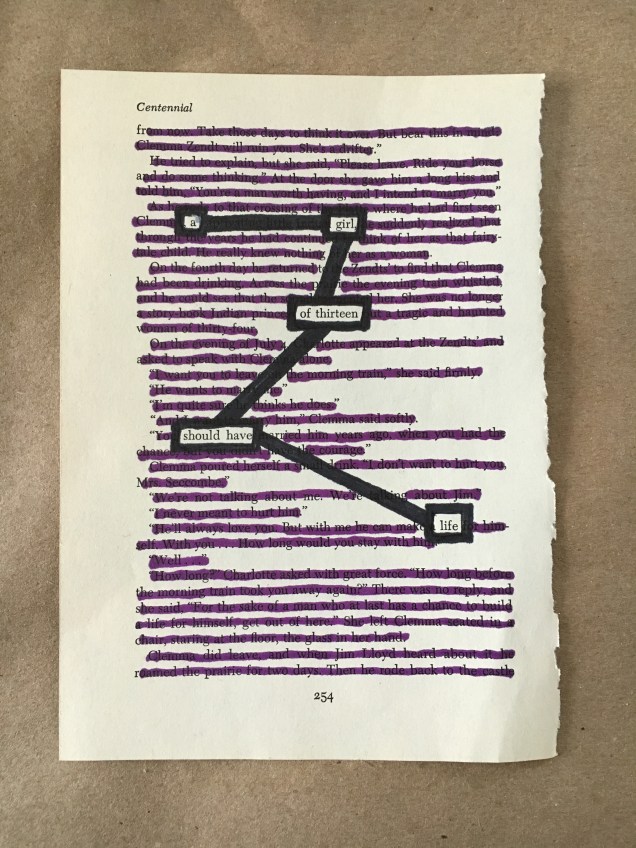
“A girl of thirteen should have life”

blackout-girl-of-thirteen

It’s been a difficult week for a small Indiana town where bodies were recovered of two young teenage girls who were simply thought to be missing.

Besides having happened in my corner of the world, my only connection to the events are that 1) my own children were once young teenagers; 2) I deeply love middle schoolers; and 3) I believe life is sacred – at every age.

But it does always hit a bit harder when someone dies too young. And middle school is absolutely too young, by far.

I did not know Liberty or Abigail. But I know countless other middle school girls, and I wish for all of them to live, to be known, to breathe joy, to know truth, to be seen, to be loved, to be listened to, to be valued, to be honored, to be cheered on, to be.

That doesn’t seem like too much to hope for, even in this often dark and dreary world.

In the most obvious sense, this is not my personal tragedy. And yet in the most truthful sense, this tragedy is all of ours. Each and every one of us. Because two of our own – two young human beings who lived and breathed and were – no longer are.

This should shatter us. 

It should shake our bones, open our eyes, and wake our sleeping souls.

“A girl of thirteen should have life.” Indeed she should. Indeed they all should – every person, every age, everywhere. We should have life – deeper, sweeter, and more meaningful Life than we could ever hope or imagine.

Oh dear God – bring light to the dark. Bring hope to the weary. Bring joy to the suffering. Bring your life to us all.

For we are lost – utterly and hopelessly lost – without You.


500 Reasons to Hope (post-inaugural & non-political things)

In the midst of an angst-ridden world (the reasons for which I am not inclined to either debate or deconstruct ) I am filled with hope – genuine, deep, joyful, solid, reasonable, tangible, and vibrant hope.

It has nothing to do with marching or winning, protesting or legislating, yelling or cajoling, or anything else that currently floods the media waves.

It has to do with this only: that in the past three weeks I have been in the presence of 500 people who are changing the world.

Their impact ripples past rhetoric, policies, statements, and signs. Their influence extends beyond sound bites, screen shots, strategic branding, and social media. Their identity is rooted deeper than gender, race, economic reality, and Enneagram number.

They are youth workers from across the country – students pastors, Young Life leaders, youth workers, WyldLife leaders, small group leaders, Capernaum leaders, middle school ministers, and Young Lives leaders.*

They are men and women – some paid (but many not) who love Jesus, love adolescents and believe that life without the Saviour isn’t life as it was meant to be. They spend their days living out these truths, working creatively and tirelessly to collide their passion, calling, and faith in such a way that Jesus shines brightly while students are loved deeply.

In the past three weeks, I spent time with 300 new staff from across the Young Life mission and 200 youth workers from 17 churches in the Madison area, which is to say: in the past three weeks, I spent time with 500 people who are changing the world because they are pouring into the lives of those who are often ignored, bemoaned, overlooked, demeaned, stereotyped, disregarded, brushed off, feared, sold short, sidestepped, and otherwise treated as less than someone created in the image of God.

These 500 people love, care for, spend time with, are committed to, walk alongside, mentor, listen to, talk with, and pour into middle school and high school students – joyfully, enthusiastically, fully, sincerely, energetically, and prayerfully.

While the world is focused on large-scale events; while people debate what should and shouldn’t be; while groups tackle policy and those who generate it; while movements stake a claim for their particular vision of right and wrong; while some embrace and others reject someone or something; while some cry foul and others cry fair; while the world spins crazily on its axis (as it has done since just about forever), I invite you to stop for just a moment and rejoice because FIVE HUNDRED PEOPLE (and so many, many more) who you will likely never see, meet, or know are quietly, confidently, boldly, and faithfully doing the work to which they’ve been called.

And because they are, this world is being changed, one beloved adolescent at a time.

Indeed, that is reason to rejoice. Over and over and over again.

[These people are changing the world – and the world is sweeter because of it.]

* WyldLife (Young Life’s ministry to middle schoolers); Young Life Capernaum (Young Life’s ministry to teenagers with special needs); Young Lives (Young Life’s ministry to teen moms)