Young Lives Camp, Day Zero: getting ready for mamas and babies

[*note: Young Lives is the a Young Life ministry for teen mothers]

This week in Michigan, in a little tiny corner of the world known as Timberwolf Lake, a group of people are getting ready for the arrival of 100-plus teen mamas … and their babies.

Yesterday, one little tiny spot in this little tiny corner of the world looked like this:

YLives no strollers

It’s a lovely place indeed, a place where many people hear the beautiful truth about Jesus Christ and God’s love.

But this week, it’s especially beautiful, because this week, it looks like this:

YLives strollers

In one short day, this place – intended primarily for teenagers without babies – has been transformed into a place absolutely and perfectly and completely intended for teenagers with babies.

I wish I could describe the transformation. Pack-n-Plays, high-chairs, booster seats, napping cots, tricycles, bouncy chairs, swings, kiddie pools, blocks, toys, toys, toys, blankets, sheets, diapers, snacks, juice, rocking chairs, and so much more. It all must be unloaded, unpacked, sorted, washed, organized, and delivered to twelve – yes, twelve different nursery spaces.

But it’s always the strollers that get me – those colorful, joyful, inviting, ready-to-roll strollers. They are the first thing the mamas will see when they climb out of a car, van, or bus. The strollers, saying, “We are ready for you. We’ve been waiting for you. We welcome you. We love you.”

Those are powerful words for a young mama to hear.

But they are not the most important worlds they will hear this week. These are: you are loved by a God who is not just a father but also a mother, like –

an eagle who hovers over its young
a hen who gathers her chicks under her wings
a comforting mother
one who gives birth to the dew and the frost.


Most breathtaking of all, when in the very beginning God breathed the breath of life into humans and made them living creatures, he was like a mother, for that breath (neshamah) is derived from an older word nasham, a verb that means “to pant, especially of a woman in travail or labour.” It shows up in Isaiah 42:14 where the LORD, marching forth like a mighty hero, will say:

I have long been silent; yes, I have restrained myself. But now, like a woman in labor, I will cry and groan and pant.

The LORD – our father God – like a woman in labor.

Gracious. Mercy. Astounding.

This week, 100-plus young mamas are going to learn about that God – the God who loves them, the God who became human to demonstrate that love, the God who offers new life, the God who created all life, the God who breathes life into us, the God who hovers, gathers, comforts, and gives birth to all that is.

Bless the LORD, oh my soul, for being just exactly what and who each one of us needs.


How to make a cereal wallet

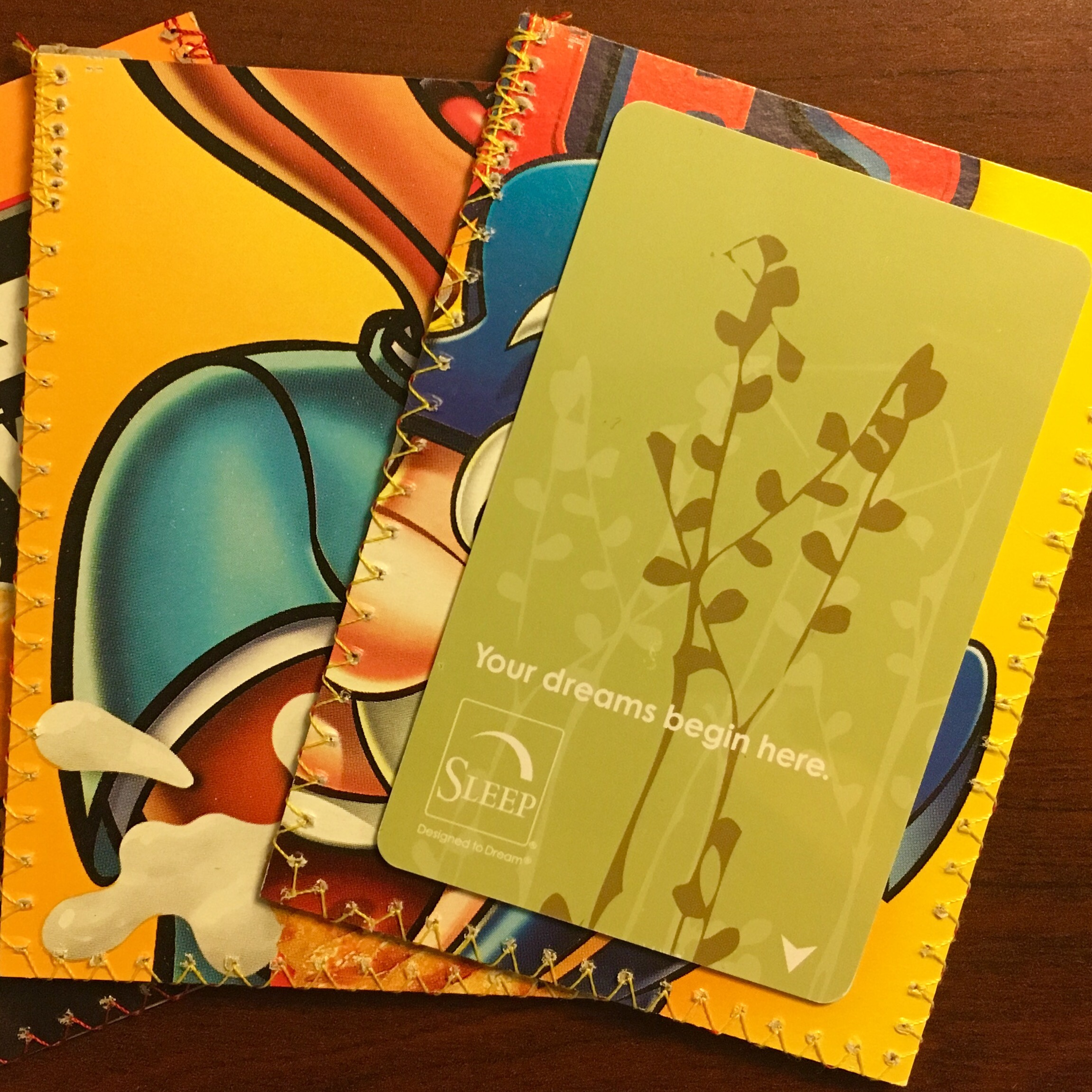
This is a cereal wallet. 

  
Actually, that is a trio of cereal wallets, which are in fact cereal box wallets – or even more precisely, pieces-of-cereal-boxes wallets, but who’s got time for such a sloggy name? “Cereal wallet” is perfectly concise and zingy. 

This is how to make a cereal wallet:

1. Cut two pieces from a cereal box that are this size (a litter bigger than a credit card, driver’s license, hotel room key, school ID, or Starbucks card) –

  
 2. Clip out a triangle from one of the cereal box pieces like this –

  
Don’t fret about perfection. Just snip-snip.

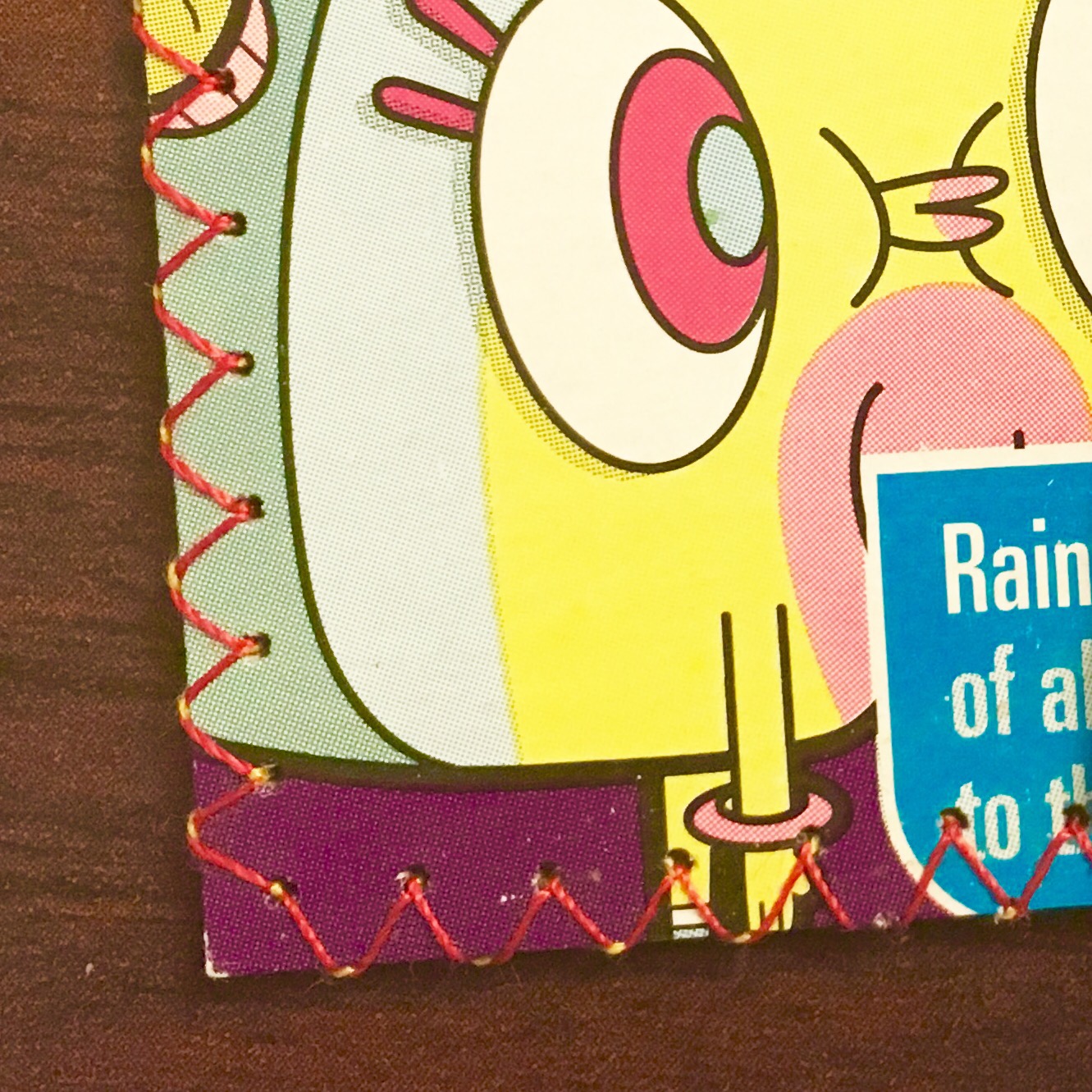
3. On a sewing machine, zig-zag around the edges like this –

  
 You know all those ridiculous colors you’ve accumulated over the years from altering bridesmaid dresses and patching baby clothes? This is your chance to use them all up. Finally. Forever. 

Be sure to do that forward-backward-forward thing (that probably has an official name) when you start and stop sewing, like this – 

  
4. Put something precious in the wallet, like a photo or a Starbucks card or a handwritten note or a dollar, like this –

  
Cereal wallets are the perfect kitschy and inexpensive token of you-are-awesome-ness. 

Important: cereal wallets are suitable for framing, public display, holding a dollar, and carrying in your pocket – but don’t swim with them. They will disintegrate. 

The end. 

You’re welcome. 


Clearwater Cove Day 0

CWC yl hands

In less than 24 hours, several hundred middle school students and leaders will descend on a sacred place in the Ozarks for the very first week of summer camp at Young Life’s Clearwater Cove.

Most of the world knows absolutely nothing about this.

But a very small sliver of the world – and all of God himself – knows very well what is about to happen here: fun, love, Jesus, grace, hope, and real life.

While much of society is bemoaning the current trends and behaviors of teenagers, twenty high school students have given up a month of their summer to willingly, enthusiastically, and joyfully serve middle school students at this sacred place nestled atop a mountain of rock. No joke. These people right here are people you should know. They are going to change the world – while they are still in HS – because they are serving the very God who made the world.

CWC work crew

In the midst of depressing headlines, deadly conflicts, and desperate situations, these twenty high schoolers (and 36 college students, and so many others) are choosing hope, life, love, joy, forgiveness, and transformation.

God does that. He gets hold of a person’s heart, flips it upside down and inside out, remakes it into something  alive, and sends it out into the wide world to be light and love, salt and sweet aromas, in order to draw others into his infinitely welcoming arms.

I don’t know what you’re doing this summer. But these folks here, and countless others like them across the US and the world, are doing something big and bold and beautiful: they are being obedient, they are being humble, they are serving, they are giving, they are considering others as more important than themselves – and because of that, God is going to do mighty things. I have no doubt.

Clearwater Cove, tucked away in a corner of God’s overwhelmingly breathtaking creation, is ready to fling wide open its doors and welcome teenagers to a week they will never forget. Gracious sakes – the work of celebration and the celebration of work have just begun, and for many people, life will never be the same again.

Five Rules for How to Use Media in Christian Education

We’ve all been there – whether planning a Sunday School lesson, a youth group meeting, or a Young Life club talk; that moment when we ask ourselves: “What video clip could really illustrate this point well, perhaps better than Scripture itself?”

It’s a deeply spiritual and philosophical question that is two-fold (when should and I use media and how should I use media) that often leads to deeply theological tangles (“Does Monty Python truly reflect the epistolary messages of Paul in their doctrinal fullness?”) that have no clear-cut answer (except in the case of Monty Python, when the answer is almost always “yes”).

To help with this distressing process of pedagogical discernment, I offer some much-needed insight from a little book I recently stumbled across:

Blackboard 1
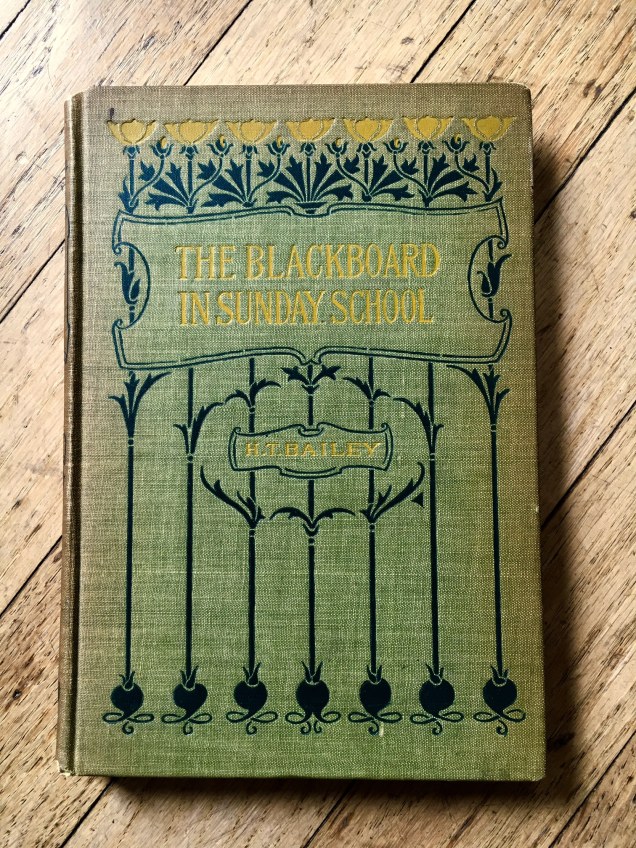
The Blackboard in Sunday School (Henry Turner Bailey, 1899)

See here The Blackboard in Sunday School, published in 1899 – right on the heels of The Blackboard in the Sunday School, published in 1884 (because if one book about blackboard use by Christians is good, two is better).

In 1899, the blackboard was the height of advanced technology – in the church, anyway. It was pretty well established in every public and private school across the country for 50 years prior. But we do so often wait until we’re very sure that something can be used by the Lord before we appropriate it from the wicked world into our own sacred milieu.

The book opens with a properly spiritual hook, a tragic narrative about another adolescent boy gone wrong (a hooligan, a ruffian, a petty criminal), a boy who at one time had regularly attended Sunday School.

Bad boy. Bad Sunday School. Bad church. Woe unto us.

Enter: The Blackboard. (There’s a few more plot points in the narrative, but I’m condensing for ease of space and time, a strategy often used in presenting the Gospel.)

Per the author, in 1899:

“Among all the workers for the coming of the kingdom of God, none, perhaps, ought to be held in higher estimation than faithful Sunday-school teachers. As a rule they are among the busiest people in the world, every hour of the week filled with crowding duties, every volt of energy required to do that which their hands are forced to do by the conditions of our congested life. Yet these, who most need a Sabbath of rest, cheerfully devote that day to teaching, give to their classes their best thought, and patiently continue year after year a self-sacrificing service without remuneration, perhaps without a word of encouragement or appreciation.

“It would be cruel to add one straw to the burden such men and women are carrying, especially by a word of harsh or cold criticism. But sympathetic criticism is never unkind. The truth, spoken in love, and the truth only, will enable us to see ourselves and our work in clearer light and move us to self-improvement.” (24)

Then follows a long essay on why over-busy, under-appreciated, un-paid Sunday School teachers should learn how to use the blackboard.

[In fairness, the pedagogical premises in the book are solid: 1. Learning is dependent upon interest and attention; 2. Ideas must be taught by means of their appropriate objects; 3. Never tell a pupil what he may wisely be led to see for himself; 4. Proceed from the known to the related unknown; 5. Correlate with the life of the pupil.]

And then follows all a person needs to know about how to effectively use graphics and media to supplement and enliven the teaching of God’s truth.

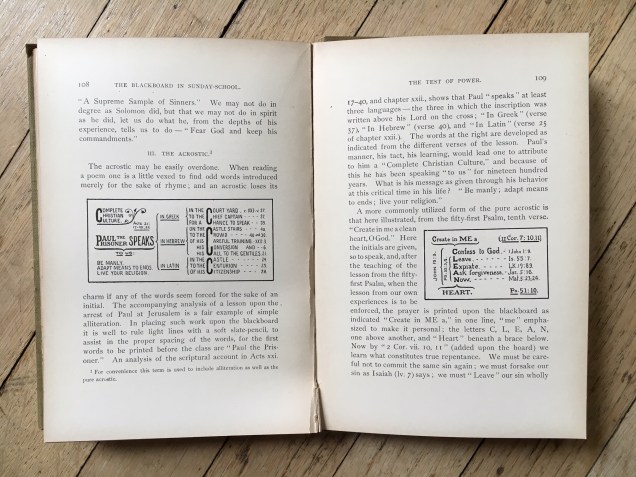
  1. Use fonts purposefully:

blackboard fonts

2. Use emojis freely:

blackboard emojis

3. Use photo-editing judiciously:

blackboard photoshop effects

4. Use info-graphics intentionally:

blackboard infographic

5. Use visual data liberally:

blackboard visual data

Above all, remember this:

“The Sunday-school teacher who understand all mysteries and all knowledge, who speaks with the tongues of men and of artists, but who has not insight, good sense, wisdom in adapting means to ends, will fail…When the question of the week is not, ‘How shall I teach that lesson?’ but, ‘How can I find a blackboard illustration for that lesson?’ it is high time to ask another question: ‘Is it wise to use the blackboard every Sunday?’ The answer must be simply, No. Because one can use the blackboard is no reason for always using it…The blackboard should be a servant, not a taskmaster.” (88)

Thus do our ancestors whip our little media-frenzied technology-addicted butts into shape.

Amen.

Naughty teens, pernicious literature, and scare quotes: a glimpse at 1884

Youth's Golden Cycle

132 years ago – when (according to some) people slipped seamlessly from childhood into adulthood – John Fraser (Professor of Rhetoric and English Literature, University of Chicago) published a 439-page-thick doorstop book titled:

Youth’s Golden Cycle: or, Round the Globe in Sixty Chapters: Showing How to Get on in the World, with Hints on Success in Life; Examples of Successful Men; The Blessings of Loving Mothers, Careful Housewives, Clean, Cozy Homes; What and How to Eat and Drink: What to Read and How to Write; the Structure and Uses of the Most Important Members of the Body; How to Be and Keep Strong; The Wonders of Creation, Science and Art; Little Things-their Importance; Entertaining Stories of Animals; Animals-their Language and Habits; (etc.)

Back in 1884, titles were often as cumbersome as the books themselves.

This book was written for adolescent readers in response to “the rapid increase of the evils that result from the reading of pernicious literature,” “immoral fiction,” “bad books,” and other things being written by “vile writers” and being marketed by “worse publishers.”

Shocker: the market has been targeting teens for quite a while now. And adults have been afraid about the commercialized culture for as long as the market has been targeting teens. As the author says in his introduction:

“Every hour, the havoc wrought by the perusal of immoral fiction by our school-boys is assuming graver aspects. Almost daily we read of bands of youthful desperadoes, just entering their teens, being broken up by the police, and nearly always it is found that the organizations so broken up were directly suggested by dime novels…”

In other words, young teens and the media marketed to them have been viewed with alarmist fear for – well, for quite awhile now, even long before 1884. Cell phone apps and music videos may be new; the fears surrounding them are not. Nor are our lofty attempts to replace the offending filth with something nobler.

This particular book attempted to do just that: “Now the express object of this book is to counteract the evil influence of this vicious literature, and to furnish youth with reading that will be as exciting as any novel, and at the same time instructive, wholesome, manly, and fresh. Nor will it be of the ‘goody-goody’ order, to which so much of our Sunday-school literature belongs.”

Ouch. Genuine scare quotes in 1884. “Goody-goody” used pejoratively in 1884. Sunday-school taking it on the chin in 1884.

In some ways, things haven’t changed at all.


The “problem” with middle school ministry (how they got it wrong…again)

In case you missed it, middle schoolers (all of them, presumably) are in the news this week.

Real Simple (which I thought was mostly about food, fashion, and repurposing canning jars and wood pallets into anything and everything you could ever need or want) recently posted this story:

“Sorry, Parents. Middle School is Scientifically the Worst (and you thought the Terrible Twos were bad).”

Spoiler alert: the article isn’t very hip on early adolescents. And I quote: “middle school is not fun for anyone” and “[every middle schooler is] a surly, exasperated pre-teen.”

Bah. Boo. Piffle. Grrr.

Then there’s this from Science Daily last week:

“Mom, You Think Babies Are Tough? Wait Until Middle School.”

This sounds a little less alarmist than the other article, but equally down on middle schoolers. How thoughtful of them.

Both articles are lay-summaries of a study out of Arizona State University titled:

“What It Feels Like to Be A Mother: Variations by Children’s Developmental Stages” (Luthar and Ciciolla, Developmental Psychology 52:1 (2016), 143-154).*

You may notice that this title doesn’t diss middle schoolers at all – doesn’t even mention them by name. That’s not to say the article is all warm and fuzzy on middle schoolers. In fact, before the study was even conducted, the authors “anticipated, first, that the middle school years would be the most challenging” for mothers. (Fathers weren’t part of this study, so there’s that to consider.)

The study – conducted between 2005 and 2010 – of 2,247 well-educated American women showed that many mothers (many of those specific mothers, anyway) do/did in fact experience some more negative things and some fewer positive things when their children were in middle school than when their children were other ages.

So, therefore, hence, ergo middle school is scientifically proven to be The Worst.

The End.

Except for, well, these (and other things) that the authors concede:

  • mothers might have experienced higher stress levels because they themselves often become busier when their children reach middle school (extra-curricular activities, more friend events, extended soccer-mom chauffeuring – that kind of thing)
  • mothers might have sensed more child negative to me attitudes – which were measured by distancing behaviors because middle school is when children start naturally displaying more independence
  • mothers might have experienced less fulfillment and lower levels of life satisfaction because of their own transition to mid-life (a time of “heightened introspection and increased awareness of mortality” due to “declines in their physical and cognitive functioning” (150) or: My Life Rots)
  • mothers might have experienced more depression and parenting overload due to “contagion of stress” in which mothers internalize and worry about their children’s ability to cope with middle school challenges (perhaps because she is reliving her own middle school experience, something mothers are notoriously good at doing)
  • &c.

All of that to say – “Middle School is Scientifically The Worst” is horribly misleading and ridiculously unhelpful and eminently unfair – to middle schoolers primarily, but also to those who care about them.

But it sure makes for a dramatically catchy headline, which the world loves. And it confirms what those of us in middle school ministry know the world thinks of us: “you are big losers” (or maybe “you are demented saints” depending on the day).

But we know better. We know that we are the big winners not because of anything we’ve done or said (don’t stumble by patting yourself on the back) but because Jesus has graciously given us an enthusiastically authentic love for the kids too many people think are unlovable and unmanageable.

Guess what: we don’t care one teeny tiny bit about dramatically catchy headlines. We care about middle schoolers – each of them and all of them.

Here might be the most important statement in the study:

“This developmental transition [early adolescence] is especially difficult because junior high schools bring decreased personal, positive relationships with teachers at a time when youth particularly need connections with supportive adults.” (150)

Spoiler alert: enter – you.

The middle school pastor. The Wyldlife leader. The involved parent. The caring aunt and uncle. The interested neighbor. The loving grandparent. The faithful small group leader.

So go ahead – go change a middle schooler’s world today by showing up, being present, celebrating them, sharing real life, and breathing Jesus all over the place.

Really. Just go do it. Now. Because the only problem with middle school ministry is that there’s not enough room in our hearts for all the love for all the kids.

*The original peer-reviewed study can be accessed through EBSCO host PsycARTICLES research database. You can find an earlier public-access version of the study here.


Walking on Water: how we (maybe) got the story of Peter wrong

Like all adventurous, busy, do-big-things followers of Jesus, I love the story of Peter walking on water. Matthew 14:22-33 is a guaranteed slam-dunk sermon passage for me. It exhilarates me. Enlivens me. Emboldens me. Elevates me. (That’s a whole lot of me.)

YES! I’M READY! I’M WILLING! CALL ME OUT ONTO THE WATER, JESUS!

(Insert the lyrics for “Oceans” here.)

But four years ago, that all changed – not because of an outer tragedy or an inner crisis, but because I read the story very, very carefully – the story as it’s recorded in Scripture, not the story as I’ve learned to know it over the years.

I think that just maybe we’ve been missing something – something desperately important, especially in a culture that upholds and exalts Doing Very Big Things for Jesus.

CONTEXT:
Jesus had just fed thousands of people – 5000 men, plus women and children – with only five loaves of bread and two fish (for you grammarians, fishes if they were different species). He multiplied the food over and over and over, an endless bounty of simple sustenance, until everyone was fed and full. The disciples did the grunt work of distribution, passing and delivering the food to a sold-out crowd.

Even if there were only a 1:1:1 ratio of men, women, and children, each disciple still connected with over a thousand people – a thousand people who I am positively sure knew what was going on. A story like that doesn’t stay quiet. I suspect that after the first hundred or so people ate from the same loaf of bread and the same fish, the whispers started. Even without social media, stuff like that doesn’t go unshared.

On that day, the disciples had become the peoples’ visible connection with this manifold miracle. They are known. They are stupendous. They are really something. They are with the band. They ARE the band.

COMMAND:
Immediately after the people had been fed – right on the heels of burgeoning celebrity-hood for the disciples (who are with the band, who ARE the band) – Jesus insisted (aka commanded) them to
get back into the boat and
go back to the other side while
he sent the people away.

In other words: being with the band (being THE band) didn’t count for anything. No one would have a chance to shake their hands, tell them how awesome they were, snap a selfie (or a hundred) with them, ask for an autograph, whatever.

GET BACK IN THE BOAT AND GO BACK TO THE OTHER SIDE. Period.
I’LL stay with the people. I’LL take care of the people. I’LL send the people home. I’LL close out the miraculous day as I see fit. (That’s a lot of Jesus.)

You guys (“the band”) don’t need to worry about it. So long. See you soon. Trust me on this one.

Here’s the thing about the boat: it’s b-o-r-i-n-g. It’s drudgery. It’s the same-old-same-old. It’s the very thing some of the disciples had been called out of (praise the sweet Lord) in order to follow Jesus in the first place. It’s the world of fishing, smelliness, repetitive daily routine, seclusion, not-being-known-ness, not-being-with-the-band-ness.

The boat is not spectacular, stunning, astounding, adventurous, stupendous, or anything else that makes us feel fantastic and awesome.

The boat stinks. And maybe also sucks, depending on how the day is going.

CRISIS:
As if boring, stinky, nothingness weren’t bad enough, weather patterns turned traitor and the disciples – in the boat, not with the crowd, on the lake, not walking home with the people (where they could have, you know, talked about what a great day it had been) – are whomped by a storm. Far from land (which, by golly, is where they deserve want to be) they’re fighting heavy waves (and maybe also thinking, “Great job, Jesus – nice follow-up to the fish and loaves thing – the crowd undeservedly get fed with crumbs, and we undeservedly get whomped by wind. We cry foul.)

Isn’t that how it often seems to go? We do what Jesus says (even if it’s ridiculous and anti-self-serving) and then get whomped.

And if that weren’t bad enough, GHOSTS ON THE WATER!

COMFORT:
 Immediately (that word again, at just the right time) Jesus spoke to them.
Don’t be afraid.
Take courage.
It’s me.
I’m here.

(Say it over to yourself a few times. A few times more. Go on – it’s important.) Isn’t that just like Jesus? To gently speak words of comfort and calm to us, just when we are all tangled up with irritation, anger, and frustration with him?

“CALL”:
This is where the story gets good, where Jesus lays down the ultimate call and challenge to Peter (and us), where we stand on the precipice of magnificent courage and accomplishment, where we ready ourselves to become one of the great ones. (That’s a lot of we.)

This is where Jesus calls Peter out onto the water.

Except that it isn’t.

Rather, this is where Peter lays down the ultimate self-serving whomp on the God of the universe, the Jesus of bread and fishes, the Spirit of love and comfort. This is where Peter says:

Lord (read: you are trustworthy and deserving of my obedience…except that thing about getting back in the boat)

if it’s REALLY you (read: I hear your voice, I know your voice, but your voice recently told me to get back in the boat, so, you know…)

tell me (read: I’d prefer a different narrative, a better life story, hence I will use the Greek word that means “command” here because I want it to be that strong, that definite, that anti-the-thing-you-previously-told-me-to-do)

to come to you, walking on the water (read: though it serves absolutely no one except myself and has no purpose beyond – well, nothing – I feel inclined to do something that only God can do like, well, let’s go with walking on water, shall we?).

Let’s review:
1. Get back in the boat.
2. Go to the other side.
3. Don’t be afraid.
4. Take courage.
5. It’s me and I’m here.
6. If it’s really you…

Here’s the thing about Jesus: if we are determined to climb out of the boat into which he has commanded us, and to walk in the direction opposite of which he sent us, and to attempt something that only God Almighty himself can do – he lets us. 

Jesus might have thought something like this:
Okay Peter. I know what’s going on here. I see what you’re struggling with. I know the disappointment you’re carrying. I understand your weakness. Sigh. This is going to be disastrous – but I will not force you into anything you won’t willingly do, so come on out. (Brace yourself, Peter – remember this is what you wanted, Peter – ready yourself for what is logically going to happen next, Peter – .)

SINK:
(Yes, I know it doesn’t start with a ‘c’ – some words just don’t. “Crash and burn” is too aeronautical. Metaphorical conundrums are a real thing.)

What a surprise. What an unexpected turn of events. What a shocking plot development.

Peter – the man, the fully-and-only-human human being, the both non-divine and non-aquatic one – sinks.

Do you know what the story doesn’t say? It doesn’t say, “When he took his eyes off Jesus.” Nowhere. Really. It just says:

“When he saw the strong wind and the waves… (if the storm were as bad as the story says, Peter would have seen the strong wind and waves without ever taking his eyes off Jesus. They were all around him. Everywhere. So much so that seasoned veteran fisherman were troubled and afraid. They may have obscured his view of Jesus, but they didn’t overpower his view.)

“…he was terrified…” (No kidding. Of course he was terrified. He was stepping out onto water. This might have been the first common-sense thing Peter did that night – to acknowledge the vey real terror of that moment because, newsflash, he was a human and humans weren’t created to walk on water.

“…and began to sink.” (See above.)

COMFORT (the sequel):
Immediately (that word again – almost like Jesus is right there all along, knowing just what we’ll need and just when we’ll need it) Jesus reached out and grabbed him, almost like he knew this was going to happen, in which case my response (were I the son of God and Savior of the world) might have been something like:

Peter, you got what you asked for.
Peter, this is a logical consequence of your choice, so think about that for a minute.
Say you’re sorry, Peter – 490 times, please (that’s 70 x 7 in case you can’t do the math).
Let’s reflect for a moment on what really happened here, Peter, shall we?
Et cetera. (I am a mother and have a deep reservoir of similarly witty phrases.)

Jesus did and said none of that. He just reached out and saved him. Immediately. Even though Peter deserved what he got. Even though Peter was as stubborn and self-serving as a mule. Even though Peter was as short-sighted as whatever creature is short-sighted.

Fact: Peter deserved to sink, maybe not because of insolence, but surely because of stupidity.

Further fact: Don’t we all?

CORRECTION:
The story could have gone like this:

Then Jesus said to the other disciples in the boat, “Let’s discuss Peter’s actions. Who can tell me where he made his fatal mistake? James? John? Anyone?”

Or it could have gone like this:

Then Jesus turned away from Peter and pretended nothing had happened. Rather, he ignored him for the next hour (rightfully so) and let him stew in his own miserable smallness and inflated self-importance.

Or maybe this:

Then Jesus said, “That’s it, Peter. I’m done with your petty, thoughtless, impulsive, Peter-centered way of living. You may get bonus points for enthusiastic energy, but you get an F for everything else. When this boat gets to the other side, you’re outta here.”

But of course it didn’t happen like that.

It happened like this:

Holding him tightly, hauling him up from under the pounding waves, and dragging him back to the safety of the boat, Jesus said to Peter, “You have so little faith. Why did you doubt me?”

After following Jesus for a lifetime and knowing the Bible like the back of my hand, I was very sure the story said: “Why did you doubt that I could make you walk on water? Why did you doubt that you could do something so stupendous and spectacular and adventurous and world-changing? Why, Peter, why???”

But it doesn’t. It just says, “Why did you doubt?” And I think Jesus meant:

Why did you doubt I was who I said who I was?
Why did you doubt that I would protect you in the storm?
Why did you doubt that when I said “Get back in the boat and go back to the other side” that was really what I wanted you to do?
Why, Peter, why??

I hate the boat. I have lots of them, and to varying degrees, I want nothing more than to climb out of them so that I can do Big Things for God. I’m pretty positive that’s what he wants of me.

But I’m learning – very slowly, which is how I do most things in life – to live in the boat contentedly, peacefully, intentionally, joyfully even. Not because I’m afraid to step out of it – but because I’m inclined to step out of it for all the wrong reasons. I’m a chronic boat-climber-outer. That’s a real thing.

Here’s what I’ve learned over the past few years (because I was too smart and too thick-headed to learn it before that):

‘In the boat, going to the other side’ is where most of life happens – in the mundane, day in and day out routines of life.

‘In the boat, going to the other side’ is not the same old same old if it’s done with an obedient heart and a joyful spirit. It’s only the same old same old when done with a bitter, constricted, petty, discontented spirit that is typically human-centered.

We all desire to do big things for God. Really Big And Awesome Things. We assume this requires us to be brave (Yes! I will! I am! I am better than Peter!) and we assume that being brave means climbing out of the boat onto the stormy sea.

Maybe that’s not brave. Maybe that’s just stupid. And self-serving. And disobedient.

Maybe the real courage happens there – in the boat – where God has placed us – where nothing “Big” happens – where we don’t keep trying to write a better story of our lives because we are busy living the life God has given us – where no one sees us or applauds us or notices us or follows us or says, “Oh my, look at her! Look at him! What a sight! Gracious, aren’t they grand?!”

Maybe the real question isn’t, “When God calls you out of the boat, will you be courageous enough to go?” but rather, “When God commands you into the boat, will you be obedient enough to stay?”


Being small (in which the Perseid meteor shower and Indiana corn give perspective)

By all accounts, last night was the peak viewing time for the Perseid Meteor shower (per here and here and here and here and a hundred other places). I would give almost anything to see a real Mrs. Whatsit, Coriakin, or Ramandu for even just a split second*. Since that’s unlikely (in this lifetime at least), a meteor shower seemed like a good option. So we set the alarm for 2:00 a.m., climbed into the pickup with our pillows, blankets, and dog, and headed north on 43 in search of glory.

Mostly, we found corn.

Meteor Corn (Photo: CKirgiss)

To be fair, corn is a glory of Indiana, and I surely do glory in it as much as any other devoted Midwesterner.

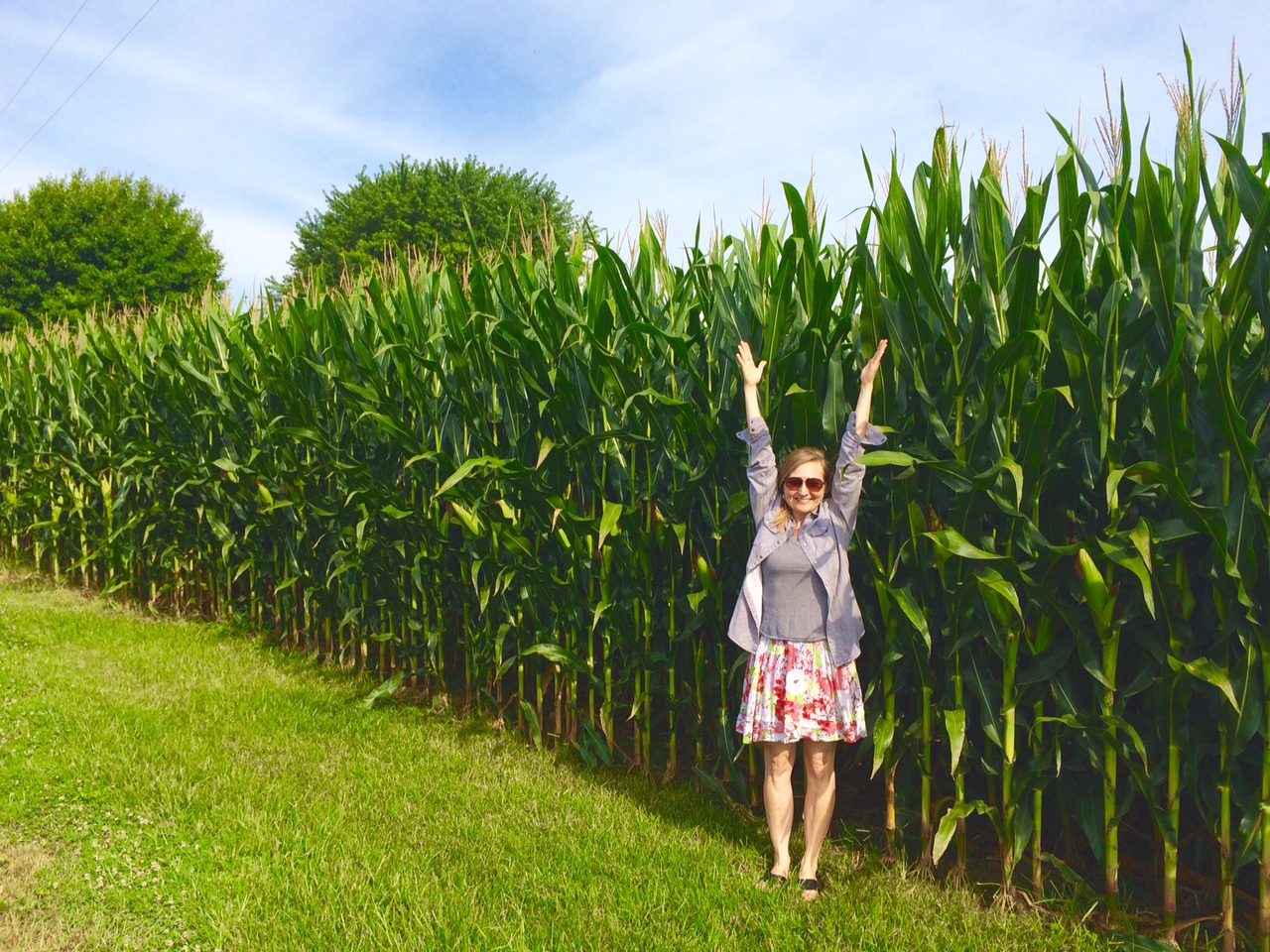
Regular Corn (Photo: CMartin)

Fact: corn makes me feel small.

Even with my arms stretched to the sky, I am dwarfed by those solemn stalks of jade leaves drooping gracefully towards the earth below and those delicate tassels of filagreed gold reaching elegantly towards the sky above. All of that majestic height – row after row after row sweeping across the endless countryside – is stunning not just for its immensity but also for its unexpected smallness; each of those towering stalks gives birth to a single ear of corn (twins and triplets occur sometimes).

One ear of corn. All of that height and hugeness and majesty for just one ear.

It’s ludicrous in a way. What a (seeming) waste of plant.

Which brings me back to the Perseid meteor shower that (by all accounts) peaked here in corn-covered Indiana last night.

We laid in the truck bed, wrapped against the chill (and also against the hard plastic of the truck liner made of dent- and scratch-resistant plastic molded into an innovative ribbed design – or: bad for the back), eyes wide open, prepared for glory, waiting for majesty.

Here’s the thing about glory and majesty: you can’t capture it in words, or in a photo, or in the largest corner of your mind, because words and photos and large corners of the mind are too small to speak or see or comprehend glory and majesty.

Fact: the night sky – even without a meteor shower – makes me feel small.

Even though I can block out a large swath of invincible lights with my outstretched hand and can compress infinity behind my closed eyes, I am dwarfed by that canopy of heavens reaching down to the earth’s firm edge and soaring up to the sky’s endless cosmos. All of that incomprehensible magnitude  – layer after layer after layer sweeping across the endless universe – is stunning mostly for its immensity but also for its unexpected smallness: many of the meteor shower particles dragging streams of trailing light behind them are the size of a pea – as in the vegetable that is much much smaller than a stalk of corn.

How can this be? How can a speck of dust stream across the night sky in a blaze of energy that makes you catch your breath and clasp your hands for the sheer beauty and unexpected joy that it brings?

That is me. A speck of dust. Tumbling through life, tossed here and there, one of 7 billion souls on the planet, desperately seeking a way to blaze across the sky – not in fame or renown or majesty, but in glory – not the glory of self but the glory of the Almighty.

There are (by all accounts) 1 octillion stars in the night sky. That’s 1 plus 29 zeros. Try to fathom that for a minute. Words and pictures and thoughts can’t begin to compute such an incomprehensible number. Even 7 billion (which has only 9 zeros and which [by all accounts] is how many people currently live on this tiny ball of earth) is beyond my ability to compute.

So sit in this truth for a moment or a day: each and every one of those 1 octillion stars is named, known, and placed. Each and every one. Surely God has enough on his universe-sized hands to consider small and paltry us not worth his time.

Now sit in this truth for a moment or a lifetime: when He considers the night sky, the work of His own fingers, the moon and stars He set in place, He considers them as nothing compared to small and paltry us. Nothing. Nothing.

New math rule 1:

7 billion people > 1 octillion stars.

New math rule 2:

1 single soul > 1 octillion stars.

Sit in that for a bit and see how it stirs up your soul.

*A Wrinkle in Time and Voyage of the Dawn Treader. Read them. Now

The Big Cookie turns 21: the authorized** and re-updated history of Young Life Castaway Club’s signature dessert

**update and addenda at end

(Originally written in 2015, and updated shortly thereafter.)

(Reposted in 2022 for the BC’s 20th birthday.)

(Updated in 2023 for the BC’s 21st birthday.)

The Big Cookie - exhibit A Castaway Club’s The Big Cookie

Once there were four friends from the suburbs of Chicago who were fans of Lou Malnati’s pizza. For obvious reasons. Reasons like, oh, I don’t know, World’s Greatest Pizza of All Time. (They ship nationwide. Game changer.)

On Friday nights, instead of going to the lights, they went to get Lou’s pizza. For obvious reasons. See above. They ate pizza for dinner. If their guts and souls weren’t full, they ate pizza for dessert. Chocolate Chip Pizza, that is, “a freshly baked chocolate chip cookie prepared in a deep dish pizza pan, topped with vanilla bean ice cream and whipped cream. Serves 2-3.” 1610 calories per serving. In case you’re wondering.

Some years later, one of those four friends from the suburbs of Chicago – let’s call him Russell – found himself working in the kitchen at a lovely little place in northern Minnesota called Castaway Club (a Young Life camp) alongside the main chef – let’s call him Dave. During the summer months, Castaway Club serves 3 meals a day to 400 people, give or take.

One day in early 2002, Russell and some Castaway Club co-workers drove to The Medium-Sized City just down the road a ways to eat at a new “chicago” pizzeria – which every Chicagoan knows is a slippery claim to make and a nearly impossible standard to uphold unless the pizzeria is, you know, actually in Chicago. They went hoping for the best, but prepared for much less.

That “chicago” pizzeria in A Medium-Sized City on the outskirts of northern Minnesota had a chocolate-chip-cookie-ice-cream-ish dessert on the menu. Like Lou’s. Sort of. The friends ordered it. The friends ate it. The friends thought about it. Then Russell – the only Chicagoan in the bunch – said to his friends, “Hmmm. Well. Er. We could do better than this. Way better. We could make The Real Thing.”

He wasn’t talking about making The Real Thing for that small group of friends. He was talking about making The Real Thing at camp. For 400 people, give or take.

Thus began a long process of experimenting with ingredients, temperatures, timing, pans, ice-cream, serving, and all sorts of baking-in-a-big-kitchen-for-several-hundred-people issues. With summer fast approaching, there wasn’t much time to crack the code of The Perfect Dessert.

After several months of trying all manner of bakeware, schedules, recipes, and systems (see ** at end of post), Russell, Dave, and some others – let’s call them Kristina, Mandi, Lindsay, and Brad – finally perfected what has come to be lovingly known as The Big Cookie.

The secret to its success is simple:
1. keep it simple (just cookie and ice-cream)
2. keep it hot (on the bottom)
3. keep it cold (on the top)

That’s it. Really. Truly.

Keeping it simple, though, isn’t easy. It rarely is.

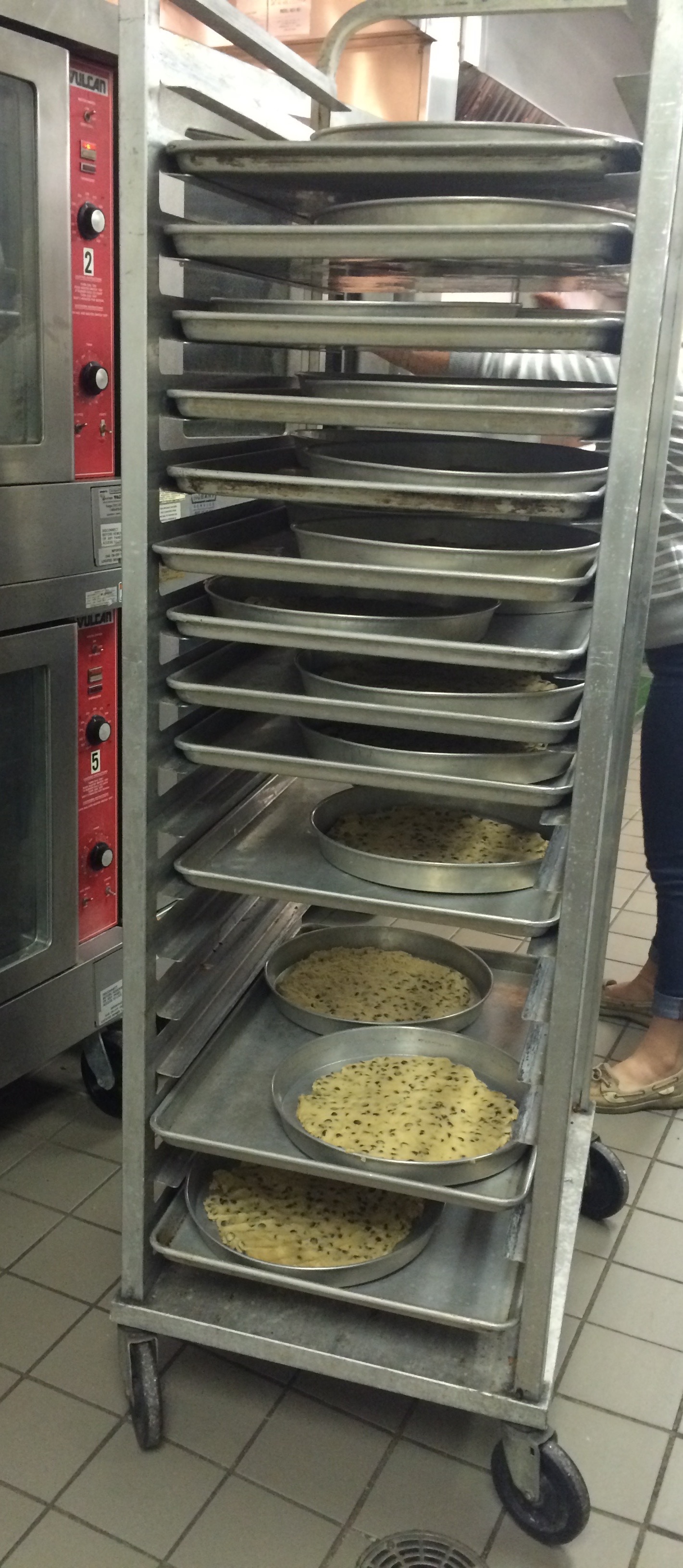
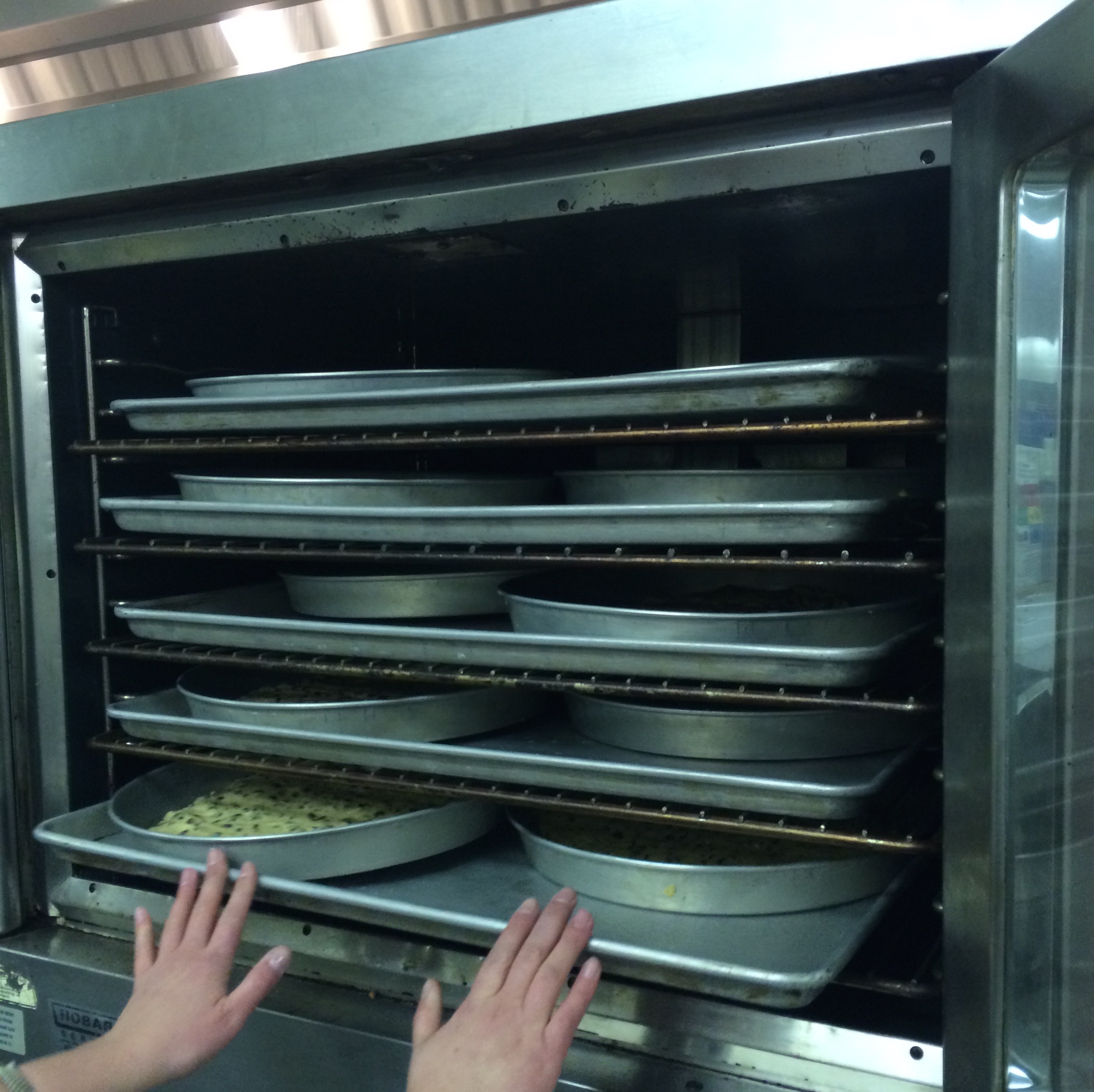
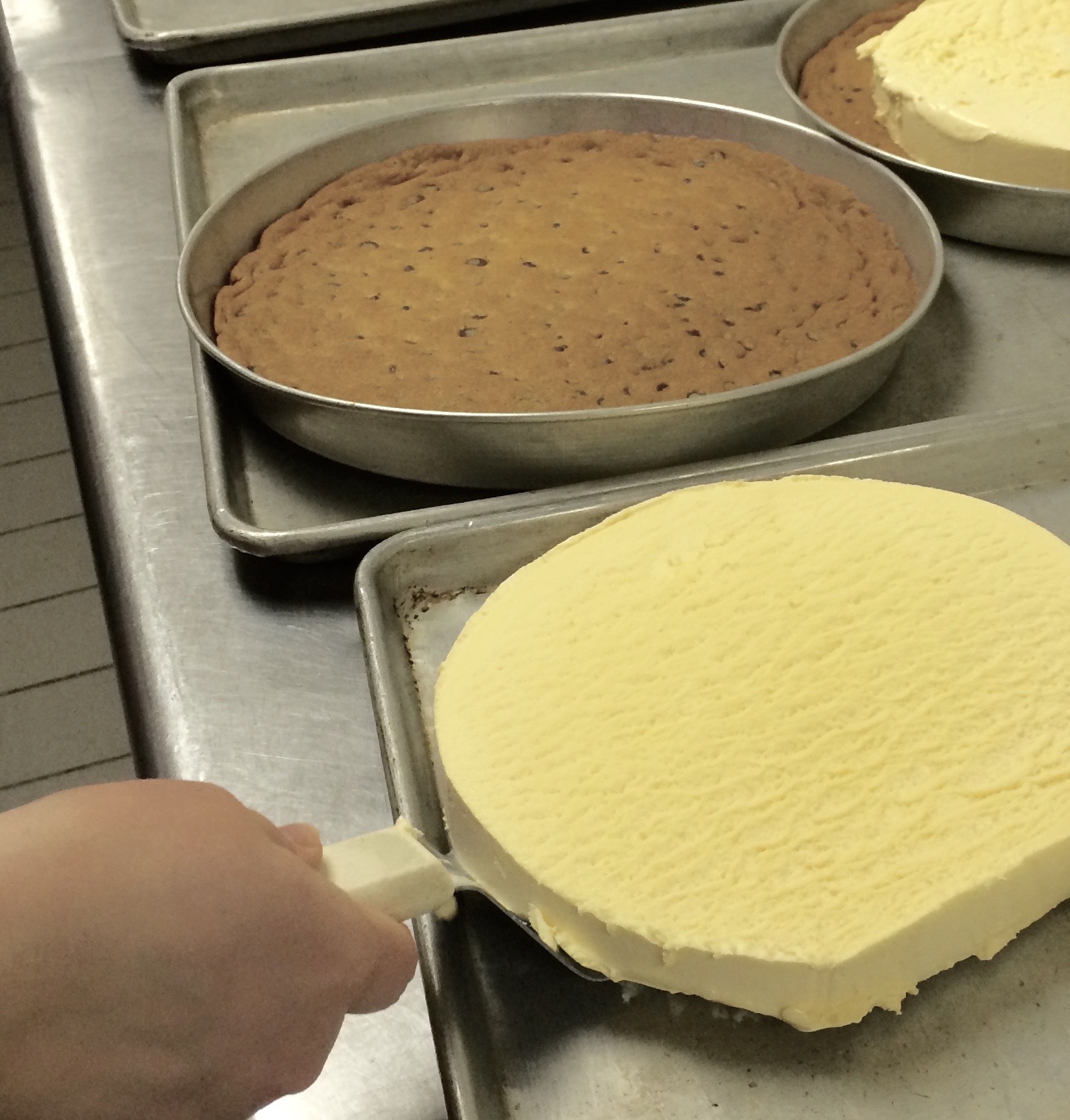
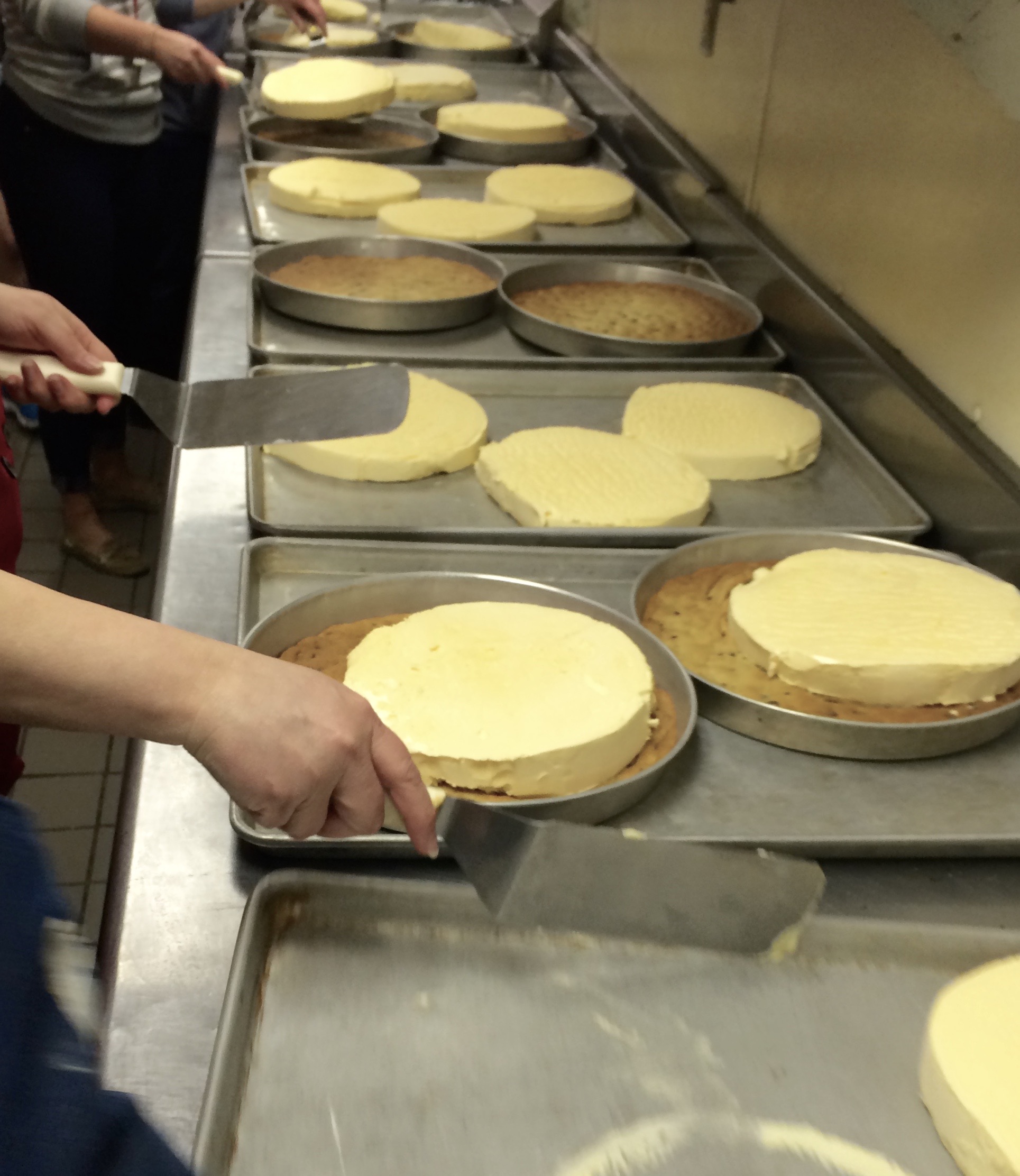
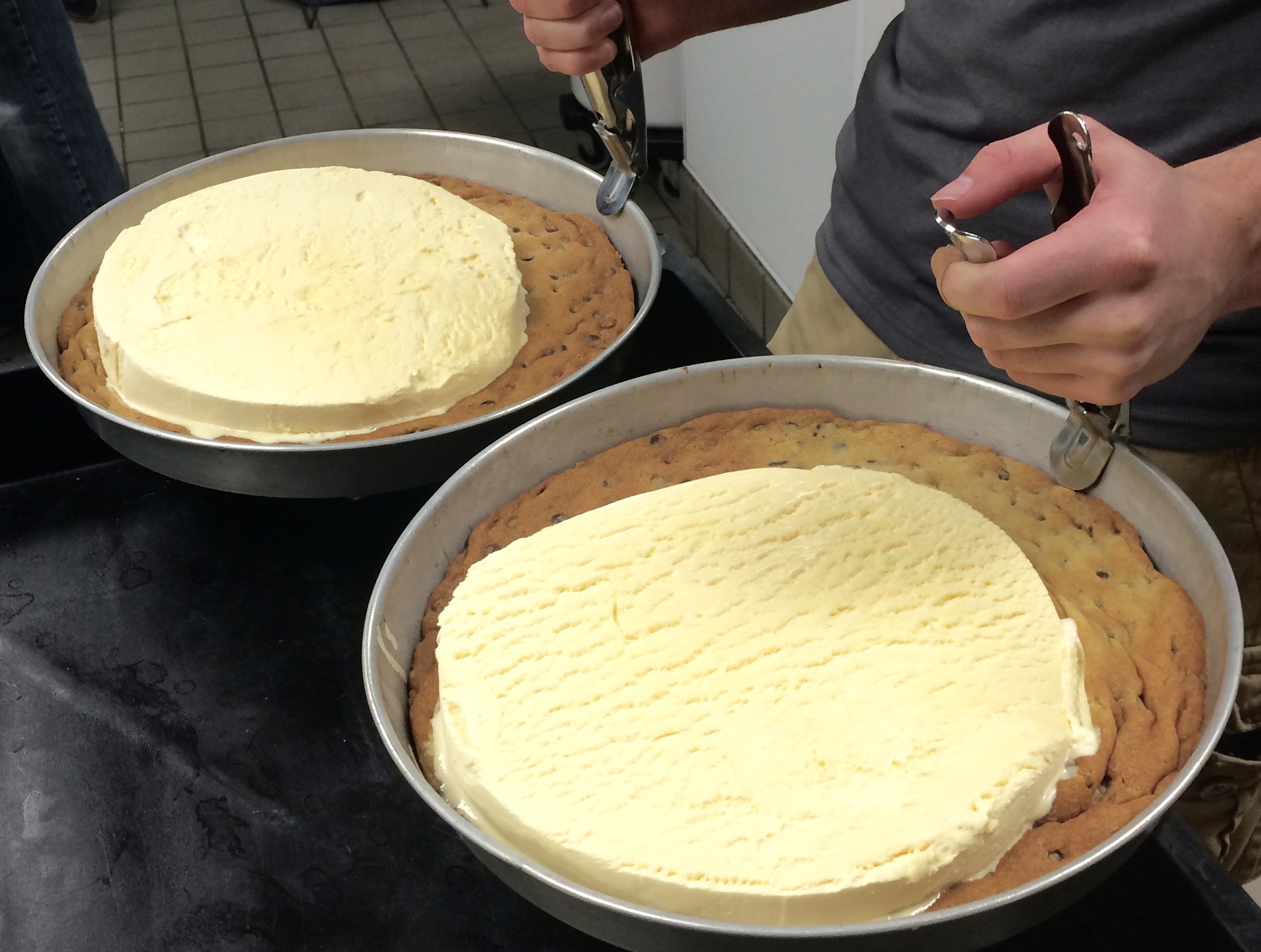
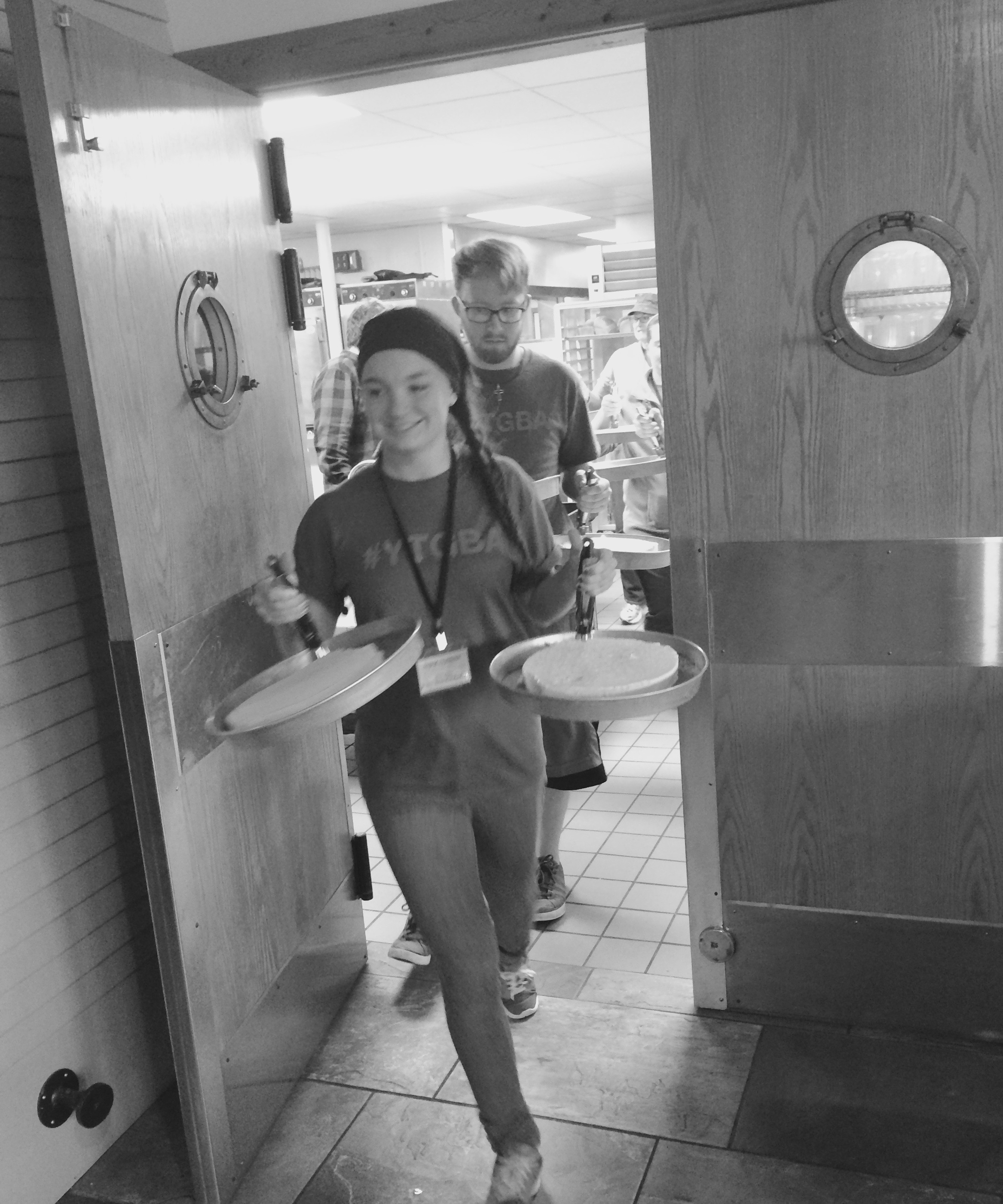
After serving dinner to 400 folks, the Big Cookies – pressed perfectly into their deep-dish pizza pans – go into the oven. Not a moment sooner. While they bake, thick round slabs of ice cream – cut and kept frozen until just the right moment – are rolled out of the freezer. Just as 400 folks finish eating their dinner, the Big Cookies come out of the oven, cooked so that the outside is perfectly browned and the inside is perfectly gooey. Each one is quickly topped with its own wheel of ice cream that cools the cookie innards just enough to maintain the just-on-the-edge-of-gooey stage while the hot cookie warms the ice cream just enough to make it just-on-the-edge-of-melting creamy. And then they’re served. Immediately. Without a moment to lose. While still hot/frozen. While still perfect. While still sublime.

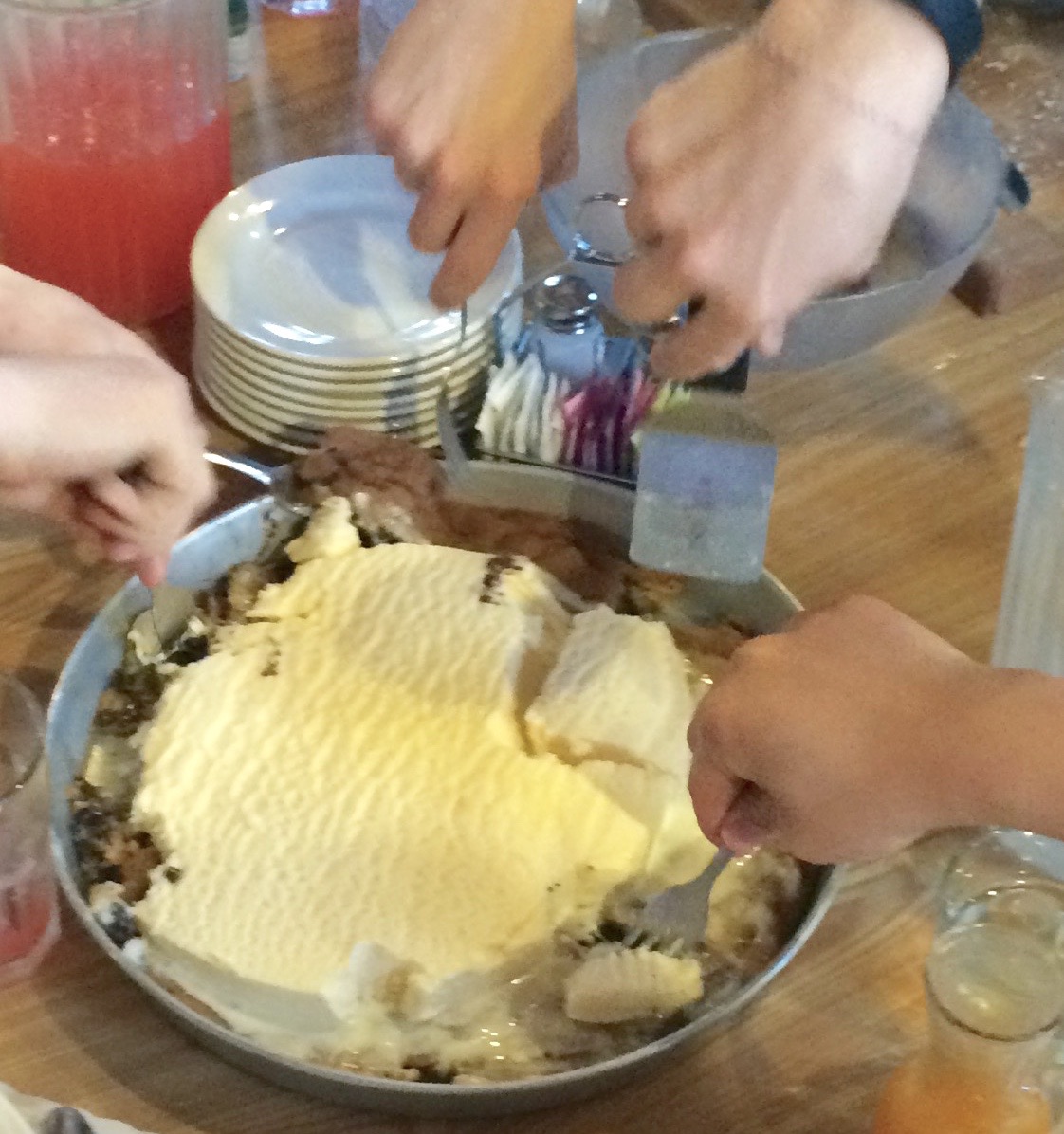
There is no eating etiquette. Fact. Anything goes. [Actually, post-CoVid, anything doesn’t go – but it’s still nice to remember those days of yore.] Some people like to savor the wonder. Others like to inhale it. The only rule about eating The Big Cookie – and it’s more of a law, really, like gravity, because it’s not legislated on the front end but it proves to be true on the back-end 100% of the time – is that it must be fully consumed. Every last chip. Every last crumb. Every last drip.

Over the years, The Big Cookie has made its way to almost all of the other Young Life camps (a textbook example of market demand precipitated by word-of-mouth chatter), and each one has its own distinct personality. But the first Big Cookie – The Original, if you will – was first served in a lovely little place in northern Minnesota in the summer of 2002 to 400 people, give or take.

That was 13  20 21 years ago. The Big Cookie is officially a teenager an icon a full-fledged iconic adult now, but just as wondrous and delicious as ever.

On June 14, 2015  June 24, 2023 (give or take a day), the first Big Cookie of the summer season will be served at Castaway Club, now made by a new generation of kitchen folk – let’s call them Deb and Brandon Abby and company. It’s going to be a stupendous event. Only a very few people will know the story of how it came to be. Most will have no idea how much thinking and hoping and strategizing and trial-and-error went into making it just the perfect combination of hot and cold, cooked and gooey, sweet and sweeter. They for sure won’t realize how much work and planning is required to make such a simple looking dessert so perfectly perfect, week after week after week.

That’s okay. Local history and camp food systems don’t top most people’s list of favorite things. The Big Cookie, though…

The Big Cookie(s) ready for baking The Big Cookie(s) ready for baking
The Big Cookie(s) - into the oven after dinner is served The Big Cookie(s) – into the oven after dinner is served
Frozen slabs of ice cream, ready for The Big Cookie(s) Frozen slabs of ice cream, ready for The Big Cookie(s)
Building The Big Cookie Building The Big Cookie

IMG_8812

Building the Big Cookie Building the Big Cookie

IMG_8815

Serving The Big Cookie Serving The Big Cookie
Serving The Big Cookie option A Serving The Big Cookie option A
Serving The Big Cookie, option B Serving The Big Cookie, option B
The Big Cookie The Big Cookie

**Wowsa. The Big Cookie is near and dear to many people. No surprise there. A few people have asked about the veracity of this story, so I thought I’d give a short background – for those who are interested. From 1992-2004, we lived in Detroit Lakes, MN – just a hop, skip and a jump down the road from Castaway Club. For much of that time, my husband was on property staff while also serving as the Area Director in Detroit Lakes. We hosted many weekend camps, did many summer assignments, and knew the kitchen staff (and others) like family. Russell (his real name) just happened to grow up down the street from me in the NW ‘burbs of Chicago. When he moved to MN to work at Castaway Club, he lived with us for a while, and is as close to being family as non-family can be – which is to say he’s family. This past March In March of 2015, I was at Castaway Club for a LYO (Lutheran Youth Organization) retreat. They served the Big Cookie. That’s when all of these pictures were taken. All those Big Cookies I’d eaten over the years, and I didn’t have a single photo memory. Weird. Anyway, Dave (his real name) and his daughter Kristina (also real name) were there that weekend in 2015: she was the camp director and he was serving on kitchen work crew back in his old stomping grounds. One of them mentioned that the very first Big Cookie “experiment” had been at an LYO event a number of years ago. I was curious about just how long ago, so called Russell and had a long talk with him. All of that to say, the veracity of this story is primo veracious.

Of course, many more people have been part of The Big Cookie story than those mentioned above. For example, there was a summer kitchen intern that year – let’s call him Jon – who probably constructed more Big Cookies than he can count. And probably every other property staff person has at one time or another been part of the extravaganza known as Big Cookie Night (which is, er, well, the night they serve The Big Cookie). Add in countless kitchen Summer Staff, hundreds of dining hall Work Crew … and everyone who’s ever partaken of The Big Cookie (because let’s be honest, after you’ve eaten it the first time, you are part of The Big Cookie Family forever). I knew Big Cookie Loyalty and Love ran deep – but even I’ve been surprised by exactly how deep it runs. Really, it’s just one dessert of one night of camp that many people experience only once in their lifetime – but often it’s the small things that become The Big Things, isn’t it?

Writing a Better Life Story Is Not the Best Answer

Last summer I mused here about our innate human desire to live an adventurous life-story. Sadly, this is often equated with a high measure of circumstantial thrills, personal charisma, and self-fashioning that serve primarily to elevate and soothe the self. If along the way others are deflated and God is reduced, so be it.

Alongside the desire for an adventurous life story is the drive for what has been called a wholly authentic and fully genuine life story – which is perhaps more like a self-directed and self-starring biopic (the ultimate human endeavor) than anything like a Real Story.

Stories continue to be The Thing. In today’s zealously narrative culture, the tepid “Tell me about yourself,” has become wholly passé. Anyone who knows anything and who is even the least bit Christo-hipster knows that “Tell me your story” is the singular way to start a legitimately intentional conversation, after which a person can then tell her own story in return while drinking deeply from the well of transformative vulnerability, all of which will lead to deeper relationships and a more meaningful life.

Amen.

To be sure, telling one’s story is a meaning-filled act. Our stories do matter – just maybe not in the way we think or have been told.

We are daily bombarded with stories, each one more exciting and colorful and dramatic than the one before. And while it can be exhilarating to be bombarded with exciting and colorful and dramatic stories, it can also be depressing and dangerous. What if my story pales in comparison? What if my story doesn’t measure up? What if my story is entirely unexciting, uncolorful, and undramatic?

Even worse: what if my story isn’t as self-satisfying, self-revealing, self-directed, self-actualizing,  and self-controlled (as in controlled by self rather than in control of self) as those other stories?

The world (and sometimes those in the Church) would say: well then, go out and write a better story for yourself, a story that excites you, a story that suits you, a story that serves you – as if an ear for narrative, an eye for revision, and a taste for self-fulfillment (as in filling myself rather than fullness of self) are the answers to what ails us.

Having a better story sounds lofty. Noble. Spiritual, even.

But I think that having – or rather living, which is not quite the same thing as having – a real and true story (as in true to God rather than true to self) is the thing that actually matters, and real and true stories – however unexciting, uncolorful, and undramatic they may seem on the surface – and however difficult, challenging and sacrificial they may be in the soul – are the only stories worth living.

The problem with ‘writing a better story for ourselves’ is that we are all of us pitiful life-story authors. We fumble around with plots and conflicts and settings and characters, hoping to somehow weave them into a tale for the ages. But we are not life-story authors, not a single one of us. Rather, we are one character (a character who does not get to determine the actions and attitudes of other characters, which is a bitter disappointment, indeed) in a much larger Real Story (a story into which we are graciously invited as a full-fledged and beloved player but not the major protagonist, which is a beyond-bitter disappointment, decidedly).

Though personal stories matter, and though desiring to live a better story is perhaps a fine goal, it is exceedingly trite for people of faith to reduce God to being merely the Author of My Story, or more grandly The Author of Life. Rather, God is the only Authority of life. All of life. Every single life. Life now and forever. (Lest we think God does not notice or care about our skewed understanding of ourselves in relationship to him, read Job 38-41. And lest we think God is a patronizing and distant deity whose sole discursive and creative practices are theocentric, read Job 42. Then contemplate the cross.)

Further, inviting God (however humbly) to be the author of my life leaves open the door (indeed widely) for me to then be the eager and knowing editor of my life who will zealously reorganize, revise, and rewrite the story more to my own liking. If we are pitiful life-story authors, then we are even more surely blundering life-story editors.

I will live a better story – a better life – only if I recognize God’s authority, fully embracing it with both heart and mind (Christ abiding in me), and fully embedding both heart and mind in it (I abiding in Christ).

On paper, it may not sound like much. But we are not paper stories. We are living stories. And a living story composed and centered around the Authority of Christ is surely and absolutely a story for the ages – and the only kind worth living.