You (and I, and we all) take God’s breath away

Photo: CKirgiss"I will take out your stony, stubborn heart and give you a tender, responsive heart."
Photo: CKirgiss
“I will take out your stony, stubborn heart and give you a tender, responsive heart.”

It’s a very big day. For shoppers, at least.

Black Friday. Sales. Deals. Drastic cuts. A shopping day to make one’s heart race.

All is well. (Indeed.)

Meanwhile, there is this:

Good Friday. The crucifixion. The substitution. The redemption. The superlative act of gracious, undeserved, breathtaking love.

These words I have spoken to thousands of people regarding the Creator’s love: You take God’s breath away.

You. Take. God’s. Breath. Away.

The Creator of the universe – who set the stars in place, who suspended the planets in the spheres, who ordered the species, who painted the landscape with unimaginable life – that God, that Creator, that infinite source of power, majesty, and grace – – – well, He finds us each (and oh, how can this possibly be?) breathtaking.

Indeed He does.

Utterly. Thoroughly. Completely.

What manner of love is this that He should love such as I?

And yet He does.

So then it should come as no surprise (but oh, it does – comes as a surprise that I cannot fathom or comprehend or grasp in my tiny hands) that on this day, more than 2000 years ago, He would demonstrate this endless, boundless, ceaseless love on the cross.

But He did.

Willing death.

Voluntary suffering.

Immeasurable sacrifice.

For those He finds breathtaking.

For me. For you. For us all.

We take God’s breath away. Once and for all at the cross. Each and every day in his love.

“At noon, darkness fell across the whole land until three o’clock. Then at three o’clock Jesus called out with a loud voice:
           Eloi, Eloi, lema sabachtham?
Then Jesus uttered another loud cry and breathed his last. And the curtain in the sanctuary of the Temple was torn in two, from top to bottom.” (from Mark’s gospel)

You take God’s breath away. That is how He loves – on that day, on this day, and on every other day that will ever be.

All is well. Indeed.

YTGBA
Photo: CKirgiss
“He breathed his last…”

[All content copyright Crystal Kirgiss.]
Winter in Spring (or: This, Then, is March 2013) (or: When Narnia comes to Indiana)

So, March 20 was the first day of spring in this, the year 2013.

Ergo, yesterday – March 24 – was the fifth day of spring. As in the season the follows winter.

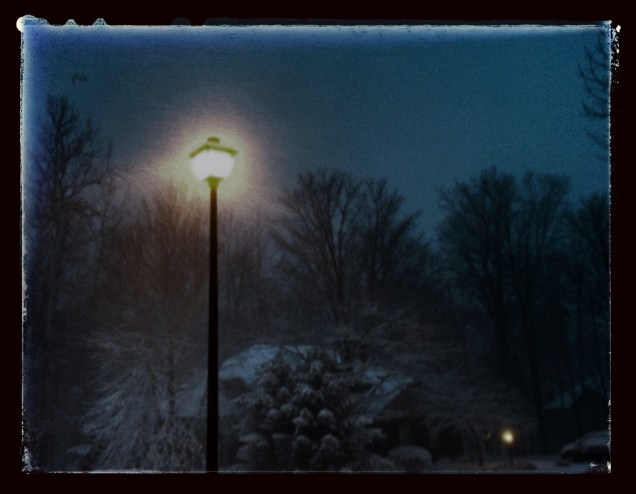
But there must have been some confusion because last night – the fifth evening of spring – looked like this:

Photo: CKirgiss
Photo: CKirgiss

Note, if you please, the white-covered branches. I half expected a faun to the step out from among the trees into the light of the lamp-post, holding an umbrella in one arm and carrying several brown-paper parcels in the other.

Admittedly, it was quite magical for any number of reasons. The still silence. The storybook setting. The anticipation of curling up in a warm bed under a pile of toasty blankets.

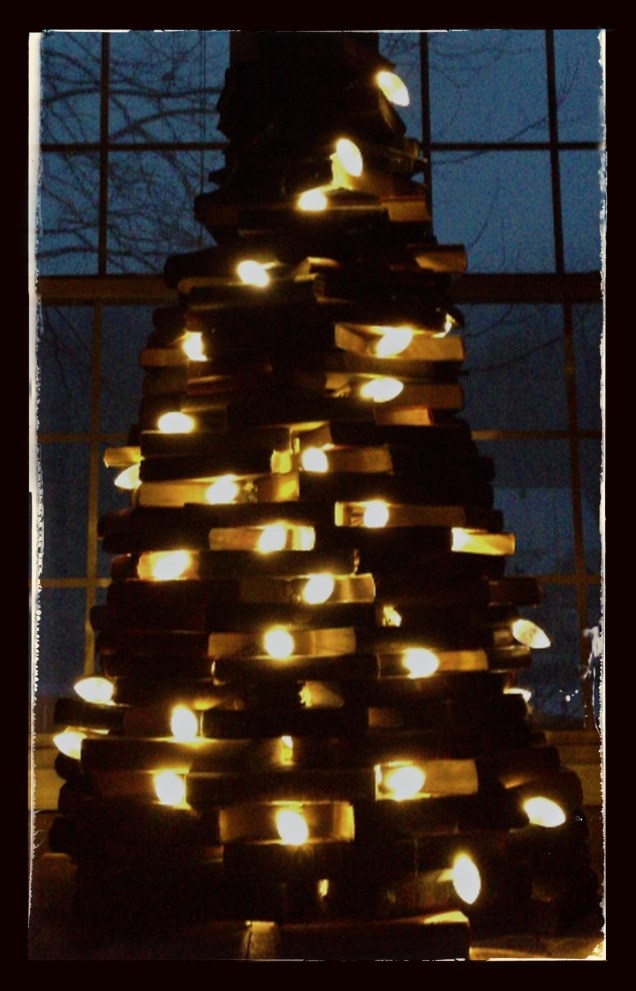
Best of all, I did not have to sneak silently back to a distant wardrobe, trusting neither tree nor bird, but rather could joyfully re-light my Christmas tree that is still standing because, well, it’s made of books and so it still is. (I find it quite impossible to contemplate a home where it is not, but of course one must prepare oneself for the possibility.)

Photo: CKirgiss
Photo: CKirgiss

Thankfully I do not live in a land where it is always winter and never Christmas. Where there is no sight of spring. Where grace and hope and love are hidden away in small and secret places.

I live in a land where winter – even if it lasts for ever so long – is always filled with the joy of Christmas and always followed by the miracle of Easter. Where grace and hope and love are free for the taking.

That is: the sun always shines, no matter how dark the wintry clouds may be. And just when it is needed most, it pierces through the air and sky and soul to shatter our little world and save our desperate hearts.

The spell, you see, is broken. The patches of green are growing bigger. The patches of snow are growing smaller. The mist has turned from white to gold. And overhead, there is blue sky between the tree tops.

Photo: CKirgiss
Photo: CKirgiss

Rest assured: underneath the deep, deep snow, springtime and new life are bursting from the ground.

All is very, very well.

(Select descriptions of both winter and spring borrowed respectfully from Narnia.)

Psalm XXVI (for a Monday Morning)

Photo: CKirgiss
Photo: CKirgiss

Sometime or other, I picked up a small Book of Psalms for tens of tens of pennies. Maybe at a library sale. Maybe at a thrift store. Maybe at an estate sale. (Since then I’ve learned that it’s important – for my own sake – to document each and every book purchase on the inside front cover. “Bought in May 2006 for $1.00 at a tiny, crowded, musty fusty bookshop in southern Michigan when I was passing through.” That kind of thing.)

I picked up this particular Book of Psalms because

  1. it is leatherbound
  2. it has quirky (some might say elegant) gold-gilt type on the cover
  3. it is of a size and shape and weight that feels just right in my hands
  4. it has an intact binding
  5. it has a personalized fly-leaf noting that Aunt Lil gave it to her nephew Arthur on December 17, 1916
  6. it has a quirky (some might say historical) book stamp on the title page noting that it was once the property of Arlington Street Church, Boston
  7. it boasts 1882 as a publication date (and 1882 books are, as a general rule, good for the soul)
  8. it numbers the individual songs Romanically (which apparently is not a word, but whatever).

That last one is important. There is something mighty and majestic about “Psalm XXVI” as a title that “Psalm 26” lacks. Perhaps that’s why we say “Twenty-Second Winter Olympics,” but we write “XXII Winter Olympics.”

No matter. Whether XXVI or 26, this morning’s Psalm – as is so often the case – is best considered as a series of questions and challenges before starting yet another week of full, rich, real life.

Have I acted with integrity and trusted the Lord without wavering?
Have I invited the Lord to truly test the motives of my heart?
Am I always aware of His unfailing love?
Have I lived according to His truth?
Do I resist going along with hypocrites?
Do I refuse to join in with the wicked?
Do I enter the glorious presence of God, singing with thanksgiving and telling of His wonders?
Have I fully embraced God’s redemption and mercy so that I can (undeservedly) stand on solid ground?
Do I publicly and joyfully praise the Lord?

Of course not. At least not to the extent that I could or should, and certainly not to the extent that He deserves.

But (oh glory!) “of course not” is not a static state of being. Rather, it is the reality from which we launch ourselves anew each and every morning straight into the loving arms of our Creator and Savior, there to be embraced just as we are. For it is only in those arms – the source of all love, forgiveness, strength, and grace – that we have any hope to live a life that can answer “yes” to the questions of Psalm XXVI. After all, it is not just “A Psalm of David” but rather “A Psalm of Us All.”


Of A Tiny Letter “C” (And also Jesus)

Photo: CKirgiss
Photo: CKirgiss

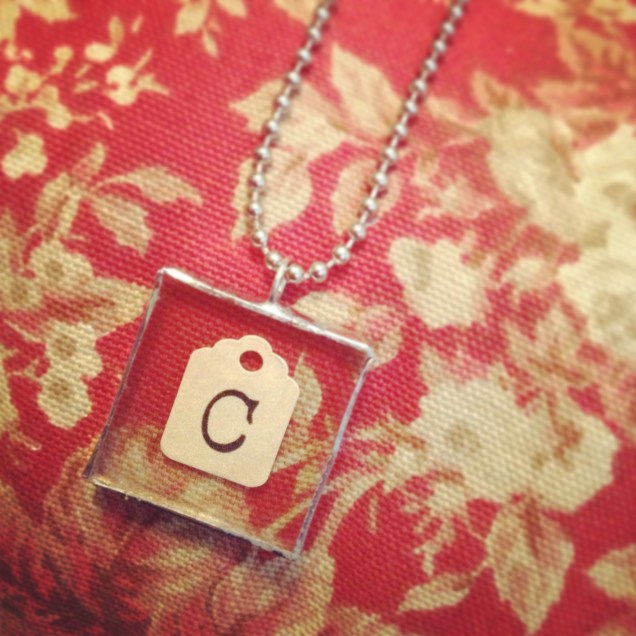
Every now and then, someone gives the perfect gift. Something meaningful. Something delightful. Something unexpected.

Something so perfectly suited to the receiver that it’s near impossible to put its awesomeness into words.

I got one of those gifts this Christmas. Something meaningful. Something delightful. Something unexpected.

Something so perfectly suited to me that it was near impossible to put its awesomeness into words.

So instead, I put it on. Wore it constantly. Fingered it lovingly. Glanced down at it joyfully. Slid it back and forth contentedly along its bumpy metallic chain. Enjoyed deeply its personalized kitschy awesomeness.

For three days.

Until I lost it.

Either in the Denver International Airport or somewhere near seat 27C on Flight 773.

Lost. It. Absolutely. Thoroughly. Indubitably. Tragically.

Kerthunk-went-my-heart. Over and over and over again.

That kerthunk is an achy thing indeed. Takes over your insides. Sends you into a frantic state of frenzy. Messes with your breathing. Undercuts your contented self.

So at 2:30 a.m. a few days post Christmas – after glancing in the airport restroom mirror while washing my hands and seeing a bare, broken chain slowly swinging back and forth, back and forth from where it dangled around my neck – I plunged into panic-frenzy-frantic mode and started walk-searching the entire A concourse. Up and down, up and down. Over and over and over again. Back and forth, back and forth. Every corner. Every tile. Every carpeted aisle. Every moving walkway. Every stair. Everywhere.

I begged the crew to reboard the plane of Flight 773 and search seat 27C (and also mayhap all the other seats, and the aisles, and the underseats, and the restrooms, and the galleys, and maybe even the cockpit) in search of a Scrabble-tile-sized pendant encasing a teeny-tiny “C” within its soldered glass.

Which they did.

Unsuccessfully.

While I kept walking.

Without ever finding.

Which was really just too sad for words.

The search to replace that little “C” expended more emotional energy (and actual time) over the new few weeks than was perhaps warranted.

But I loved it. And missed it. And wanted it to be hanging from around my neck where it belonged.

So today when a long-awaited replacement – made by the original artisan – arrived in a teeny-tiny package from way down South, well, it was a very happy day indeed.

Because what was lost is now found. Remade actually. Into a new thing altogether. Straight from its creator’s hands.

And where was once an empty chain, there is now a new letter “C.”

Safely home at last.

I – who have so keenly felt the kerthunked-heart sorrow of a lost little pendant that I did not make and that had been mine for only a few short days – will never doubt the Almighty’s kerthunked-heart sorrow for lost little me. Or His infinite love. Or his unceasing search. Or his miraculous remaking into a new thing altogether. Straight from my Creator’s hands.

And where was once an empty soul, there is now a new forgiven me.

Safely home at last.

[This moment of breathtaking (and undeserved love) brought to you by the little letter “C.”]


Things I learned while laid out with the flu

(or is it “laid up with the flu”…?)

1. It is, in fact, possible to be sicker than one’s spouse. In run-of-the-mill illness contexts (and contests, which much of marriage is), one is never sicker than one’s spouse, no matter how sick one is, and regardless of which one you are – the really sick one or the other really sicker one. But when laid out with the flu, one is by default sicker than one’s spouse (and one’s children and one’s friends and maybe one’s entire circle of acquaintances), unless one’s spouse is also laid out with the flu, in which case you are both winners. Or losers, as the case may be.

2. Fevers are hallucinogenic. Not being personally familiar with the hallucinogenic qualities of other substances, I can’t speak to the relative quality of flu’s hallucinogenicness. But its quality is really a moot point when one is in a comatose (and also victorious) state of being sicker than one’s spouse.

3. Based on their cumulative-use consistency, tissues are most likely made out of tree-bark. I checked the label to confirm this. I see that the packaging is made from recycled paper; that the tissues themselves are touted as “kind” and “pampering” and “indulgent” (the truth of which ranks right up there with one’s spouse being sicker than oneself when one’s spouse doesn’t have flu), and that these particular tissues are made in the USA from both domestic and imported material. Meaning domestic and imported tree-bark. I also see that the design of this particular tissue box is “Ogee Birch.” My point exactly.

4. One can live without snacking every hour-and-a-half. In fact, one can live without eating anything at all for one, two, even three days. But seriously…snacklessness isn’t fatal…?

5. It’s possible to be more exhausted than one was after giving birth. Naturally. For 16 hours. With no drugs. Who knew?

6. It’s possible to be more achy (I can only assume the relative intensity, mind you) than one would be after a super-extreme-turbo-full-body workout. Which isn’t a good reason to actually do a super-extreme-turbo-full-body workout – “because it’s not as bad as the flu.” Please.

7. It’s possible to live without reading a single page (let alone a whole book) for one, two, even three days. It’s not possible to live well, but it’s possible to live.

8. It’s possible to be so out of things that one doesn’t really notice or mind the taste of throat lozenges. At all. I mean, really?

9. It’s possible to be so not-one’s-self that the world’s greatest candy tastes worse than tree-bark, worse than dirt, worse than something that died and then rolled in something else that died and so now stinks like something that double died.

10. If one can seriously imagine life without Peanut Butter M&Ms … if one’s been bookless for days … if one has contemplated having another child because “it wouldn’t be so very much work” … if one has considered engaging in a legitimate full-body workout because “really, how bad could it be?” … if one’s nasal vicinity resembles shredded tree-bark … well then, one wins.

One is definitely sicker than one’s spouse.

One is finally number one.

Drag oneself out of bed and let the party begin.

Superbowl lessons

Here’s what I learned while watching the Superbowl last night (besides the fact that if and when the world’s power goes out, we are all going to be babbling fools):

1. Soldiers and farmers deserve our admiration and respect.

2. Modesty and decency will get you nowhere.

3. A man’s courage and coolness increase exponentially based on the speed of his car.

4. Men in general behave like children.

5. Goats in general are smarter than men.

6. Women want a cellphone that matches her skin tone.

7. Little boys want only to be an astronaut.

8. Little girls want only to be a princess.

9. Being top-dog, whether you’re 6 or 60, is what matters most.

10. In the end, it’s all about sex. And beer.

I learned this while watching the game with my faithful, smart, wise husband of 27 years.

I learned this while sipping on a tall diet A&W.

I learned this while reminiscing about my humble, gracious, giving grandparents.

Today I am learning how to clear my head of all the things I learned last night because, except for the thing about soldiers and farmers, it was all a bunch of rot.


Groundhog Sonnet

Photo: CKirgiss
Photo: CKirgiss

Groundhog Day 2013 is fairly mild in the heartland. The snow is dusted sugar. The air is misted grey. A person can breathe without shellacking her nasal passages into a frozen wasteland.

But in northern Minnesota, Groundhog Day is never mild. Never sugared. Never shadowed.

It matters naught what Punxsutawney Phil does or does not see in faraway Pennsylvania. If he were brave enough to live in the northern tundra, he would always be quite shadow-free on February 2.

Truth be told, most northern tundranites like it that way. Cold and snowy, that is. Cold and snowy and beautiful. Cold and snowy and beautiful and substantial. Cold and snowy and beautiful and substantial and magical. Cold and snowy and beautiful and substantial and magical and real.

Still – every now and then, sunbeamed shadows on February 2 in the northern tundra would probably be most welcome.

Like when there’s been snow on the ground since Halloween. Like when the collective preschool population is riotously climbing the city walls. Like when the ice-fishing villages have become so established that it’s hard to distinguish whether their sprawl is seasonal or permanent – or whether they will ever yield up their devoted inhabitants (who hopefully still have jobs and families somewhere on the mainland).

I’m long gone from the northern tundra and suspect I would not survive another of her winters. But at one time, her frigid air was shellackingly familiar. Sonneteering was one of several (quirky) strategies to survive the season. And so this, from 1999:

SPRING? ME THINKS NOT

Hark! What sound doth I hear out my frozen
Window payne on this early and frigid dawn?
A scraping, snuffling, earthy noyse; chosen
Claws and whyskers scratching the earth upon.
Ah! thinks I, ’tis the February’s moon
Day two – Candlemas, Purification –
A day whereupon northerners cry, “Soon,
Oh dear God we beggeth a vacation.”
But the scraping, snuffling, earthy thyng laughs
Softly in its fur, yawning at the syght
Of a dark and shadowless land what hath
No shine, no thaw, nor any ‘morrow’s light.
Up here are froze our fannies and our cars.
But in their sacred course, we’ve still the stars.

Wishing you and yours a Blessed Groundhog Day. Go ahead. Have a party.

Treasure Island

I grew up in a typical ’50s ranch. 3 (tiny) bedrooms. 1 (tiny) bathroom. 1 (tiny) dining room. 1 (tiny-to-average) living room. And 1 (tiny) galley kitchen. You know. The kind of kitchen that doubles as a hallway. So that a person must walk through it in one direction, then turn left to access the dining room. Or walk through it in the other direction, then turn right-ish to access the living room.

At least it was a through-street galley kitchen. It may have been squished for cooking but it was ideal for running circles around the inner core of the house. In pairs. Going opposite directions.

My first adult-apartment-galley kitchen, not so much. It was one of those architectural wonders tucked into a back corner of nothing. You know. The kind of kitchen that doubles as a hallway. To nowhere.

I’m all grown up now and I have a kitchen that still serves as a hallway in some respects. But that doesn’t matter because now I have an island.

That place around which crowds gather.

For a long time.

To talk. And feast. And talk some more.

It is quite possibly the 8th wonder of the modern world.

Late on Wednesday nights, after a crowd of college women depart my house (where they have consumed several loaves of banana bread, many tall glasses of milk, some mugs of coffee, a few cups of tea, and a portion of Scripture) my island is tangly. Busy. Scattered.

Lovely.

Wednesday's treasure island
Wednesday’s treasure island

It’s my favorite night of the week. It’s my favorite view of the island.

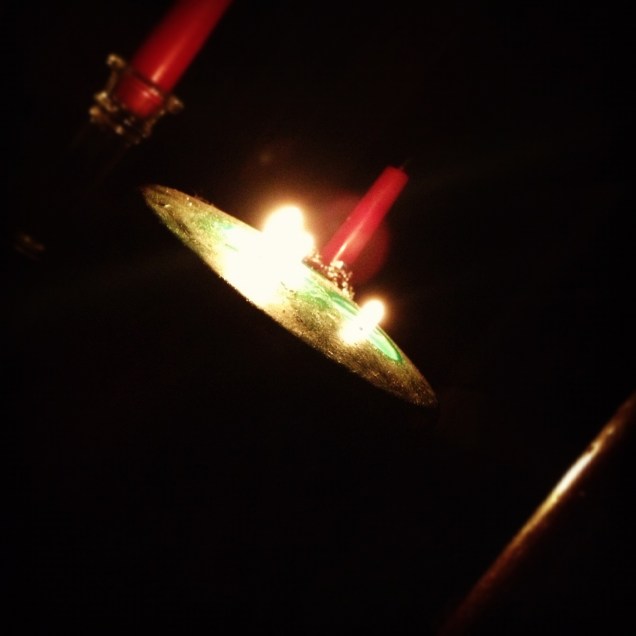
Except for those very rare occasions when the power goes out just before dinner on another night. And the only way to eat the 9×13 pan of goulash is by candlelight. Candlelight that evokes Advent. (Or maybe radioactive elbow macaroni.)

Thursday's treasure island
Thursday’s treasure island

What’s more lovely than enjoying a candlelight family dinner around the kitchen island? The glow is joyful. The ambiance is restful. The quiet is soothing. And the goulash is especially splendid.

Of course, the looming question soon becomes this: what, exactly, happens next? After we take our last bite? After this unexpected sweet dinner vigil is over?

Because, well, you know, there’s no power. There’s no way to use anything requiring electrical juice or internet bandwidth.

Panic. (I can’t live without modern conveniences which makes me an immigrant-descendant super-failure.)

Stress. (So are we supposed to just talk all night?)

Sadness. (We used to know how to play board games.)

And then sweet relief. (Oh look – the power’s on. We are saved from our pathetic selves.)

…and then…

Sadness. (It was prettier by candlelight.)

Stress. (We’ve become those people – the ones who are defined by their power adapters.)

Panic. (How can I recover just a tiny little sliver of that peaceful beauty, proving I’m not one of those people?)

With a flip of the power-company master-switch (and the hard work of many devoted employees), my kitchen island went from being an oasis in the dark to being a harsh glare of manufactured light. Which changed everything about the room. And the meal. And us.

Sure, we could see better.

But it wasn’t as sweet. Or as peaceful. Or as (dare I say it) holy.

So I acted. With a flip of the electric-customer kitchen-switch (and a few puffs of breath to soften the candlelight even more), my kitchen island went from being drenched in glaring rays to being cloaked in whispered light. And it changed everything about the room. And the meal. And us.

Thursday's recovered treasure
Thursday’s recovered treasure

For about 5 minutes. Because powered habits are really hard to break. So the electronics are running full force. Like usual.

I find that sad.

Even so, my kitchen island – whether lit by a satin-nickle triple-globed ceiling fixture, 10 candles, or just 1 – is a treasure, more than adequate for hosting a feast, surviving the darkness, or welcoming the occasional castaway. Or all three.

I think Robert Louis would approve.

Inverted Psalm

Book of Psalms, 1882

Monday morning. Psalm 5.

Sometimes it’s just too early and too soon and too messy to wrestle with all the nuances of David’s lyrics. The Almighty’s intolerance, destruction, and declarations of guilt – are these really the point of this song, or merely reflections of David’s emotional circumstances? Are these things upon which to build a doctrine, or simply the cry of a creative and wounded heart? Are these descriptions that saturate all of the sacred Word, or rather one poet’s attempt to wrap in human language that which is spiritually unknowable?

God’s infinite grace, love, and forgiveness – as demonstrated through creation, incarnation, and resurrection – sweep aside all doubts about His nature.

But still there is this Psalm (and many others) that lie before us – words that must be read, chewed, digested.

On this particular Monday, I find that the verses of Psalm 5 are best considered and consumed when inverted from ancient poetic statements into modernly personal queries. Soul-baring queries. Uncomfortable queries. Convicting queries.

1. Are my prayers intensely honest to the point of groaning?

2. Do I look to God alone for my soul’s help?

3. Do I pray daily with patient expectance?

4. Do I foolishly assume that God overlooks and tolerates my sin?

5. Does my pride keep me from drawing near to God?

6. Am I truthful and honest in all things?

7. Do I enter God’s presence in awe of myself or in awe of him?

8. Do I invite God to lead me on His chosen path?

9. Are my words untruthful, destructive, foul, or falsely flattering?

10. Have I been caught in my own trap of rebellion?

11. Do I love the Lord’s name and take joyful refuge in it?

12. Do I pursue a godly life and rest in His shield of love?

Suddenly Psalm 5 is my Psalm, for these are questions my heart needs to face and my soul needs to answer.

These are questions that bring me to a narrow place of reflection, a focused point of confession, a singular place of desire –

to rely only on God (not the things of this world)

to rely always on God (not just when I am confused and wounded)

to rely wholly on God (not also on myself)

and to rely humbly on God (acknowledging my selfish helplessness and his loving grace).

Welcome to Monday. Welcome to Psalm 5. Welcome to life. Welcome to divine love.

For the chief musician. A Psalm of David.

Subjunctive – schmunctive

subjunctive

Just to clarify: I am not the grammar police. Not even after 20 years of being a professional writer and 8 years of being an English teacher. It’s too frustrating. And heartbreaking – it’s to show possession, Smith’s to indicate plurality, and their to contract “they are.” There are just no words for it. Though if you were Trumpkin, these might do: Beards and bedsteads! Thimbles and thunderstorms! Cobbles and kettledrums! Weights and water-bottles!

Which brings us to the English verb – 3 simple tenses, 3 past tenses, 6 progressive forms, the emphatic “do” form, and hey, how about that modal trinity of can-must-should – and LUCKY LUCKY US, beside all those tenses, let’s not forget The Many Moods of Verbs (which rather sounds like a title of a 70s soft-listening LP).

“If you were Trumpkin” is a prime example of one such mood: the subjunctive.

Of or pertaining to that mood of the finite verb that is used to express a future contingency, a supposition implying the contrary, a mere supposition with indefinite time, or a wish or desire.

Yeah. That thing.

We’ve all heard it.

If I were a rich man, yubby dibby dibby dibby dibby dibby dibby dum.”

If I were king of the for-eheheheheheheheheheh-st.”

From these, one might reasonably conclude that the subjunctive mood has more to do with lyrical freestyling and jabberwocky antics than with a verbal mood.

If I was. If I were. Does it really matter?

To some people, yes. They argue that if we were to subjugate our subjunctives so as to use them less subjectively and more submissively (in respect to grammar rules) and more subliminally (in respect to rhetorical flair) our speech would more accurately reflect our progressive civility and refinement (or maybe our panties-scrunched-in-a-bunch-ness) and the world would be a better place. For you. And me. You just wait and see.

Maybe. Maybe not. I don’t know.

But I do know this: if I were a rich woman and also were queen of the forest, I would be able to buy more books and store them in my ever-expanding royal library, which would definitely make the world a better place. For me. For me. You just wait and see.